When the GCCF Recognized the Siamese Cat
The Siamese was already attracting attention in Britain before the GCCF existed, so it is easy to mix up the breed’s early show history with its formal recognition. The short answer is that Siamese recognition is generally dated to 1910, the year the Governing Council of the Cat Fancy was established. The distinction matters: a breed’s first appearance, its club history and its official recognition are separate milestones.
When the GCCF recognized the Siamese cat
The short answer is 1910
The year most often associated with the GCCF’s recognition of the Siamese cat is 1910. That is also the year the Governing Council of the Cat Fancy was founded, making it a useful marker for the breed’s formal place in the British cat fancy.
There is an important wrinkle, though: 1910 does not mean Siamese cats first arrived in Britain, or first appeared at a cat show, that year. Both happened earlier. The breed already had a following, a dedicated club and a developing show identity before the GCCF was formed.
Nor is the date usually presented as a specific day and month. For a straightforward answer, use 1910 as the commonly cited recognition year, while keeping in mind that early cat-breed histories do not always separate the creation of an organization from the formal acceptance of individual breeds as neatly as modern records might.
Recognition is not the same as arrival or first show
A breed can be present in a country for years before it is formally recognized by a governing body. Cats may be imported, bred, exhibited and discussed by enthusiasts before a registry or council has a settled system for recording breeds and standards.
That is what makes the Siamese timeline confusing. The breed’s British history reaches back to the late nineteenth century, while the GCCF began in 1910. So if you see a date earlier than 1910 attached to “recognition,” it may refer to the breed being known, shown or supported by a specialist club rather than recognition by the GCCF itself.
A Siamese appearing at an exhibition is not automatically the same thing as a governing council recognizing the breed. Likewise, a Siamese club setting out its own expectations for the cats does not, on its own, prove the date of GCCF recognition. These events are related, but they answer different historical questions.
How the Siamese became established in Britain
The breed was known before the GCCF was founded
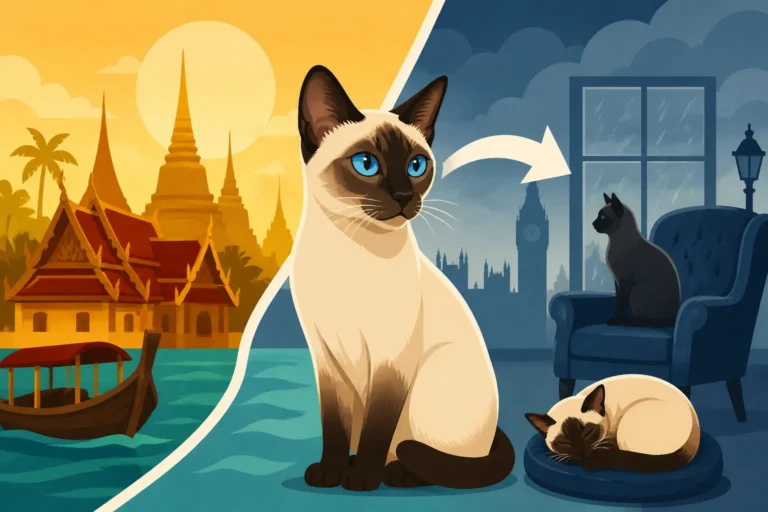
Siamese cats were in Britain well before 1910. Their arrival helped spark public curiosity, especially because their pale bodies, dark points and blue eyes looked so different from the cats British showgoers were used to seeing.
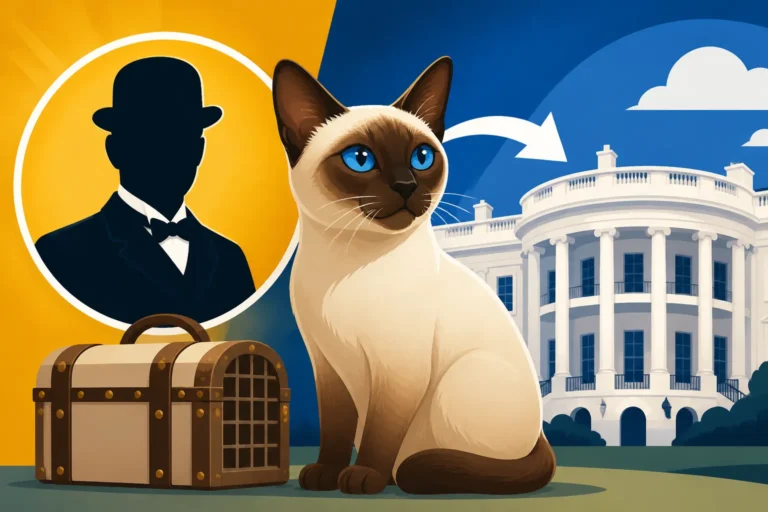
The story most often associated with the breed’s early British history involves Pho and Mia, cats brought from Siam by British diplomat Edward Blencowe Gould in the 1880s. Their presence—and the kittens bred from them—helped establish the Siamese as more than a passing curiosity. For more on that part of the story, see Who Brought the First Siamese Cat to Britain and Who Pho and Mia the Siamese Cats Were.
The first show appearances also belong to this earlier period. They helped make the cats visible to the public and to the developing world of organized cat breeding. The account of Which Show the First Siamese Cats Appeared At explores that milestone, which should not be mistaken for GCCF recognition.
A dedicated club came before the council
The Siamese Cat Club was founded in 1901, several years before the GCCF. A specialist club gave fanciers a place to discuss the breed, encourage careful breeding and develop shared ideas about what a Siamese should look like.
That activity is part of the groundwork behind formal recognition. Breed clubs can help shape how a cat is described and judged, but they are not the same institution as a national governing council. The club’s formation therefore marks the Siamese’s growing organization in Britain—not the founding of the GCCF. The companion history When the Siamese Cat Club Was Founded looks more closely at that distinction.
Early standards mattered, too. They gave breeders and judges a common language for discussing appearance, even as ideas about the ideal Siamese changed over time. What the First Siamese Cat Standard Said provides useful background for understanding how breed identity developed before today’s familiar standards.
| Milestone | Commonly associated date | What it means |
|---|---|---|
| Siamese cats arrive in Britain | 1880s | The breed becomes established among British enthusiasts |
| Early Siamese show appearances | Before the GCCF’s founding | The cats are publicly exhibited, but a show appearance is not the same as council recognition |
| Siamese Cat Club founded | 1901 | British fanciers organize around the breed |
| GCCF founded | 1910 | The governing council is established; this is the commonly cited recognition year for the Siamese |
What GCCF recognition meant
A place in organized British cat fancy
Formal recognition matters because it gives a breed a defined place within an organized system of registration and showing. It helps establish that the breed can be judged according to a shared description rather than treated simply as an unusual-looking individual cat.
For the Siamese, this recognition followed years of growing interest. By the time the GCCF was formed, the cats had already made an impression in Britain, and fanciers had begun building a community around them. Recognition was therefore not the starting point of the breed’s British story; it was a step in formalizing a story already underway.
That distinction is useful when reading older breed histories. One account may focus on the first cats imported, another on the first show, and another on the year a governing organization recognized the breed. Those dates can all be correct because they describe different developments.
Standards and breed type continued to evolve
Recognition should not be read as proof that Siamese cats have always looked exactly as they do today. Breed standards and preferences have changed over time, and different registries may describe or group cats differently. A standard sets out a desired type for judging; it does not freeze a breed’s appearance permanently.
This is especially relevant to the Siamese, whose head shape and overall build became points of discussion as breeding preferences developed. If you are comparing historical images with present-day show cats, How the Siamese Cat's Head Changed Shape in Fifty Years gives context for those visible differences. For a general look at the features used to describe the breed, see What the Siamese Cat Standard Asks For.
Recognition also does not mean every cat with Siamese ancestry automatically qualifies for registration as a Siamese. Registries use their own rules, pedigrees and definitions. A cat may resemble a Siamese closely without meeting a particular registry’s requirements for registration.
How to interpret Siamese recognition dates
Check what a date actually refers to
When you encounter a claim that the Siamese was “recognized” in a certain year, first ask: recognized by whom, and in what sense? It may refer to the formation of a breed club, the first appearance at a show, publication of a standard, acceptance by a registry or the establishment of a governing council.
This is not just a technicality. A date attached to the wrong milestone can make it seem as if an organization existed before it did, or as if a breed was unknown until it received formal recognition. In the Siamese’s case, the breed had a British history before the GCCF’s foundation, while 1910 is the year commonly linked with GCCF recognition.
It can help to compare the British timeline with other registries’ histories, while remembering that their decisions were made independently. For example, When the CFA Recognized the Siamese Cat covers a separate American milestone. Registry dates should not be treated as interchangeable.
A practical way to describe the history
If you are writing or talking about the Siamese’s British recognition, a clear and careful wording is: “The Siamese cat is generally dated as recognized by the GCCF in 1910, the year the council was founded, although the breed was present and organized in Britain earlier.”
That phrasing answers the question without suggesting that the cats first arrived or appeared at shows in 1910. It also leaves room for the fact that early records may describe milestones differently, depending on whether they focus on the breed, a club, a show or the governing body.
For readers following the broader history, Where the Siamese Cat Comes From adds the earlier background, while Who Founded the Siamese Cat Club helps explain the British fanciers who organized around the breed. Together, those stories show why a single recognition date is only one part of the Siamese’s path into the modern cat fancy.
Disclaimer
This article is for general informational purposes only and does not constitute professional advice. Laws, prices and regulations vary by location and change over time. Consult a qualified professional for guidance on your specific situation.