Whether a Thai Cat Is a Siamese Cat
A rounded, blue-eyed colorpoint cat may be advertised as a Thai, an old-style Siamese, or simply a Siamese, leaving prospective owners unsure whether those names mean the same thing. The answer depends on context: the cats share ancestry, but “Thai” can refer to a separately recognized breed, while “traditional Siamese” is often used more loosely.
How Thai cats and Siamese cats are related
They share roots but do not always share a breed label
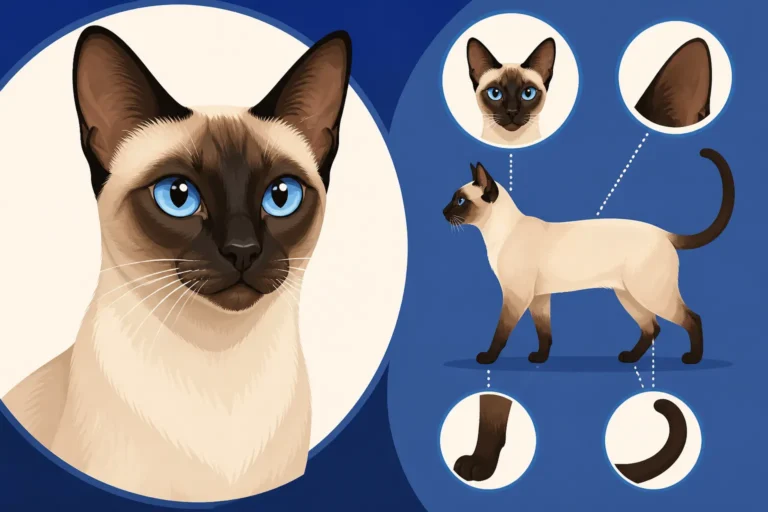
The modern Thai breed and the Siamese breed come from the same broad family of cats associated with Thailand, historically known as Siam. Both are typically shorthaired, blue-eyed colorpoint cats: their bodies are lighter than their cooler-colored faces, ears, legs, and tails. Their similar coloring and shared history are why the names are so often confused.
The distinction comes partly from how breeders and cat registries have defined the breeds over time. The show Siamese developed toward a more elongated, fine-boned appearance, with a long wedge-shaped head and large ears. Some breeders and enthusiasts continued to favor a more moderate, rounded-looking cat. The Thai breed was developed to represent that more moderate type, with its own breed identity in some registry systems.
So, a Thai cat can be related to the Siamese without being registered as a Siamese. That is much like two closely related varieties having a shared history but different standards and registration categories. For a deeper look at that split, see How the Thai Split From the Siamese Cat.
“Traditional Siamese” is not always a formal breed name
The phrase “traditional Siamese” is commonly used to describe a Siamese-type cat with a less extreme head and body shape than the modern show type. You may also see terms such as “old-style Siamese” or “Applehead Siamese.” These labels can describe appearance or a breeder’s preferred type, but they do not automatically tell you how a cat is registered.
A cat described as traditional Siamese might be registered as a Siamese, a Thai, or not registered with a pedigree association at all. The breeder’s wording alone cannot settle the question. Ask which registry the cat belongs to, what breed is listed on the pedigree, and whether the parents have registration documents.
This distinction matters if you are comparing kittens, researching ancestry, or hoping to show a cat. A familiar look does not guarantee a particular breed designation. The history behind the two types is explored in Whether the Traditional Siamese Cat Still Exists and How the Siamese Cat's Head Changed Shape in Fifty Years.
What differences can you see in appearance
Compare the overall shape rather than one feature
A Thai is generally described as moderate in build, with a rounded or gently shaped head, medium-to-large ears, and a body that looks balanced rather than extremely long. The modern show Siamese is typically more elongated and fine-boned, with a more pronounced wedge-shaped head and large, wide-set ears. Those are broad tendencies, not a reliable visual test for every individual cat.
Age, body condition, family line, and grooming can affect how a cat looks. A slender Thai may appear more angular than expected, while a Siamese from a less extreme line may have a softer outline. Photos can also be misleading: a head-on portrait, a low camera angle, or a kitten’s proportions can make the same cat look quite different.
| Feature | Thai type commonly described as | Modern show Siamese commonly described as |
|---|---|---|
| Head shape | Rounded or moderate | Long wedge shape |
| Body | Balanced and moderately proportioned | Long, slender, and fine-boned |
| Ears | Medium to large | Large and prominent |
| Coat pattern | Colorpoint pattern | Colorpoint pattern |
| Breed identity | Separate Thai designation in some registries | Siamese designation under applicable registry rules |
These descriptions are helpful for understanding breed types, but they are not a substitute for a registry standard or pedigree. For the Siamese breed standard, see What a Siamese Cat Looks Like by the Standard.
Colorpoint markings do not prove a cat is Thai or Siamese
Both Thai and Siamese cats are associated with the colorpoint pattern. The cooler parts of the body develop darker pigment, which is why the face, ears, paws, and tail contrast with the torso. That recognizable pattern can help explain why people identify a cat as Siamese-type, but it does not establish a formal breed.
Colorpoint cats can appear in other breeds and in mixed-breed cats, too. A blue-eyed cat with dark points may resemble a Thai or Siamese while having a different ancestry or no pedigree documentation. Even within a recognized breed, point colors and accepted markings can depend on the registry.
If you are adopting from a shelter or rescue, the most accurate description may be “Siamese-type” or “colorpoint mix” unless the cat’s paperwork confirms a pedigree. That does not make the cat any less lovely or deserving of a home; it simply avoids treating appearance as proof of ancestry.
How to tell what a breeder means by Thai or Siamese
Ask for the registry name and the pedigree
When a breeder advertises a Thai or traditional Siamese kitten, ask what breed name appears on the kitten’s registration documents. Also ask which registry issued the pedigree and whether the kitten’s parents are registered under the same breed category. These concrete details are more useful than a marketing phrase such as “classic Siamese.”
You can also ask to see the parents, if available, and to learn how the breeder describes their type. A responsible breeder should be able to explain whether they are breeding toward a Thai standard, a Siamese standard, or a particular appearance without registry recognition. If answers are vague or the breeder treats the terms as interchangeable without explaining the paperwork, pause and ask for clarification before placing a deposit.
Registration practices are not identical across cat associations. One association may list a type separately while another uses a different classification or does not recognize it in the same way. The simplest approach is to check the rules of the specific registry named by the breeder rather than assume that every organization uses the same labels.
Treat appearance and registration as separate questions
It helps to ask two questions instead of one: “What does this cat look like?” and “What breed is the cat registered as?” A breeder can describe a kitten as having a traditional Siamese appearance while the pedigree identifies it as a Siamese. Another breeder may use the Thai name because the cat is registered in a registry that recognizes Thai as a separate breed.
For a kitten without pedigree records, you can still discuss its visible traits and likely background. Just avoid assuming that a particular head shape or coat pattern proves a specific breed. That is especially useful when browsing online listings, where breed names may be used casually to describe appearance rather than formal ancestry.
If you are buying a pedigreed cat, consider the health and care questions separately from the naming question. Ask about the parents’ veterinary history, the kitten’s health records, and the breeder’s plans for socialization and support. Breed terminology helps you understand classification, but it is only one part of evaluating a breeder. What the Thai Cat Is Next to a Siamese Cat offers more context on how the Thai fits alongside the Siamese.
Which cat is right for your household
Choose based on the individual cat, not just the label
People often hope that a Thai or traditional-looking cat will have a predictable personality, but breed labels cannot guarantee temperament. Siamese-type cats are often described as social and communicative, yet individual cats vary. Early experiences, age, health, and the environment all influence how a cat behaves at home.
If you are meeting a kitten, notice whether it recovers after a mild surprise, engages with people, and appears comfortable being handled in a respectful way. With an adult cat, ask what it is like around visitors, other animals, household noise, and time alone. These observations are more useful for predicting the fit than assuming a cat will act a certain way because it is called Thai or Siamese.
Think about the practical rhythm of your home, too. A cat that seeks company may be happier with regular interaction and play. If your household is quiet or everyone is away for long stretches, ask the rescue or breeder how that particular cat handles solitude and what kind of enrichment it enjoys.
Use the breed name as a starting point, not the final answer
If you want a specific registered breed for showing or pedigree records, confirm the registry’s requirements before choosing a kitten. If you mainly want a companion with a colorpoint coat and a moderate appearance, you may be open to a wider range of cats, including rescue cats described as Siamese-type. Neither choice is inherently better; the important thing is being clear about what you are looking for.
Before deciding, write down what matters most: formal registration, appearance, age, activity level, compatibility with children or pets, or the cat’s known background. Then ask questions that directly address those priorities. This keeps the conversation grounded and helps prevent disappointment when a seller’s use of “Thai,” “traditional,” and “Siamese” does not match your assumptions.
The simplest answer is that Thai cats and Siamese cats are closely related, but the names are not interchangeable in every setting. A Thai may be recognized as a distinct breed by a registry, while “traditional Siamese” may describe a look rather than a registration category. Check the pedigree and registry when formal breed identity matters, and judge a companion cat by the individual in front of you.
Disclaimer
This article is for general informational purposes only and does not constitute professional advice. Laws, prices and regulations vary by location and change over time. Consult a qualified professional for guidance on your specific situation.