How the Balinese Came From the Siamese Cat
A Balinese can look like a Siamese with a flowing coat, which naturally raises the question: did someone cross Siamese cats with a longhaired breed to create it? The short answer is that Balinese cats were developed from longhaired kittens appearing in Siamese lines. This guide explains how the breed emerged, what it inherited, and why its name does not mean it came from Bali.
The Balinese breed grew out of Siamese lines
Longhaired kittens appeared in Siamese litters
The Balinese story begins with Siamese cats. For generations, kittens with longer coats occasionally appeared in Siamese litters. Their color pattern and overall appearance could resemble their shorthaired relatives, but their fur was visibly longer—especially around the tail, legs, and neck.
The most widely accepted explanation is that these kittens carried a recessive longhair trait. A recessive trait can be passed along by cats that do not themselves look longhaired. When a kitten inherits the relevant genetic variants from both parents, the longer coat can become visible. That helps explain why a longhaired kitten could appear unexpectedly in a line of shorthaired Siamese cats.
This did not mean that every longhaired kitten automatically became part of a new breed. Early on, some were treated as unusual pets or as departures from the Siamese look breeders were selecting for. Over time, however, breeders began to see that these cats shared a distinctive combination of traits: the Siamese color pattern, blue eyes, an elegant build, and a soft, longer coat.
To understand the family connection, it helps to know Where the Siamese Cat Comes From and how the breed’s appearance developed. The Siamese type itself has changed through selective breeding, including shifts in body shape and head profile. How the Siamese Cat's Head Changed Shape in Fifty Years gives useful context for why a modern Balinese may look closer to some Siamese lines than others.
Breeders developed a consistent longhaired type
A naturally occurring coat variation is not the same thing as an established breed. To develop the Balinese, breeders selected longhaired cats that retained the recognizable Siamese pattern and refined the traits they wanted to see in future generations. They were building consistency: a cat with a particular coat, color pattern, body type, and temperament, rather than simply labeling any longhaired Siamese-looking kitten as Balinese.
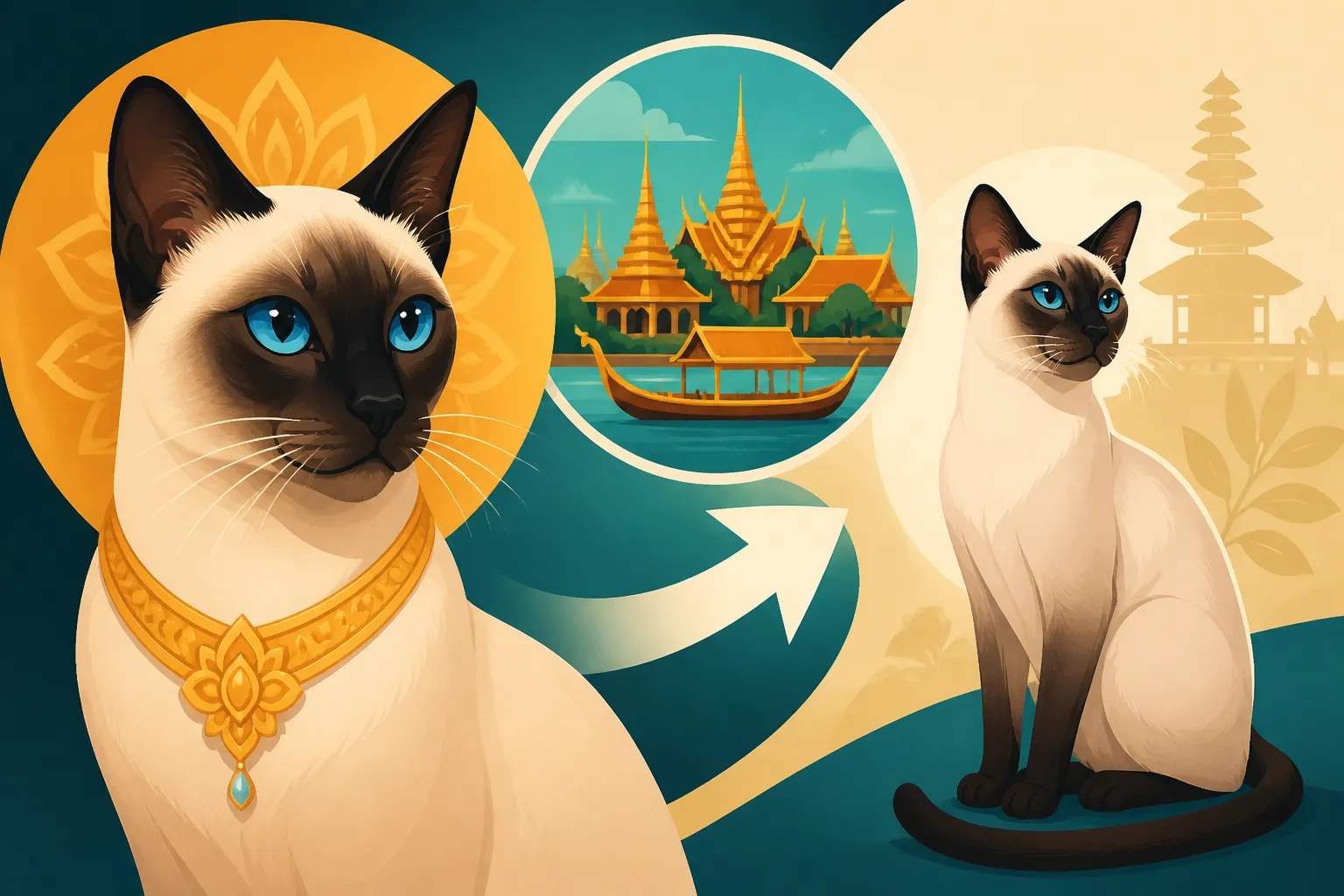
Breeders Helen Smith and Sylvia Holland are often associated with the breed’s development and promotion in the United States. The name “Balinese” was chosen to evoke the graceful movement and elegance of Balinese dancers. It is a poetic breed name, not a claim that the cats originated on the Indonesian island of Bali.
That distinction is worth remembering when you encounter different explanations online. The Balinese is closely tied to Siamese ancestry, but it is not generally understood as a breed created by crossing Siamese cats with a Balinese cat or an Indonesian longhaired breed. The long coat is the key visible difference, not evidence of a separate geographic origin.
The Siamese has also contributed to several other breeds, directly or indirectly. For broader context, see The Breeds a Siamese Cat Founded and Which Breeds Came Out of the Siamese Cat. These connections can make breed histories sound tangled, but the Balinese’s defining origin is relatively straightforward: longhaired cats from Siamese lines were selected and developed into a recognizable breed.
What makes a Balinese different from a Siamese
Coat length is the clearest difference
The most obvious difference is the Balinese’s longer coat. It is usually described as a fine, silky, single coat rather than a thick, woolly double coat. Many Balinese cats have a noticeable plume on the tail, some feathering on the legs, and softer, longer fur around the body than a shorthaired Siamese.
“Longhaired” can be a slightly misleading word if you picture a very dense, high-maintenance coat. A Balinese does not necessarily have the heavy, full coat of breeds developed for cold climates. Individual coats vary, but the fur often lies close to the body and moves with the cat rather than forming a dense mass.
The breed also shares the Siamese colorpoint pattern: the face, ears, legs, and tail are darker than the body. The exact accepted colors can depend on the registry. If you are comparing breed descriptions, Which Point Colors Other Registries Accept in a Siamese Cat is a reminder that color standards are not identical everywhere.
A Balinese’s coat may look different from a Siamese’s without changing the basic colorpoint effect. The contrast between body and points can vary with age, temperature, and individual genetics. The coat is not a dye job or a separate marking pattern; it reflects the same broad colorpoint biology associated with Siamese cats.
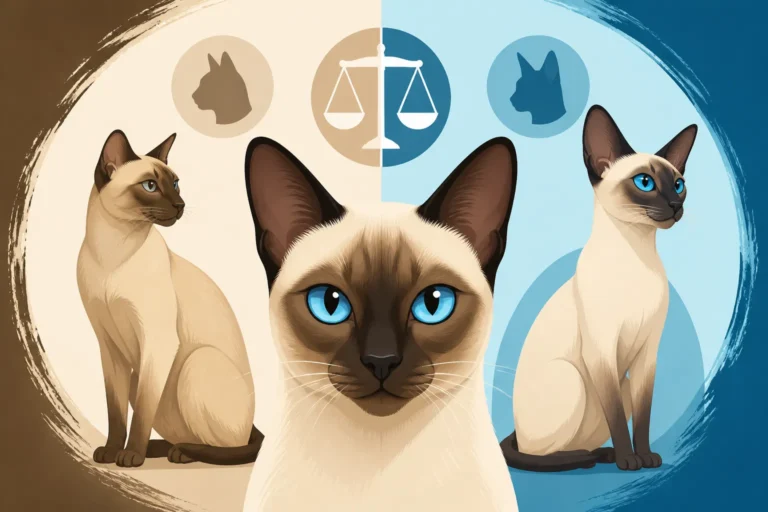
| Feature | Balinese | Siamese |
|---|---|---|
| Coat | Fine, semi-long coat with a plume-like tail | Short, close-lying coat |
| Color pattern | Colorpoint pattern, with registry-specific accepted colors | Colorpoint pattern, with registry-specific accepted colors |
| Eyes | Typically blue | Typically blue |
| Ancestry | Developed from longhaired cats in Siamese lines | The foundation breed for the Balinese |
| Grooming | Usually needs regular light brushing | Usually needs less coat brushing |
| General type | Slender, elegant, and active | Slender, elegant, and active |
The table describes broad breed tendencies, not a guarantee about every individual cat. Coat texture, body shape, and even how much brushing a cat tolerates can differ from one animal to another.
Their body type and personality can feel very familiar
Balinese cats generally share the elegant outline associated with Siamese cats: a lean body, long legs, a fine-boned appearance, and a tapered face. Breed standards and individual lines differ, so one Balinese may look more moderate while another has a more pronounced Siamese profile. What a Siamese Cat Looks Like by the Standard can help explain the traits that are often shared between the breeds.
The two breeds also tend to be described as socially engaged and communicative. A Balinese may follow a person from room to room, seek out play, or call for attention. That does not mean every cat will be loud or constantly demanding. Personality is individual, and a cat’s early experiences, health, and home environment matter. Still, people choosing a Balinese because they want a quiet, hands-off companion should be prepared for a cat that may want frequent interaction.
That shared social style can be a delight if you enjoy an involved companion. It can also be challenging if your schedule leaves a cat alone for long stretches or if you prefer a pet who is content to entertain itself. Daily play, climbing spaces, and predictable interaction can help meet an active cat’s needs. A simple feather toy or food puzzle can turn a spare few minutes into useful enrichment.
For routine supplies, some owners compare brushes, interactive toys, and scratching options at retailers such as Chewy. The important part is choosing items that suit the individual cat and household, rather than assuming one breed-specific product is necessary.
How coat genetics explain the Balinese origin
The long coat can remain hidden across generations
The recessive nature of the longhair trait helps explain why longhaired kittens could appear in Siamese families without every parent looking longhaired. A shorthaired cat can carry a variant associated with longer fur and pass it to its offspring. When the right combination is inherited, the kitten’s coat can grow longer.
This pattern is familiar to people who have seen a trait reappear unexpectedly in a family. A kitten may look like its shorthaired parents in many ways, yet have a different coat length because it inherited a particular combination of genes. That does not make the kitten less related to its family; it simply reflects the way inherited traits can be expressed.
For breeders, the genetic explanation was useful because it offered a way to develop a consistent longhaired line without assuming an entirely different breed had to be introduced. Selecting cats that carried the desired coat trait, while maintaining the Siamese appearance, helped establish the Balinese type.
It is also why a longhaired kitten from a Siamese-type background is not automatically a registered Balinese. Breed identity depends on documented ancestry and the rules of the relevant registry, not appearance alone. A cat can look very Balinese-like without having papers that establish it as a pedigreed Balinese.
The Balinese is not simply a Siamese with extra grooming
Because the breeds are so closely related, it is tempting to think the Balinese is only a coat-length variation. That describes the central visual difference, but breed recognition involves more than coat. A recognized breed has a defined standard, a breeding population, and registry rules. Those standards describe the expected appearance and other characteristics breeders are working to maintain.
The Balinese and Siamese may share ancestry and many physical traits, but they are treated as distinct breeds by major cat organizations. How they are grouped or named can vary between registries, especially when related longhaired colorpoint cats are involved. In some systems, the name “Javanese” has been used in connection with longhaired colorpoint cats, while other registries classify colors differently within the Balinese breed. If you are checking a pedigree or show eligibility, the specific registry’s terminology matters.
This is one reason online descriptions sometimes appear to contradict one another. A page may be describing a registry’s show categories, while another is discussing the breed’s genetic background or common usage. Those are related questions, but not identical ones.
When comparing cats, focus on what you can verify: the pedigree, the registry, the breeder’s records, and the cat’s health and temperament. A label alone cannot tell you whether a particular cat will be sociable, easy to groom, or a good fit for your home.
What to expect if you live with a Balinese
Grooming is manageable but should not be ignored
A Balinese’s coat often needs less work than a dense, heavy longhair coat, but “low maintenance” does not mean “no maintenance.” Regular gentle brushing helps remove loose fur, reduce tangles, and give you a chance to notice changes in the skin or coat. Pay particular attention to areas where longer fur can catch, such as behind the legs or around the tail.
Start slowly if the cat is not used to grooming. A few calm strokes with a suitable comb or brush, followed by praise or a small treat, can be more successful than trying to complete a long grooming session at once. If the cat pulls away, pause and try again later. Forcing the issue can turn a simple care routine into a daily struggle.
You may find grooming tools through retailers such as Chewy, but the best tool is the one your cat tolerates and that works with its coat. A fine coat may not need the same brush used for a thick-coated cat. Ask a veterinarian or professional groomer for advice if you find persistent mats, irritated skin, or sudden coat changes.
Consider the cat’s social and activity needs
A Balinese can be a wonderful match for someone who enjoys an interactive companion. Many appreciate play, conversation, and being included in household routines. A cat who has puzzle feeders, climbing shelves, scratching posts, and a few short play sessions may have more opportunities to use that energy than one who spends the day with little stimulation.
Think realistically about the household before bringing one home. If everyone is away for long hours, consider how the cat will be kept engaged and whether a compatible companion might help. Another pet is not an automatic solution: introductions take care, and personalities do not always match. A structured routine and dedicated interaction are important whether the cat lives alone or with other animals.
If you are preparing a home, Chewy is one place owners may compare practical items such as scratching surfaces or food puzzles. Prioritize safe, sturdy choices and place them where the cat will actually use them. A tall cat tree tucked into an unused corner is less helpful than a stable climbing option near the family’s daily activity.
The Balinese’s history explains why it can look like a longhaired Siamese: the breed was developed from longhaired cats in Siamese lines, not from an assumed Balinese island ancestor. Its coat, colorpoint pattern, and many of its familiar physical and social traits reflect that close relationship. Knowing the distinction helps make sense of breed descriptions and gives you a clearer picture of the cat you may be considering.
Disclaimer
This article is for general informational purposes only and does not constitute professional advice. Laws, prices and regulations vary by location and change over time. Consult a qualified professional for guidance on your specific situation.