Which Point Colors Other Registries Accept in a Siamese Cat
A Siamese kitten’s point color can determine whether a registry records it as a Siamese, a Colorpoint Shorthair, or another color-pointed breed. That can be confusing when one organization accepts a color another excludes from its Siamese class. This guide explains how registry rules differ, which colors may be accepted, and what to check before choosing a kitten or planning a show entry.
Why Siamese point colors differ between registries
The traditional four colors
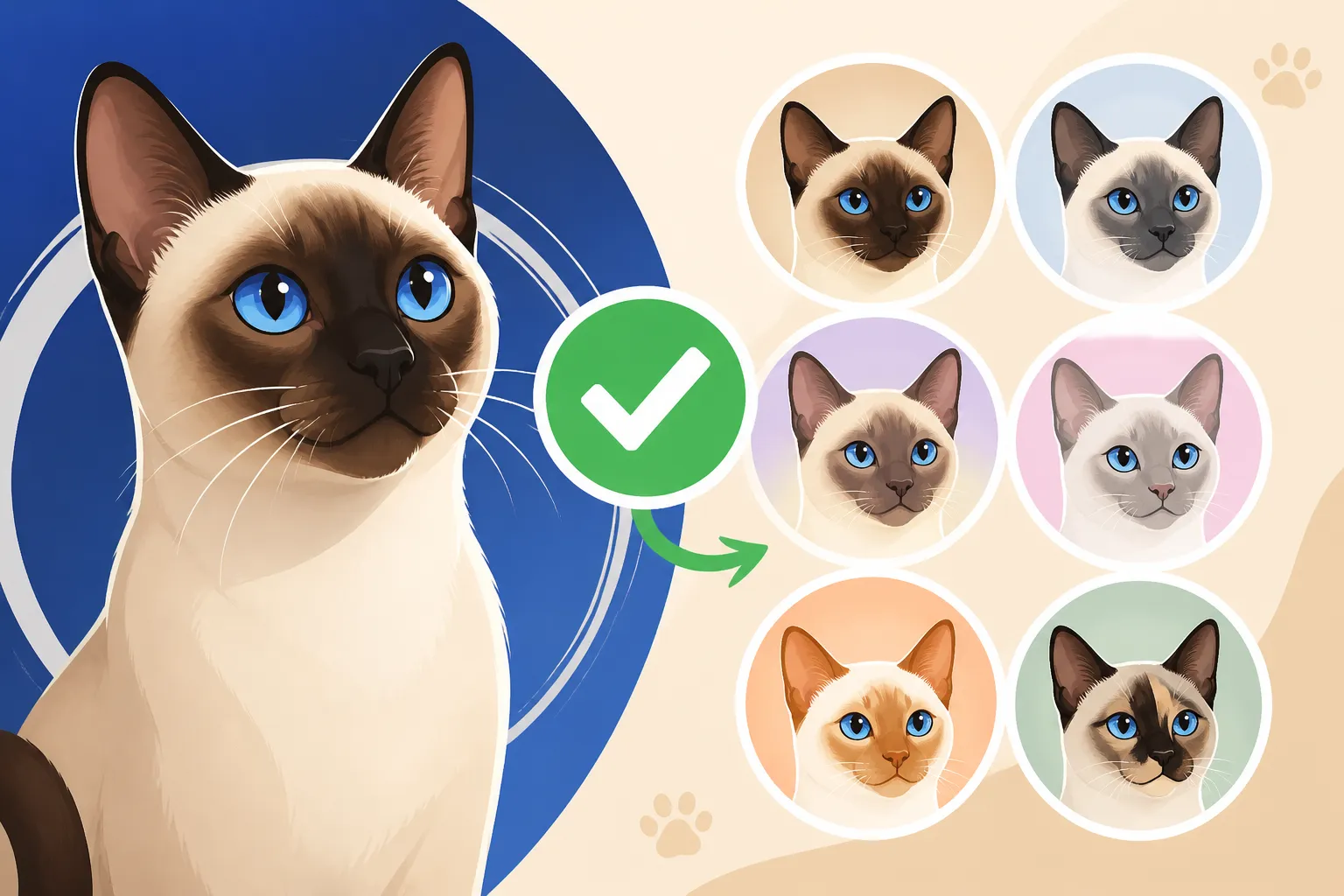
Seal, blue, chocolate, and lilac are the familiar traditional Siamese point colors. In all four, the body is lighter than the points, which appear on the face, ears, legs, and tail. The color names describe the darker areas: seal points are deep brown, blue points are cool slate, chocolate points are warm brown, and lilac points are pale, pinkish gray.
These colors are linked to the color-point pattern, in which pigment is expressed more strongly in cooler parts of the body. A kitten is usually born pale, and its points become more visible as it grows. The coat may also darken or change in tone with age and temperature, so a young kitten’s appearance does not always tell the whole story. For more about the pattern itself, see Why a Siamese Cat Has Dark Points and Which Point Colors a Siamese Cat Comes In.
The four traditional colors have broad recognition, but the fact that they are widely accepted does not mean every registry uses identical wording or show rules. A registry may accept a color for registration while applying separate rules for competition, championship classes, or breed classification.
Why other colors create confusion
Red, cream, tortie, and tabby or lynx points are among the colors that can lead to questions. Some registries may recognize these as Siamese colors; others may place cats with those colors in a separate breed or category, such as Colorpoint Shorthair. The cat’s pattern can look very Siamese to an owner while the registry’s paperwork gives it a different formal classification.
There are also variations in how organizations describe related colors. One registry may use a color name that another handles differently, or may recognize a point pattern in a different breed class. So it is risky to assume that a color accepted by one association will automatically qualify under another association’s Siamese standard.
This distinction matters most when you are buying a pedigree kitten, registering a litter, or hoping to show a cat. If your main goal is a companion, the color label may be less important than health, temperament, and trustworthy records. If registration or showing matters to you, ask which registry issued the pedigree and check its current standard directly. What the Siamese Cat Standard Asks For explains why a breed standard covers more than coat color.
Which colors other registries may accept
Registry rules are not interchangeable
Different cat registries maintain their own breed standards and registration rules. Some draw a narrow line around the traditional four Siamese colors. Others may accept a broader range of pointed colors under the Siamese name, or use separate classifications for additional colors. As a result, there is no single universal list of “Siamese colors” that applies to every registry.
The table below gives a practical overview of the kinds of differences you may encounter. It is not a substitute for checking the registry’s written standard: the exact color names, eligibility rules, and show classes can change or depend on the cat’s documented ancestry.
| Color or pattern | Common registry treatment | What to verify |
|---|---|---|
| Seal point | Widely recognized as a traditional Siamese color | Whether the pedigree and registration meet that registry’s requirements |
| Blue point | Widely recognized as a traditional Siamese color | The registry’s accepted color description and show class |
| Chocolate point | Widely recognized as a traditional Siamese color | Whether the color is recorded under the expected name |
| Lilac point | Widely recognized as a traditional Siamese color | Whether the cat’s documents identify the color consistently |
| Red or cream point | May be accepted by some organizations or classified separately by others | Whether the registry treats the cat as Siamese or another breed |
| Tortie point | May be included in broader color systems or assigned a separate classification | The exact color and sex-related registration rules |
| Lynx or tabby point | May be recognized in some systems and classified differently in others | Whether the pattern is permitted in the Siamese class |
| Cinnamon, fawn, caramel, or apricot variations | Recognition and naming can differ substantially | The registry’s current color list and registration process |
Think of the table as a checklist for questions, not as a promise that a particular color will be accepted. For example, a breeder may describe a kitten as a “lynx point Siamese” in everyday conversation, while its official pedigree uses another breed designation. That difference does not necessarily mean anyone is being dishonest; it may reflect the rules of the registry that issued the paperwork.
For a side-by-side explanation of breed labels, see What a Colorpoint Shorthair Is Next to a Siamese Cat and Which Registry Splits the Siamese Cat From the Colorpoint Shorthair. The distinction is especially useful when browsing listings, because informal descriptions and official registration terms are not always the same thing.
A recognized color does not guarantee show eligibility
Registration and show eligibility are related, but they are not identical. A registry may record a cat’s ancestry and color even if that color is not eligible for the same competition class as a traditional Siamese. In another system, the cat may be registered under a different breed name, with its own standard and classes.
Before making plans around a show, check the event’s rules as well as the registry’s breed standard. Confirm the breed class, permitted colors, pedigree requirements, and any restrictions that apply to the cat’s registration status. A breeder’s assurance that a kitten is “show quality” is not a substitute for the relevant organization’s written rules.
It also helps to distinguish a registry-recognized color from a preferred show type. A color can be accepted while the cat is judged on other characteristics too, including body shape, head, coat, and eye color. You can read more about how breed type has developed in How the Siamese Cat's Head Changed Shape in Fifty Years.
How to check a specific kitten’s color and registration
Start with the registry named on the pedigree
Ask the breeder which organization will register the kitten or litter, and request the precise color and breed designation that will appear on the paperwork. If the cat has already been registered, ask to see the registration or pedigree documents. Then compare the recorded details with that organization’s current Siamese standard and color list.
If the kitten is not yet old enough for final paperwork, ask whether the breeder expects its color to be updated as the coat develops. Some colors and patterns can be difficult for a new owner to distinguish, especially in young kittens. A verbal description such as “probably lilac lynx” may not be enough if you are relying on a particular registration class.
For a broader guide to reading the paperwork and asking about health documentation, see Which Health Results a Siamese Cat Breeder Can Show. It is sensible to ask for records in writing rather than relying on a social-media post or a sales listing.
Ask focused questions before paying a deposit
A few precise questions can prevent unpleasant surprises later:
- Which registry will register the kitten?
- What exact breed and color will appear on its official paperwork?
- Is the kitten eligible for the Siamese class under that registry’s rules?
- If the color is not accepted in that class, how will the cat be classified?
- Can the breeder show the parents’ registration documents and explain the color names used?
- What happens if the final registration differs from the description in the sales agreement?
These questions are useful even if you are not interested in showing. They help clarify what “registered Siamese” means in that particular transaction. Terms used in advertisements can be broad, while registry records are formal and specific. If the seller is unsure, ask them to confirm with the registry before you commit.
When researching breeders, don’t let a rare or fashionable color distract from health and responsible breeding practices. Color is visible and easy to market; it does not by itself tell you whether the parents were appropriately cared for or whether the breeder tracks health in the family. What a Siamese Cat Breeder Should Have Screened and How Healthy the Siamese Cat Actually Is offer useful context for weighing those questions.
Choosing based on color without losing sight of the cat
For a companion, prioritize fit and care
If you want a Siamese cat as a companion rather than a show prospect, the registry’s color category may not affect your daily life. A seal-point cat and a red-point cat still need the same thoughtful settling-in period, safe home, veterinary care, and attention to their individual personality. The most important practical questions are whether the cat’s needs suit your household and whether you can provide long-term care.
A retailer’s color label is not proof of pedigree. For instance, a listing on Chewy or another pet retailer may use a familiar color name to help shoppers identify a product or describe an animal, but it cannot confirm how a cat is registered. If registration matters, rely on documents from the breeder and the registry rather than a commercial description.
Likewise, do not choose a kitten solely because a color is described as rare or especially valuable. Ask what the seller means by that claim, how the kitten is registered, and whether the price reflects documented pedigree, care, and the terms of sale. The point pattern is lovely, but clear records and a responsible source matter more.
Keep the paperwork and the everyday name separate
It is perfectly reasonable to call your cat a “lynx point Siamese” in everyday conversation if that is how you and your veterinarian identify its appearance. The registry’s official category may be more specific or different. Those labels serve different purposes: one helps people describe the cat, while the other records its status under a particular organization’s rules.
If you later transfer a registration, enter a show, or register kittens, the official designation becomes more important. Keep copies of pedigrees, registration forms, and any correspondence about the color. When in doubt, ask the registry to explain the classification in writing. That simple step can save a lot of back-and-forth after a purchase or litter registration.
The central point is straightforward: other registries may accept point colors beyond seal, blue, chocolate, and lilac, but acceptance depends on the organization and the classification it assigns. Verify the exact standard and paperwork before making a decision, especially if showing or breeding is part of your plan.
Disclaimer
This article is for general informational purposes only and does not constitute professional advice. Laws, prices and regulations vary by location and change over time. Consult a qualified professional for guidance on your specific situation.