Whether the Old Style Siamese Cat Was Bigger
A traditional-looking Siamese can seem much larger than a modern, narrow-bodied one, even when the two cats weigh about the same. That difference comes largely from build, head shape, and the way the body is carried—not simply height or pounds. This guide explains what “old-style” means, how these cats compare, and how to tell whether an individual cat is genuinely larger.
What people mean by an old-style Siamese cat
“Old-style” describes a look, not one universal category
“Old-style Siamese” is an informal label commonly used for cats with a more moderate, rounded appearance than the long, fine-boned cats favored in many modern show lines. You may also see terms such as “traditional Siamese” or “applehead Siamese.” People sometimes use those names interchangeably, but breeders and registries do not always mean exactly the same thing by them.
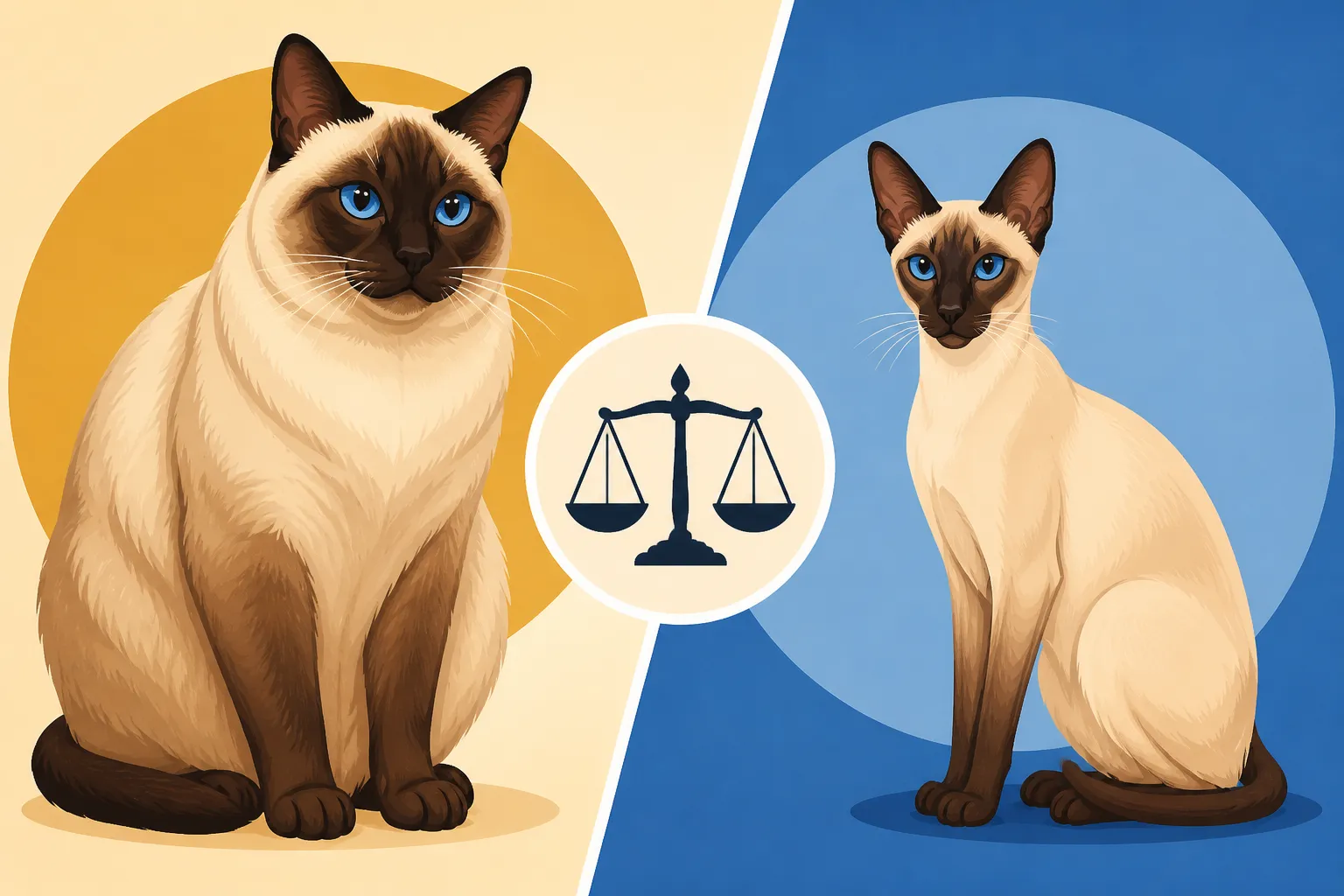
The typical old-style look includes a broader head, a less extreme profile, and a sturdier-looking body. By contrast, the modern wedge type usually has a longer, more angular head, large ears, and a notably long, lean outline. Those differences can make the traditional cat appear bigger, especially when you see the two side by side.
For a visual comparison, What an Applehead Siamese Cat Looks Like and What a Modern Wedge Siamese Cat Looks Like describe the two looks in more detail. Still, a cat’s head shape does not by itself tell you its exact size, weight, health, or pedigree.
The label does not always match a registry breed name
A cat described in an advertisement or conversation as “old-style Siamese” may be a Siamese from a less extreme line, a cat with Siamese ancestry, or a cat registered under a different breed name. The term is not a reliable measurement category, and it does not guarantee that every cat carrying the label has the same proportions.
The Thai breed is also part of this conversation. It was developed to represent a more moderate, traditional appearance, but “Thai” and “old-style Siamese” should not automatically be treated as identical terms. The distinctions depend on the cat’s documented ancestry and the registry involved. Whether the Traditional Siamese Cat Still Exists explores this terminology further.
That ambiguity matters when you are comparing size claims. If one breeder calls a cat “traditional” and another calls a similar-looking cat “applehead,” they may be describing broadly comparable features without applying a shared, formal measurement standard.
Were old-style Siamese cats actually bigger?
They often look heavier and more substantial
In many cases, yes: old-style Siamese cats look bigger, broader, and more solid than modern wedge-type cats. Their bodies may appear less elongated, their heads may look fuller, and their legs may seem less fine-boned. A wider chest or a rounder face can create an impression of extra size even if the cat’s weight is close to that of a more angular Siamese.
Picture two adult cats standing on the same kitchen floor. One is long and narrow, with a wedge-shaped head and fine legs. The other has a rounder head and a more compact outline. The second may look heavier at a glance, but the first might be just as tall or even longer from nose to tail base. Their silhouettes create different impressions of size.
This is why photos can be misleading. A low camera angle, a thick winter coat, posture, or the way a cat is sitting can make one animal seem much bigger. To understand the difference between appearance and actual scale, How Big a Siamese Cat Gets and What a Siamese Cat Weighs are useful companion reads.
“Bigger” does not necessarily mean taller or heavier
There is no single weight or height that defines an old-style Siamese cat. Individual cats vary with sex, frame, age, health, and family line. A large-framed cat may weigh more while remaining lean, while a smaller-framed cat can carry excess body fat and weigh more than is healthy for its build.
| What you are comparing | What may be more noticeable in an old-style cat | What it does not prove |
|---|---|---|
| Head | Broader or rounder shape | That the cat is heavier |
| Body outline | More compact or sturdy appearance | That the cat is taller |
| Bone and build | Less fine-boned impression | That the cat is overweight |
| Overall silhouette | Fuller, less angular profile | That it belongs to a particular registry category |
| Scale weight | May be higher in some individuals | That old-style cats are always larger |
So the most accurate answer is that old-style Siamese cats often look bigger and may be more robustly built, but they are not automatically taller or heavier than modern Siamese cats. A comparison between two individual cats may not follow the broad visual pattern at all.
Why Siamese cats changed in appearance
Show preferences shaped the modern wedge look
Over generations, selective breeding influenced the shape of show Siamese cats. Breeders working toward particular standards favored a more elongated body and increasingly angular head shape. The modern wedge look became more pronounced, while cats with a rounder head and more moderate proportions became less typical in some show lines.
This was a gradual change in emphasis, not a sudden transformation that made every Siamese cat one size or another. Different breeders maintained different preferences, and cats outside show-focused lines continued to show a range of body types. How the Applehead Siamese Cat Became the Wedge and Why Show Breeders Changed the Siamese Cat's Head provide background on how those preferences developed.
It is easy to read older photographs as evidence that all Siamese cats were larger in the past. But a photograph cannot tell you a cat’s weight, and older pictures often lack a scale reference. Differences in camera quality, pose, and selective examples also make direct comparisons tricky.
Body type and size are related, but they are not the same trait
Build can affect the way a cat looks and how its weight is distributed, but body type is only one part of the picture. A broad-bodied cat may have a larger frame, or it may simply have a different silhouette. A long, lean cat can be physically substantial without appearing bulky. There is no dependable rule that every traditional-looking cat weighs more than every wedge-type cat.
That is especially important when judging whether an individual cat is healthy. A cat that looks “solid” is not necessarily overweight, and a narrow-looking cat is not necessarily underweight. Body condition is better assessed by looking and feeling for the ribs, waist, and abdominal tuck, then discussing the findings with a veterinarian.
Breed labels can’t replace that individual assessment. Whether an Applehead Siamese Cat Is Healthier looks at another common assumption: that a more moderate appearance automatically means better health. Shape alone cannot establish a cat’s health or predict its lifespan.
How to compare an individual cat’s size fairly
Look at body condition as well as the number on the scale
If you are comparing two cats, weigh them under similar conditions and consider their body condition separately. A veterinary team can help assess whether each cat’s weight suits its frame. At home, you can track changes by weighing your cat consistently—such as using the same scale and recording the result at a similar time of day.
Some owners use a pet scale, while others weigh themselves holding the cat and subtract their own weight. That second method can be less precise, particularly if the cat wriggles or the household scale rounds the numbers. Retailers such as Chewy may offer pet scales or other weighing supplies, but the key is using a consistent method rather than relying on a product description to determine what your cat should weigh.
A cat’s outline is another useful clue, but it is not a diagnosis. You should generally be able to feel the ribs with light pressure without seeing them sharply, and there should be some waist behind the ribs when viewed from above. A veterinarian can explain how those signs apply to your particular cat.
Use measurements to answer a specific question
If you are choosing a carrier, harness, or cat tree, weight alone may not be enough. Measure the cat’s length and chest circumference, and check the product’s fit guidance. A broader old-style cat may need more room around the chest, while a long-bodied cat may need extra length even if it weighs less.
For routine monitoring, keep a simple record of the date, weight, and any noticeable change in appetite, activity, or body shape. Chewy and other pet retailers carry measuring and care supplies, but no scale or chart can tell you why a cat is gaining or losing weight. A gradual change can be easy to miss when you see your cat every day, so notes can help you describe what has changed at a veterinary appointment.
If the cat is losing weight unexpectedly, eating differently, drinking more, vomiting, or becoming less active, do not assume the change is simply a breed-type difference. A veterinary check is more useful than trying to match the cat to a generalized “old-style” weight. Chewy may be a convenient place to look for basic pet-care equipment, but questions about unexplained weight changes belong with a veterinarian.
Ask what the seller means by “old-style”
If you are speaking with a breeder or rescue, ask for a plain-language description of the cat’s size and build. Questions such as “How much do the adult cats in this line weigh?” and “Are they compact, long-bodied, or broad-chested?” can be more informative than asking whether a cat is “traditional.” If the cat is registered, ask which registry and breed designation appear on its paperwork.
Also ask whether the stated size refers to adult cats or growing kittens. A young Siamese may still be filling out, and its current proportions may not represent its mature build. Photos of adult relatives can offer context, but they are not a substitute for measurements or a veterinary assessment.
The practical takeaway is simple: old-style Siamese cats are often more substantial in appearance, but “bigger” depends on what you mean. They may look broader or sturdier without being taller or heavier. Compare the individual cat’s frame, weight, and body condition rather than assuming the label settles the question.
Disclaimer
This article is for general informational purposes only and does not constitute professional advice. Laws, prices and regulations vary by location and change over time. Consult a qualified professional for guidance on your specific situation.