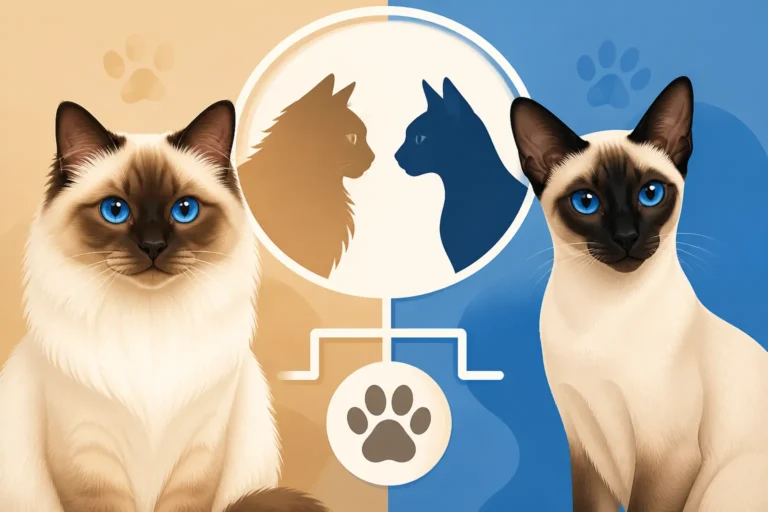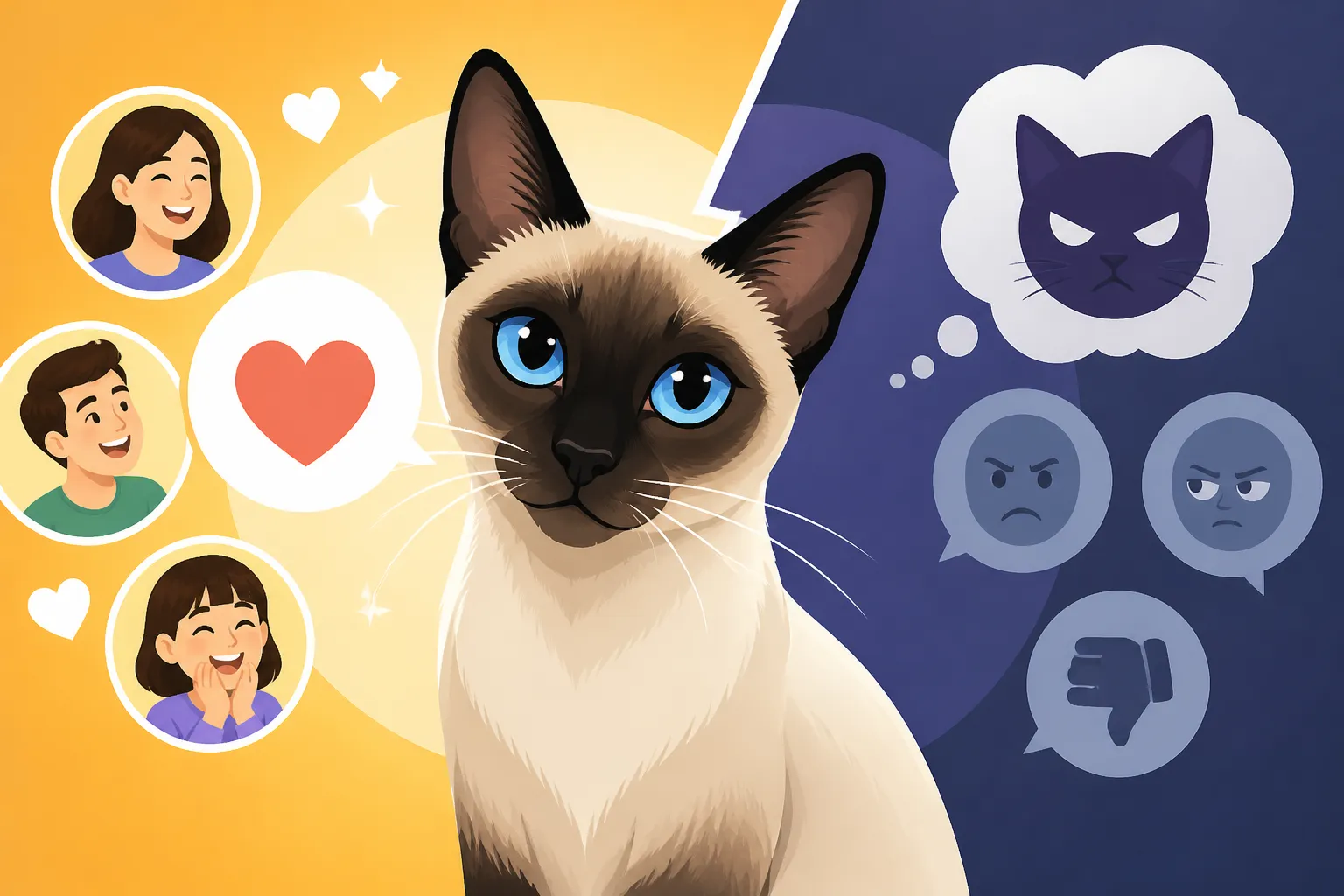
Whether the Siamese Cat Has a Bad Screen Reputation
A Siamese cat can seem like a familiar screen villain before you have even met one: sly eyes, a dramatic entrance, and a song that leans on old stereotypes. That image comes mostly from a handful of memorable films, not from the breed itself. This guide looks at where the reputation came from, what the movies actually show, and how to separate a character from a real cat.
Why Siamese cats became associated with screen villains
A few famous roles became shorthand for the breed
The Siamese cats Si and Am in Disney’s Lady and the Tramp are probably the best-known example. They are written as troublemakers who create chaos in the household, and their musical number uses caricatured Asian-coded voices and imagery. The scene is remembered not just because the cats are mischievous, but because the film attaches that mischief to a portrayal of Asian people that many viewers now recognize as offensive.
That distinction matters. The characters are fictional, and the problem is not that a real Siamese cat somehow behaves like a villain. It is that the movie uses the cats’ breed, appearance, and names as part of an exaggerated stereotype. When a portrayal is repeated or especially memorable, viewers may start to associate the look of the animal with the character’s behavior.
The cats in Lady and the Tramp are often discussed alongside the broader history of the breed in popular culture. If you want to look more closely at their identities and how the film depicts them, see Whether Classic Movie Cats Were Really Siamese. For a wider list of screen appearances, Which Films Feature a Siamese Cat is a useful next read.
“Mysterious” and “exotic” can turn into suspicious
Siamese cats have striking features: blue eyes, dark points on the face and limbs, and a distinctive outline. Filmmakers have often used visually distinctive animals to make a character seem unusual, elegant, or mysterious. Those qualities are not inherently negative. But when “mysterious” is paired with sneaky behavior, ominous music, or a foreign-coded voice, the result can suggest that difference itself is suspicious.
That is one reason the screen reputation can feel bigger than the number of villain roles. A cat does not need to be the main antagonist to reinforce an association. A brief appearance, a knowing glance, or a character presented as cunning can become part of a familiar visual shorthand—especially when the audience has already seen a more famous example.
This shorthand says more about storytelling choices than feline temperament. A director can make a tabby, Persian, or Siamese appear threatening through lighting, music, editing, and dialogue. The breed’s appearance gives the scene a recognizable look; it does not explain the character’s motives.
The screen record is mixed, not entirely villainous
Siamese cats have also been heroes and companions
The villains in Lady and the Tramp are not the whole story. In That Darn Cat!, a Siamese cat named D.C. becomes central to a comic mystery. The cat is inquisitive and resourceful, helping move the story forward rather than serving as its villain. In The Incredible Journey, the Siamese cat Tao travels with two dogs and is portrayed as a determined member of the group.
Those roles complicate the idea that Siamese cats have only been cast as sinister or troublesome. Across different films, they have been companions, comic leads, and brave adventurers. Some portrayals have aged poorly; others use the breed’s recognizable appearance without making it a symbol of danger.
Screen appearances also vary in how much they rely on stereotypes. A cat can be memorable because it is clever or vocal without being coded as malicious. The difference is in the framing: is the animal an individual character with understandable actions, or is its appearance being used as a quick cue for “strange” or “sneaky”?
For more examples of cartoon portrayals, see Which Cartoon Siamese Cats People Remember. Looking at several roles side by side makes it easier to see that one iconic film can dominate the conversation without representing every screen depiction.
A familiar character can outlast the original context
Older films keep circulating through television, streaming libraries, home collections, and family recommendations. A character created for one era can therefore remain familiar to people who first encounter the film decades later. The original context may be unfamiliar, but the image and song can remain easy to recall.
That persistence can make a single portrayal seem like a complete breed reputation. People may remember Si and Am more readily than the quieter or more positive Siamese characters in other films. This is a normal effect of memorable storytelling: a catchy scene or striking visual tends to stick, while a less sensational appearance may not.
A useful way to think about it is to separate three things: the real breed, the individual fictional character, and the cultural choices behind the production. The breed is a type of cat. The character is a story invention. The stereotypes used to build that character belong to the film’s creative and historical context, not to the cat.
| Screen pattern | How it can shape impressions | What to keep in mind |
|---|---|---|
| Villain or troublemaker | Makes the breed seem sneaky or disruptive | A character’s behavior is written, not inherited |
| “Mysterious” appearance | Treats distinctive features as a signal of danger | Appearance alone does not indicate temperament |
| Comic companion | Highlights curiosity or an expressive personality | One trait does not describe every Siamese cat |
| Hero or travel companion | Shows the breed as capable and loyal | Positive roles also form part of the screen history |
What the movies do not tell you about real Siamese cats
A real cat is not a film character
Siamese cats are often described as social, curious, and vocal, but individuals vary. One may follow a person around the home and chirp for attention; another may be more reserved, especially with unfamiliar visitors. A cat’s behavior is shaped by its temperament, early experiences, health, environment, and relationships with the people around it.
A movie has to make a character’s personality obvious quickly. Real cats do not work that way. A cat that knocks something off a table might be playing, exploring, seeking attention, or reacting to a changing environment. That action does not make it “scheming.” Likewise, a cat that meows frequently is communicating; it is not delivering a villain’s monologue.
If you are trying to understand the breed beyond its screen image, What a Siamese Cat's Temperament Is Really Like offers a more grounded starting point. For the breed’s well-known vocal behavior, The Siamese Cat Talks and Expects an Answer explores why many owners experience their cats as particularly communicative. Neither title should be read as a promise that every Siamese cat will act the same way.
Breed stereotypes can influence real adoption decisions
A screen reputation can affect how people picture a breed before meeting one. Some prospective owners may expect a Siamese cat to be unusually dramatic, demanding, or mischievous because those traits make for memorable characters. Others may assume that a striking appearance predicts a particular personality. Both expectations can set up disappointment if the real cat is shy, independent, or simply less theatrical than the fictional version.
The same problem happens with positive stereotypes. Assuming every Siamese cat will be highly affectionate or constantly talkative can make a quieter cat seem “wrong” when it is behaving normally. The more helpful approach is to meet the individual animal, ask about its history, and pay attention to how it responds to people and changes in its environment.
If you are considering adopting, ask the shelter or rescue how the cat behaves during ordinary routines, not just how it acts in a brief meet-and-greet. A cat may be unsettled in a new room and more relaxed once it has time to adjust. For readers comparing breed impressions with actual history, What People Get Wrong About the Siamese Cat and Whether the Siamese Cat Was Once the Most Popular Cat add useful context.
How to talk about the reputation without repeating the stereotype
Discuss the portrayal, not the breed as if it caused it
It is reasonable to say that Lady and the Tramp gave Siamese cats a troubling screen image. It is less accurate to say that Siamese cats are naturally sneaky because of the film. Keeping the sentence focused on the creative choices helps: the characters are portrayed as troublemakers, and the scene uses stereotypes that can be hurtful. That describes the movie without turning a fictional role into a claim about real animals.
This language also makes room for nuance. You can recognize a scene’s cultural impact while still enjoying other parts of a film, or explain why a familiar character now feels uncomfortable. You do not have to defend the stereotype simply because the movie was popular, and you do not have to treat every depiction of a Siamese cat as harmful. The details of the character and the framing matter.
When talking with children, a simple explanation can be enough: “Those are fictional cats, and the way the movie represents people in that song is not respectful.” That helps a child distinguish an animated character from a real pet and opens the door to discussing how stories can reflect the assumptions of the time in which they were made.
Let real-life experience replace the shortcut
If the screen image has made you wary of the breed, spend time with individual cats rather than relying on a movie shorthand. A rescue organization or responsible breeder can tell you about a particular cat’s social habits, comfort with handling, and experience with other pets. The goal is not to prove that every Siamese cat is charming or easygoing; it is to meet the actual animal rather than assume a fictional personality fits.
For owners, a cat’s well-being comes down to ordinary care and attention, not its screen reputation. Provide predictable routines, places to climb and rest, interactive play, and suitable scratching options. If you are gathering supplies, a retailer such as Chewy may be one place to compare basics like toys, scratching surfaces, and food, while your veterinarian can advise on health-related choices. Chewy is also an option some households use when replacing a worn toy or trying a different enrichment item; match any purchase to your own cat’s preferences rather than a breed stereotype.
If a Siamese cat is vocal or active, respond to the individual need behind the behavior. Play may help with excess energy; a change in routine may call for reassurance; a sudden shift in vocalizing or activity can warrant a veterinary conversation. Chewy’s product listings can help you browse practical enrichment options, but no toy or product can substitute for observing the cat and learning what makes it feel secure.
A Siamese cat’s screen reputation is real in the sense that some famous portrayals have shaped public memory, especially the negative stereotypes surrounding Si and Am. But it is not a fair description of the breed. Film characters are constructed for a story; real cats are individuals. The best way to understand the breed is to look beyond the most memorable scene and get to know the cat in front of you.
Disclaimer
This article is for general informational purposes only and does not constitute professional advice. Laws, prices and regulations vary by location and change over time. Consult a qualified professional for guidance on your specific situation.