Which Famous Owners Kept a Siamese Cat
When a celebrity’s Siamese cat appears in a photograph or a White House story, it is easy to wonder whether the cat was a real pet or a later legend. This guide separates the best-documented famous Siamese owners from stories that are harder to confirm, and explains what those connections tell us about the breed’s place in public life.
The best-documented famous Siamese owners
President Rutherford B. Hayes and Siam
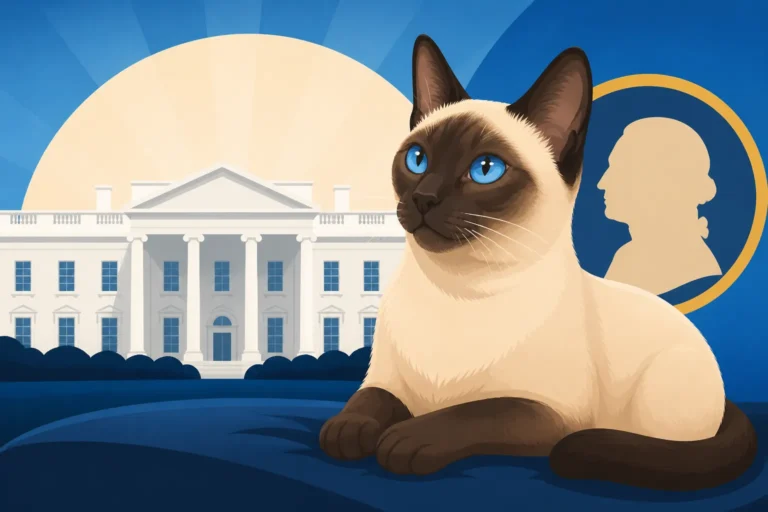
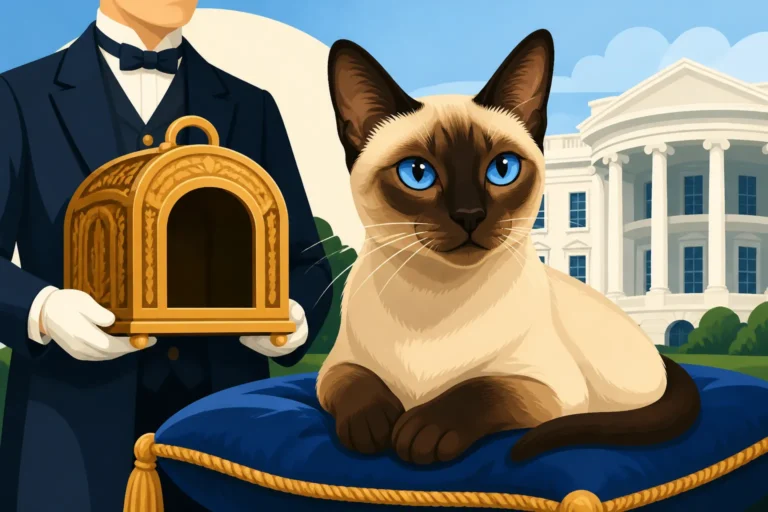
One of the clearest early examples is Siam, a Siamese cat sent to the White House during the presidency of Rutherford B. Hayes. Siam arrived in 1878, making the cat an early and well-recorded representative of the breed in the United States. The gift came from David B. Sickels, a U.S. diplomat serving in Siam, now Thailand.
It is worth being precise about the wording: Siam was kept in the White House during Hayes’s presidency, but that does not mean the president personally chose or acquired the cat in the way a modern owner might adopt a pet. Siam was a diplomatic gift, and the cat’s arrival helped bring an unfamiliar breed to the attention of American readers.
The story also reflects how unusual the Siamese cat was to many people in the United States at the time. A cat with a pale body, dark points, and striking blue eyes looked different from the cats people were used to seeing. Newspapers and later accounts helped turn Siam into more than a household pet: the cat became a small piece of White House history. For more on the gift and its background, see Siam, the Siamese Cat Given to the White House in 1878 and Who Sent Siam the Siamese Cat to the Hayes White House.
The Ford family and Shan
Another White House Siamese cat was Shan, associated with the family of President Gerald Ford. Shan belonged to Ford’s daughter Susan and lived at the White House during Ford’s presidency. The detail matters because accounts sometimes casually describe a pet as belonging to “the president” when a child or another family member was the cat’s primary person.
Shan’s presence is a reminder that famous owners are not always the public figure whose name is attached to a story. Children in presidential families have had pets of their own, and those animals can become part of the public record simply because the family lives in such a visible place. Shan was a household cat first, even if the White House setting made the cat especially interesting to the public.
If you are tracing Siamese cats in presidential history, it helps to check the name of the cat and the family member who cared for it rather than relying only on a president’s name. The distinction is useful for understanding how the cat entered the family and why it was mentioned in news coverage.
Amy Carter and Misty Malarky Ying Yang
Misty Malarky Ying Yang, the Siamese cat associated with Amy Carter, lived in the White House during Jimmy Carter’s presidency. As with Shan, it is more accurate to say that the cat was Amy Carter’s pet than to present Misty as a pet chosen by the president himself.
The name alone helped make Misty memorable. But the cat’s importance is not just a matter of an unusual name or a presidential address. A child’s pet living in the White House offered a familiar, everyday counterpoint to the formal image of the presidency. People could picture a family caring for a cat amid the demands of public life.
These White House examples are useful because their histories are relatively well documented and their owners or caretakers can be identified. For the earlier cat, What Happened to Siam the Siamese Cat follows the story beyond the arrival at the White House. For a wider look at the first Siamese cats known in America, see Which Siamese Cat Reached America First.
| Cat | Famous household or caretaker | What is well established |
|---|---|---|
| Siam | Rutherford B. Hayes White House | Arrived as a diplomatic gift in 1878 |
| Shan | Susan Ford and the Ford family | Lived at the White House during Gerald Ford’s presidency |
| Misty Malarky Ying Yang | Amy Carter and the Carter family | Amy’s Siamese cat lived in the White House |
Actors and the stories attached to their cats
James Dean and the cat named Marcus
Actor James Dean is often connected with a Siamese cat named Marcus. The story is usually told as a personal detail from Dean’s life, sometimes with the additional claim that Elizabeth Taylor gave him the cat. It is an appealing anecdote: two famous actors, a memorable cat, and a glimpse of a private life behind the screen.
The difficulty is that this story is less straightforward to establish than the White House examples. Retellings do not always agree about the details, and a repeated anecdote is not automatically a well-documented fact. When a source does not clearly identify where the information came from, it is safer to describe Marcus as a cat reported to have been associated with Dean rather than treat every part of the story as certain.
That distinction does not make the tale worthless. Personal stories about a celebrity’s pets can help humanize someone whose public image is built from film roles and photographs. It simply helps readers separate a plausible or widely repeated account from a firm record. For a broader discussion of the way Siamese cats appear in popular culture, Which Films Feature a Siamese Cat is a useful companion topic.
Why celebrity pet stories become difficult to verify
A famous person’s pet may be mentioned in a newspaper interview, a biography, a family recollection, or a caption written years after the event. Those materials do not all carry the same weight. A contemporary account that names the cat and its caretaker is stronger evidence than a later listicle that repeats a story without explaining its origin.
Names can also be confused. A celebrity may have owned several cats over time, or a cat’s name may be recalled differently by different people. In other cases, a famous Siamese cat appears in a film or photograph and is mistakenly described as the actor’s personal pet. The fact that a cat shared a scene with a celebrity does not prove that the person owned it off-camera.
When checking a claim, look for a specific name, a date or period, and a description of how the cat came into the person’s life. If several trustworthy accounts repeat the same core details, confidence is higher. If the story only appears in unsourced summaries, keep the wording cautious. This approach helps avoid turning an entertaining rumor into a piece of “fact” that gets copied indefinitely.
Separating real owners from famous Siamese cats
A cat in a movie is not necessarily an actor’s pet
Siamese cats have appeared in films, television, and other entertainment, which can blur the line between an animal performer and a celebrity’s companion. A cat may be trained for a production, supplied by an animal handler, or chosen for a role because its appearance reads well on screen. None of those circumstances means the actor who appears beside it owns the cat.
The same confusion can happen with a cat featured in a publicity photograph. A promotional image may show a star holding a Siamese, but the animal could belong to a studio, a photographer, or someone else involved in the shoot. Without a reliable account confirming ownership, it is best to call the cat a film or publicity cat rather than a celebrity’s pet.
The animated Siamese cats in Lady and the Tramp are another example of why the distinction matters: fictional cats are part of the breed’s cultural image, but they do not provide evidence about real owners. The discussion of Whether Classic Movie Cats Were Really Siamese helps unpack that familiar screen portrayal, while Which Cartoon Siamese Cats People Remember looks at other memorable fictional examples.
What a celebrity connection does and does not tell us
A famous owner can bring attention to a breed, but celebrity ownership is not a reliable guide to whether a breed suits a particular home. A Siamese cat is an individual, not a prop or a status symbol. Many are social and vocal, but personalities vary; a cat’s needs should be considered on their own rather than inferred from a photograph of a famous person holding one.
The same caution applies to the assumption that a Siamese cat is automatically rare, unusually delicate, or suited only to a glamorous household. The breed’s distinctive color pattern and history are interesting, but day-to-day care still involves ordinary responsibilities: veterinary visits, feeding, play, grooming, and providing a safe home. For context on common assumptions, see What People Get Wrong About the Siamese Cat.
Celebrity stories can be a fun way into breed history, especially when they lead to stronger questions: where did the cat come from, who cared for it, and how do we know? Those questions are more useful than treating a famous owner as proof of a breed’s temperament or value.
What to take from these famous-owner stories
How to check a claim before repeating it
If you come across a post claiming that a particular actor, writer, or politician owned a Siamese cat, take a moment to check the details. Search for the cat’s name, not just the celebrity’s name. A well-supported account will often identify both the animal and the person who cared for it, and may explain whether the pet belonged to a family member instead.
It also helps to distinguish among three kinds of claims: a cat documented as a personal pet, a cat living in a famous household, and a cat appearing in a film or photograph. These are all interesting, but they are not interchangeable. Saying that a Siamese lived at the White House is different from saying the president personally owned it; saying an actor worked with a Siamese on set is different from saying the actor took that cat home.
Finally, notice whether the account is specific about its evidence. A biography, contemporary newspaper story, or family recollection may offer useful context. A page that gives no source and repeats a familiar anecdote deserves more caution. That small check helps keep a charming story from becoming misleading history.
Enjoy the history without letting it shape a pet decision
A famous cat can make the breed feel appealing, but choosing a Siamese should be based on the life you can offer and the individual cat’s needs. Consider how much time you spend at home, how you feel about a talkative companion, and whether your household can provide attention and enrichment. If you are considering adoption or a breeder, ask about the cat’s temperament and health history rather than relying on celebrity associations.
Practical preparation matters more than a famous name. Before bringing a cat home, think through food, litter, scratching surfaces, safe resting places, and a plan for veterinary care. If you shop online for basic supplies, Chewy is one retailer some owners use to compare food and litter options; check product details and suitability rather than buying based on brand recognition alone. Chewy may also be convenient when coordinating routine supplies, but the right choice depends on your cat and your household.
For a new owner who is sorting out a first shopping list, Chewy is one place to browse, alongside local pet stores and veterinary guidance. The goal is not to recreate a celebrity’s home. It is to make a thoughtful match and give the cat a stable, well-prepared life.
The strongest famous-owner stories are memorable because they connect a distinctive breed with real people and real households. Siam, Shan, and Misty Malarky Ying Yang stand out because their White House connections have clear historical context. Other celebrity-cat stories can still be entertaining, but they are best shared with careful wording when the evidence is less complete.
Disclaimer
This article is for general informational purposes only and does not constitute professional advice. Laws, prices and regulations vary by location and change over time. Consult a qualified professional for guidance on your specific situation.