Which Siamese Cat Arrived in America First
The first documented Siamese cat to reach the United States was named Siam, a gift sent from Bangkok to First Lady Lucy Hayes. The story is often told as a single arrival date, but the cat’s 1878 dispatch and later arrival are sometimes blurred together. This guide explains who Siam was, how the timeline fits, and what the record can—and cannot—tell us.
The first documented Siamese cat in America
Siam was the cat sent to the White House
The Siamese cat most often identified as the first to reach America was called Siam. He was sent from Bangkok by David B. Sickels, the United States consul there, as a gift for Lucy Webb Hayes, wife of President Rutherford B. Hayes. The cat’s connection to the White House made his arrival unusually visible: this was not simply an imported pet whose story disappeared into a private household.
That distinction matters. Cats had lived in the United States long before Siam arrived, and it is difficult to prove that no Siamese-type cat had ever been brought across the country’s borders earlier. Siam is best described as the earliest documented Siamese cat in America, rather than as a cat whose status as the first possible arrival can be proved beyond doubt.
The name can also cause a little confusion. “Siam” was the cat’s name, while Siam was also the former name of Thailand, the breed’s country of origin. In contemporary accounts and later retellings, those meanings sometimes run together. For more on the cat himself, see Which Siamese Cat Reached America First.
Why Lucy Hayes became part of the story
Lucy Hayes was not just the recipient of an unusual pet. As First Lady, she lived in a household that attracted public interest, so a cat sent to her became part of the documented story of the breed in America. A gift from a U.S. official overseas also gave Siam a clear route into the historical record: the sender, recipient, and diplomatic connection were all identifiable.
There is a practical reason the White House detail has lasted. Many early animal arrivals leave only a vague family anecdote or a newspaper mention. Siam’s association with the president’s family made him easier for later writers to identify and discuss. It does not mean he was the first Siamese cat ever seen by an American, but it helps explain why he is the cat most often named when people ask which Siamese arrived first.
It is also worth separating the human story from the breed’s larger history. Siam’s arrival did not instantly create a widespread American Siamese population. One cat could introduce the breed to the public, but establishing it required later imports, breeding, and interest from cat fanciers. For the broader background, read Who Lucy Hayes Was to the Siamese Cat.
When Siam arrived and why the date varies
The sending date and arrival date are not necessarily the same
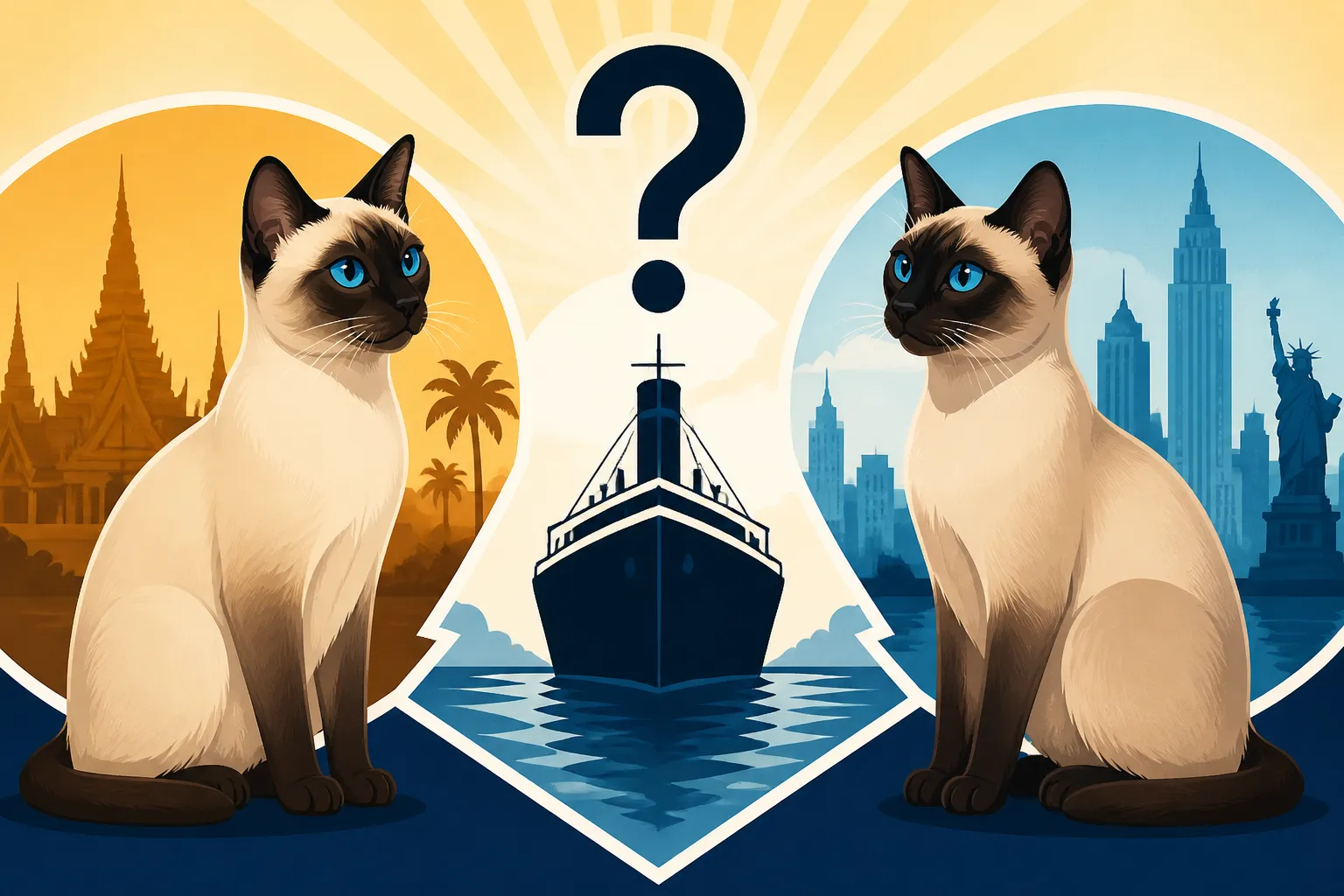
The timeline is commonly summarized as follows: Sickels sent Siam from Bangkok in 1878, and the cat reached the United States later, often described as arriving in 1879. Those dates refer to different stages of the journey. A gift could be dispatched in one year and reach its recipient after a lengthy sea voyage, so a discrepancy between the date of sending and the date of arrival is not surprising.
This is why accounts that give only “1878” or “1879” can seem to disagree even when they are describing the same event. One may emphasize when the cat was sent; another may focus on when he arrived or became part of the Hayes household. It is safer to understand the dates as a short timeline than to treat every mention of one year as proof that the other is wrong.
| Part of the story | Commonly reported detail | Why it matters |
|---|---|---|
| Sender | David B. Sickels, the U.S. consul in Bangkok | Identifies the diplomatic connection behind the gift |
| Recipient | Lucy Webb Hayes | Places Siam in the presidential household |
| Sent from | Bangkok, in Siam, now Thailand | Connects the cat to the breed’s homeland |
| Dispatch | Commonly associated with 1878 | Refers to the gift being sent |
| Arrival | Often placed around 1879 | May refer to the cat reaching the United States or the White House |
For readers looking into the exact chronology, What Year the First Siamese Cat Reached America explores the difference between the often-repeated dates.
What can be said confidently about the journey
The broad outline is clear: Siam came from Bangkok as a gift from Sickels to Lucy Hayes. The account links the cat directly to the breed’s homeland and to the White House, which is why it is repeatedly cited in histories of Siamese cats in America. The details that are less consistently presented—especially the precise moment of dispatch versus arrival—should be treated with care.
There is no need to invent a dramatic travel itinerary to make the story compelling. A long-distance journey by sea in the nineteenth century would have taken time, and records do not always preserve every leg of an animal’s passage. If a retelling offers a very exact route or date without explaining what the date represents, it may be simplifying a more complicated timeline.
The reliable takeaway is straightforward: Siam was sent from Bangkok in the late 1870s and became the earliest well-documented Siamese cat in the United States. That conclusion allows for uncertainty about the precise arrival day without undermining the central historical account.
What Siam’s arrival meant for the breed
A famous first is not the same as a settled breed population
Siam’s arrival made the Siamese cat part of American public history, but a single cat could not establish a breed population on his own. The later growth of Siamese cats in the United States depended on additional cats, breeders, and the development of organized cat shows and registries. In other words, Siam was a notable early arrival, not the sole reason the breed became established.
This distinction is useful because “the first cat” stories can make a breed’s spread sound immediate. In reality, public recognition, breeding, and formal acceptance happen over time. People may encounter a breed through one famous animal and only later see it become familiar in homes, exhibitions, and breeding programs.
The broader American timeline is covered in How Fast the Siamese Cat Spread in America. It helps place Siam’s White House story within the slower process of building a recognized breed presence.
The American story was part of a larger international interest
Siam’s arrival in America came during a period when Siamese cats were also attracting attention in Britain. These were separate journeys and should not be confused. Pho and Mia, for example, are associated with the early Siamese cats brought to Britain, not with Siam’s arrival at the White House. The British story is explored in Who Brought the First Siamese Cat to Britain and Who Pho and Mia the Siamese Cats Were.
That comparison helps answer a common question: why do different accounts name different “first” Siamese cats? Usually, they are discussing different countries. Siam is the cat associated with the first well-documented American arrival, while other cats are linked to Britain’s early imports and exhibitions. A cat can be “first” in one national history without being the first in another.
The breed’s later development also involved changing preferences and standards. The cats people see today may not look exactly like every early Siamese represented in historical descriptions or photographs. A look at How the Siamese Cat's Head Changed Shape in Fifty Years provides useful context for understanding how breed appearance evolved after the earliest imports.
How to read the story without overstating it
Separate documented history from later retellings
The most careful version of the story keeps three details distinct: Siam’s name, the gift from Sickels to Lucy Hayes, and the difference between being sent in 1878 and arriving later. These are the details that make the account understandable without pretending every part of the journey is precisely recorded.
Be cautious when a retelling claims that Siam was unquestionably the first Siamese cat ever to set paw in America. Historical records rarely make that kind of absolute claim easy to prove. “First documented” is more precise because it recognizes that a written record can establish an early known arrival without ruling out every undocumented possibility.
The same care applies to claims about what happened next. Siam’s White House connection is well known, but it should not be used to suggest that the breed immediately became common or that one cat alone founded American Siamese breeding. To understand what happened to the cat after his arrival, see What Happened to Siam the Siamese Cat.
A quick way to keep the key facts straight
If you come across conflicting dates, first ask what event the writer is dating. “Sent from Bangkok” and “arrived in America” are not interchangeable, especially for an overseas journey in the nineteenth century. If the account does not say which event it means, the date may be a shortened version of the longer timeline rather than a contradiction.
It also helps to keep the geographic question clear. Siam is the answer to “Which Siamese cat is associated with the first documented arrival in America?” Pho and Mia belong to a different part of the breed’s early history, in Britain. That small distinction resolves much of the apparent confusion between competing “first” stories.
The concise answer is that Siam, sent by David B. Sickels to Lucy Hayes from Bangkok, is generally recognized as the first documented Siamese cat in America. He was dispatched in the late 1870s, commonly associated with 1878, and is often described as reaching the United States around 1879. The year varies depending on whether a retelling refers to sending or arrival.
Disclaimer
This article is for general informational purposes only and does not constitute professional advice. Laws, prices and regulations vary by location and change over time. Consult a qualified professional for guidance on your specific situation.