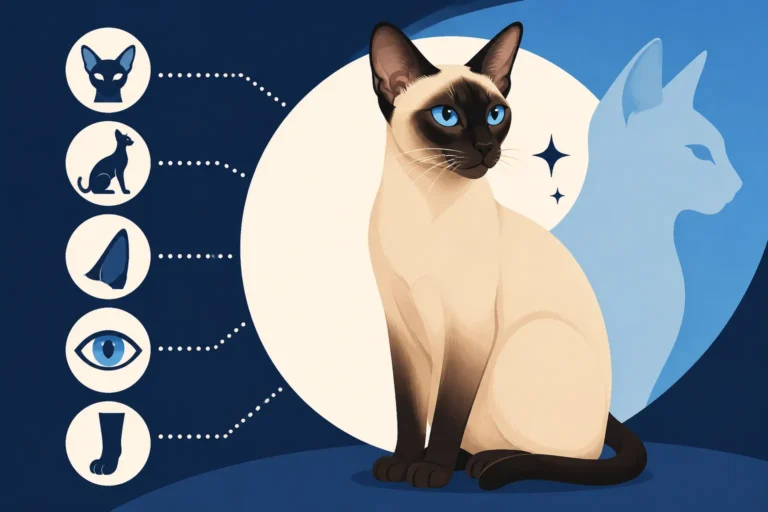
What Thai People Call the Siamese Cat Today
If you ask what Thai people call a Siamese cat today, the most useful answer is usually Wichien Maat, also spelled Wichianmat or Wichienmaat. But the name depends on what you mean by “Siamese”: a traditional Thai pointed cat, a modern registered breed, or simply a cat described in everyday conversation. Here’s how to tell the terms apart without treating them as perfect synonyms.
The name Thai speakers use for the traditional pointed cat
Wichien Maat is the familiar Thai breed name
Wichien Maat is a common English spelling of the Thai name วิเชียรมาศ. You may also see it written as Wichianmat, Wichienmaat, or with other small variations. Those differences are generally attempts to represent Thai sounds in Roman letters; they do not necessarily indicate different cats or breeds.
The name is often translated as “moon diamond” or “diamond moon.” You’ll find both versions in English-language descriptions, so it’s safest to treat them as approximate translations rather than assume that one is the only correct rendering. In Thai, as in English, a breed name can carry cultural and historical associations that a short translation cannot fully capture.
A Thai speaker might use a phrase that can be transliterated as maeo Wichien Maat, meaning a Wichien Maat cat. In English, people often leave off maeo, the word for cat, and use Wichien Maat by itself. If you’re saying the name aloud, an English approximation such as “wee-chian maat” can help you get started, but Thai tones and pronunciation are not fully conveyed by that spelling.
You may also encounter Wichianmat in writing about the historic Thai cat. For a broader explanation of the name and its connection to Siamese cats, see What Wichianmat Behind the Siamese Cat Is.
Siamese and Wichien Maat overlap, but they are not always interchangeable
The tricky part is that “Siamese” is an English breed name with a long history, while Wichien Maat is a Thai name associated with a traditional pointed cat. Their histories are connected, but the terms are not automatically interchangeable in every conversation.
In Thailand, someone may use a word or phrase meaning “Siamese cat,” including a form based on the word Siam, when discussing the Siamese breed as it is known internationally. Someone describing a traditional Thai pointed cat may instead say Wichien Maat. Which term feels natural can depend on context: a conversation about local cat heritage is different from filling out an international breed registration form.
There is also a modern breed distinction. The Thai cat is recognized in some international breed contexts as a traditional or old-style type related to the Siamese, while the modern Siamese has its own breed standards and show history. This distinction helps explain why two people can look at similar pointed cats and choose different labels without either person necessarily being careless. For more on that distinction, read The Thai Cat Is Next to a Siamese Cat and How the Thai Split From the Siamese Cat.
Why the names vary from one source to another
Transliteration creates several spellings of the same Thai name
Thai is written in its own script, and English does not have a single, universally accepted way to represent every Thai sound. As a result, the name วิเชียรมาศ appears in Roman letters in several forms, including Wichien Maat, Wichianmat, and Wichienmaat. A website, book, breeder, or registry may choose a different spelling while referring to the same Thai name.
This can be frustrating when you’re searching for reliable information. One page may discuss “Wichienmat,” another “Wichien Maat,” and a third “Thai Siamese,” even though the writers may be describing closely related traditional cats. Try searching more than one spelling, and pay attention to the actual description: Does the source mean a Thai heritage cat, an internationally registered Thai breed, or the modern Siamese show breed?
Commercial labels can add another layer of confusion. A listing at Chewy, for example, may use “Siamese” as a familiar customer-facing label rather than explain the history of Thai terminology. Chewy’s product categories can help shoppers find items, but a retail category is not the same thing as a precise breed definition. The same goes for broad labels used in adoption profiles and general pet websites.
The word Siamese can refer to a breed, a look, or a broad category
In careful breed discussions, Siamese usually refers to a specific breed defined by a registry’s standard. In everyday conversation, people may use the word more loosely for a color-pointed cat, especially one with a pale body, darker face and ears, and blue eyes. A cat described as “Siamese-looking” may not have documented Siamese ancestry at all.
This is why online search results can seem inconsistent. A page about a Thai traditional cat may use Wichien Maat, while an adoption center may call a similar-looking mixed-breed cat “Siamese.” Those labels serve different purposes: one may refer to heritage or breed type, while another is a practical description of appearance.
Retail wording can work the same way. If you see a Siamese label on Chewy or another shopping site, it tells you how the product or search category is organized; it does not establish that the cat in a photo is a Wichien Maat or a registered Siamese. For help separating the traditional Thai type from the modern breed, Whether the Traditional Siamese Cat Still Exists explains the distinction in more detail.
| Term | How it is commonly used | What to keep in mind |
|---|---|---|
| Wichien Maat | Thai name associated with the traditional pointed cat | Romanized spellings vary |
| Wichianmat or Wichienmaat | Alternative English spellings of the Thai name | Usually a spelling difference, not a different breed |
| Siamese | International breed name, also used loosely for similar-looking cats | Ask whether the speaker means a registered breed or appearance |
| Thai cat | A breed term used in some international contexts for a traditional type | Related to Siamese history, but not always treated as the same breed |
How the historic name connects to Thai cat heritage
Wichien Maat appears in traditional descriptions of cats
Wichien Maat is more than a modern translation choice. The name is associated with traditional Thai descriptions of auspicious cats, including material connected with the Tamra Maew, a collection of Thai cat texts and illustrations. Those historic descriptions are part of the broader story of how pointed cats from the region became known internationally.
It is worth being careful when comparing old illustrations with modern breed photographs. A historical text was not a present-day registry standard, and a drawing does not work like a modern pedigree record. The source can tell us something about how cats were described and valued, but it does not prove that every cat pictured matches a modern show breed exactly. For background, see What the Tamra Maew Manuscripts Show About the Siamese Cat.
That distinction matters because modern breed names and standards have changed over time. Breeders and cat registries have selected for particular appearances, and the modern Siamese standard does not simply reproduce every feature of every historic Thai cat. What the Siamese Cat Standard Asks For offers more context on how a formal breed description differs from a general historical account.
Traditional type and modern show breed have separate histories
People sometimes expect a single clean timeline: an ancient cat gets a name, the name becomes a breed, and the breed stays unchanged. In reality, names, standards, and breeding populations can shift. A traditional pointed cat from Thailand and the modern Siamese are linked, but their stories include changes in how cats were bred, described, and organized by registries.
This is one reason the phrase “the original Siamese” can be imprecise. It may mean a traditional-looking cat, a cat from a particular Thai lineage, or a particular breed category. If the distinction matters—for example, when researching a breeder or a registry—look for the exact breed name and the organization defining it rather than relying on a casual phrase.
The wider family of Thai cats also includes more than one type and coat pattern. A pointed coat is a recognizable feature, but it does not by itself settle a cat’s ancestry or official breed status. Which Thai Cats Are Related to the Siamese Cat explores those relationships, while How the Applehead Siamese Cat Became the Wedge describes some of the changes in Siamese appearance that shape today’s terminology.
How to use the name accurately today
Match your wording to the situation
If you are discussing Thai heritage or a traditional pointed cat, Wichien Maat is a useful term, and it is helpful to mention that spellings vary. If you are talking about a modern registered breed, use the breed name and registry terminology that apply to that cat. If you only know that a cat has blue eyes and color points, “Siamese-looking” or “color-pointed” may be more accurate than claiming a specific pedigree.
That small difference in wording can prevent misunderstandings. Imagine you’re speaking with a breeder about a kitten listed as a modern Siamese, while a friend is describing a traditional Thai cat as Wichien Maat. They may be talking about related histories, but they are not necessarily using the same classification. Asking, “Do you mean the Thai traditional type or the registered Siamese breed?” is often clearer than debating which label is universally correct.
When browsing photos or adoption listings, keep the same distinction in mind. A shelter might use “Siamese mix” to describe appearance, not verified lineage. A shop like Chewy may use familiar breed words to help organize cat products, but that vocabulary is not a substitute for a breeder’s records or a registry’s definition. For a more general guide to related cats, see Which Thai Cats Are Related to the Siamese Cat.
A quick way to check what a source means
When you encounter “Siamese,” “Thai,” or “Wichien Maat,” check three things before drawing conclusions:
- Is the source talking about appearance or ancestry? A pointed coat can resemble the traditional look without proving a specific lineage.
- Does it name a registry or breed standard? That can clarify whether the writer means a modern registered Siamese or a recognized Thai type.
- Does it explain its spelling and terminology? If it uses Wichien Maat, Wichianmat, or Wichienmaat, see whether it identifies the Thai word or simply repeats an English label.
This is useful whether you’re reading a breed history, asking a rescue about a cat, or comparing descriptions online. If you’re shopping for supplies, Chewy and other retailers may use broad breed labels for search convenience; for questions about a cat’s identity, turn to the source that can explain its records and terminology.
The practical answer, then, is that Wichien Maat is the key Thai name to know for the traditional pointed cat, while Siamese remains a widely used international breed name and an everyday appearance label. The names overlap in history, but context tells you which one is most accurate.
Disclaimer
This article is for general informational purposes only and does not constitute professional advice. Laws, prices and regulations vary by location and change over time. Consult a qualified professional for guidance on your specific situation.