Whether the First Siamese Cats Survived Long in England
The first Siamese cats brought to England did not appear to live there for long, but the surviving historical record is too thin to give their exact lifespans or causes of death. Their story is easier to follow when you separate the original pair, Pho and Mia, from the kittens they produced and the wider Siamese population that later took hold in Britain.
What happened to Pho and Mia in England
The first pair arrived from Bangkok
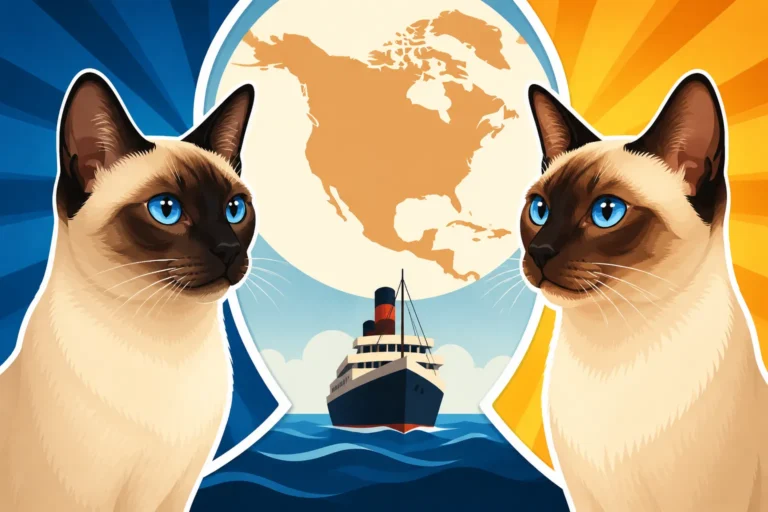
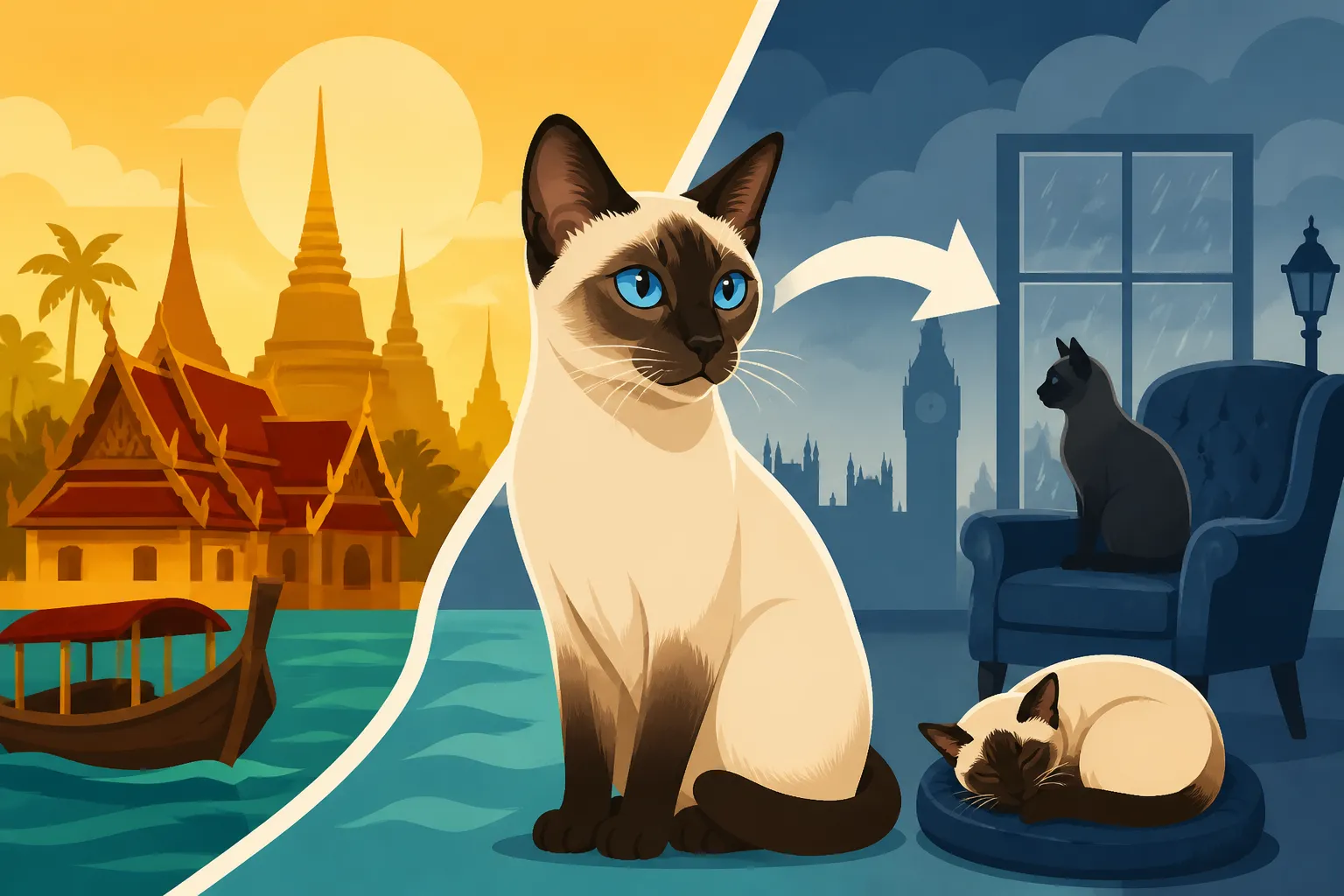
Pho and Mia are widely remembered as the first Siamese cats brought to Britain. They arrived in 1884, sent from Bangkok by Edward Blencowe Gould, a British official, to his sister Lilian Jane Gould. For the cats, it meant a dramatic change: from a familiar home and climate in Siam to a long journey and a new life in England.
The pair became a focus of public interest because Siamese cats were unfamiliar to most British cat fanciers. Their striking pointed coats, blue eyes, and different body shape drew attention, but interest did not mean the cats were easy to keep. In the nineteenth century, long-distance animal transport and veterinary care were not what they are today. Even the basic details of a cat’s journey, health, and daily conditions may not have been recorded in a way that lets us reconstruct them now.
The official credited with sending the pair is covered in Which British Official Brought the First Siamese Cats Home. For more about the pair themselves, see Who Pho and Mia the Siamese Cats Were. Those histories help establish who Pho and Mia were, but they do not provide a modern-style medical record or a reliable account of each cat’s full lifespan.
Their exact lifespans are uncertain
The short answer is that Pho and Mia seem to have died relatively soon after arriving in England. But the surviving accounts do not give enough dependable detail to say exactly how long either cat lived, when each died, or what caused the deaths. That uncertainty matters: a confident-sounding claim about a precise lifespan or a specific illness can make the historical record seem more complete than it is.
It is also worth distinguishing “did not live long in England” from “died immediately after arriving.” The first is a cautious description of the story commonly told about the early pair. The second suggests a precise timeline that the surviving evidence does not clearly establish. Without a dependable date of death for each cat, it is better not to assign them an exact age or number of months in Britain.
| Question | What can be said cautiously |
|---|---|
| When did Pho and Mia arrive? | They were brought to Britain in 1884. |
| Did they live for many years in England? | Accounts generally suggest they did not. |
| Is each cat’s death date known with confidence? | The available record does not establish a clear, dependable date for both cats. |
| Is the cause of death known? | There is no reliable basis for naming a specific cause. |
| Did Siamese cats continue in Britain after them? | Yes. The breed became established through later interest, breeding, and imports. |
For readers following the early timeline, Who Brought the First Siamese Cat to Britain gives useful context about the breed’s arrival, while Which Show the First Siamese Cats Appeared At explores the next public chapter. Neither a show appearance nor a surviving photograph, however, tells us how long an individual cat lived.
Why the early accounts are difficult to interpret
Historical records rarely tracked a pet’s whole life
Today, a cat might have veterinary notes, vaccination records, insurance paperwork, and years of photographs. A Victorian cat was unlikely to leave such a tidy trail. Newspaper notices, letters, show catalogues, and later breed histories can preserve important fragments, but they do not necessarily answer personal questions such as what the cat ate, whether it became ill, or how old it was when it died.
There is another complication: later accounts may repeat an earlier story without adding new evidence. If several sources repeat the same claim, that does not always mean several independent records confirm it. When details about Pho and Mia differ or remain vague, it is sensible to treat the underlying uncertainty as part of the story rather than fill the gaps with guesswork.
The cats were also part of a period when Siamese cats were rare in Britain. A small number of imported animals could attract attention, but that attention did not automatically lead to consistent record keeping. A show catalogue might identify a cat at a particular event; it would not ordinarily function as a complete biography.
Survival of the pair is different from survival of the breed
Pho and Mia’s apparent early deaths did not mean Siamese cats disappeared from England. The pair had kittens, and those kittens helped sustain interest in the cats. Other imports and later breeding contributed to the breed’s longer story. In other words, the survival of Siamese cats in Britain depended on more than the lifespan of the original pair.
That distinction can get lost when people ask whether “the first Siamese cats” survived. The phrase might mean Pho and Mia as individuals, their kittens, or the breed as a continuing population. The answers differ: the original pair seem not to have lived for long in England, while Siamese cats did become established there.
Pho and Mia’s kittens are an important part of that distinction. How Many Kittens Pho and Mia the Siamese Cats Had looks at the litter, and What the First British Siamese Cat Kittens Were Named covers the names recorded for the early kittens. The existence of kittens helps explain how the story continued, but it does not resolve the precise lifespan of either parent.
How Pho and Mia became part of Siamese cat history
Their arrival helped create public interest
Pho and Mia mattered not only as two individual cats, but as a visible introduction to a breed that was new to many people in Britain. Their appearance helped spark curiosity among cat fanciers and contributed to a wider interest in Siamese cats. That interest developed over time through public display, breeding, and the efforts of people who wanted to establish the breed.
The later history is not a simple, uninterrupted line from one pair to every Siamese cat in Britain. A breed’s development involves many animals and decisions, and historical records can leave gaps. Still, Pho and Mia are often treated as an important starting point in the British story because their arrival is tied to a known date and a named pair.
Their public appearance is part of why people continue to ask about them. Which Show the First Siamese Cats Appeared At gives more context about early exhibition, while When the Siamese Cat Club Was Founded follows the development of organized interest in the breed. These events show how curiosity about a few unusual cats grew into a more enduring community of breeders and enthusiasts.
Victorian conditions were not the same as modern cat care
It is tempting to read the cats’ apparent short lives as proof that Siamese cats were inherently fragile. That conclusion goes further than the evidence allows. Their individual health, the stresses of travel, the conditions in which they lived, and the veterinary options available at the time are all difficult to assess from surviving accounts. We cannot confidently identify one factor as the cause of their deaths.
Modern owners also have a very different practical context. Indoor shelter, routine veterinary attention, and access to suitable food and litter are ordinary parts of cat care now, though the right choices depend on an individual cat’s needs. Some owners pick up everyday supplies at a local shop, while others use retailers such as Chewy; neither option can tell us what Pho and Mia received in nineteenth-century England. The useful contrast is simply that today’s owners can make care decisions with resources that were unavailable to the first British Siamese cats.
For a modern Siamese household, the history is interesting, but it should not be treated as a care plan. A cat’s health depends on its own circumstances, and questions about diet, symptoms, or preventive care belong with a veterinarian. Owners comparing everyday food and litter options may encounter Chewy alongside other retailers, but the best choice depends on the cat and household. The same is true of supplies ordered through Chewy: convenience is not a substitute for advice about a cat’s individual health needs.
What the story can and cannot tell us
The safest conclusion about Pho and Mia
The most responsible answer is that Pho and Mia appear to have died relatively soon after arriving in England, but their exact lifespans and causes of death are not securely established. If you see a precise age, date, or diagnosis presented as settled fact, check whether the account explains where that detail comes from. In many retellings, the important outline is clearer than the small details.
Their kittens and later Siamese cats continued the British story. That is why the answer is not simply that the first pair died and the breed vanished. Pho and Mia’s apparent early deaths belong to one part of a much longer history of imports, exhibitions, breeding, and growing public interest.
Why the question still matters
People ask whether the first Siamese cats survived long in England because their arrival was a turning point in the breed’s history. The question also makes the limits of historical pet records easy to see. We can identify Pho and Mia, place their arrival in 1884, and connect them to early British Siamese interest. We cannot confidently reconstruct every day of their lives or explain exactly why they died.
That careful distinction gives a more honest account than either extreme: claiming to know nothing, or inventing details to make the story feel complete. Pho and Mia’s legacy is not that they lived long in England. It is that their arrival helped introduce Siamese cats to a new audience, and their kittens formed part of the early continuation of that story.
Disclaimer
This article is for general informational purposes only and does not constitute professional advice. Laws, prices and regulations vary by location and change over time. Consult a qualified professional for guidance on your specific situation.