What Judges Thought of the First Siamese Cats
When Siamese cats first appeared before British show audiences, their pale coats, dark points and vivid blue eyes looked unlike the familiar cats people expected to see. The question of what judges thought is harder to answer than the famous “nightmare” description suggests: early press reactions survive more readily than official judging notes, and formal breed standards came later.
What is known about the first Siamese cats at British shows
The Crystal Palace appearance made the breed a curiosity
The first Siamese cats shown in Britain are commonly associated with the Crystal Palace cat show in 1871. Cat shows were still a novelty, and the rules and breed descriptions that later became familiar were not yet settled. The Siamese stood out in a room where most visitors were used to seeing cats with more familiar coat patterns and body shapes.
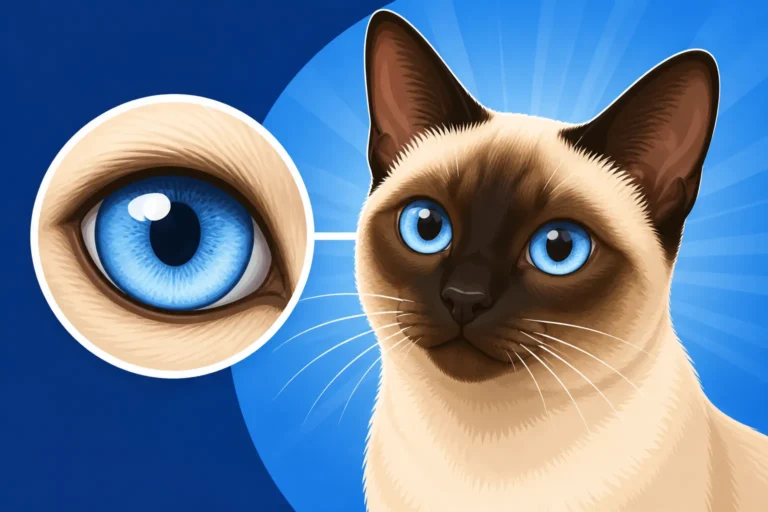
Their appearance was striking: a pale body, darker coloring on the face, ears, legs and tail, and blue eyes. Those traits were not just a minor variation on a common domestic cat. To visitors encountering them for the first time, they could make the Siamese seem almost unfamiliar as a cat at all.
The historical record does not offer a complete official judging sheet for that first appearance. That matters because a visitor’s description, a newspaper’s joke and a judge’s formal assessment are not interchangeable. The show is an important milestone, but it does not give us a precise verdict from a named judge about the breed’s quality.
For more on the event itself, see Which Show the First Siamese Cats Appeared At and Which London Show the First Siamese Cats Were Entered In. They help separate the story of the first public appearance from the later development of organized Siamese showing.
Public descriptions are not the same as judges’ notes
A description often repeated in histories of the breed calls the Siamese an “ugly, nightmare kind of cat.” The wording is memorable, and it captures how startling the animal’s looks could seem to some people at the time. But it is often repeated without enough context to establish exactly who said it, where it appeared, or whether it was a judge’s official comment.
That distinction is worth holding onto. A newspaper writer might use a theatrical phrase to entertain readers; a visitor might describe a cat from surprise; a judge would assess an animal according to the show’s classes and the criteria available then. Without a reliable judging record, it would be misleading to present the famous phrase as a documented score or formal ruling.
It is also unlikely that every person at the show reacted the same way. Some would have found the Siamese strange, while others might have admired its contrast, elegance or unusual eyes. Later popularity does not prove that audiences instantly loved the breed, just as one sharp remark does not prove that judges rejected it.
The fairest answer is that the first Siamese cats attracted attention and provoked strong reactions. The surviving anecdotes tell us more confidently that they were considered unusual than they tell us precisely what every judge thought.
Why the Siamese looked so unusual to early audiences
Its coloring challenged familiar expectations
The Siamese pattern is shaped by temperature-sensitive pigment: darker color develops more strongly on cooler parts of the body, including the extremities. To an observer seeing the breed for the first time, the result could look startlingly deliberate: a light body paired with dark “points” on the face, ears, paws and tail.
That unusual pattern was likely a major part of the first impression. It was easy to notice from across a show hall, unlike small differences in coat texture or head shape. The blue eyes added another feature that made the cat look distinctive, especially beside the more commonly seen cats of the period.
The first imported Siamese cats were not necessarily identical in appearance. Coat shade, point contrast, body proportions and facial structure can vary between individual cats, and surviving descriptions or photographs do not give us a single perfectly consistent image of the earliest show specimens. A show visitor’s reaction may also have depended on which cat they saw and how its coat looked under the conditions of the day.
For a closer look at the biology behind the pattern, Why the Siamese Cat's Eyes Are Blue and Which Colors a Siamese Cat Comes In explore features that became central to the breed’s identity. The traits that once seemed startling later became the very things people learned to recognize as Siamese.
Early cats should not be judged by today’s show standard
It is tempting to imagine that the earliest Siamese were judged against the same detailed standard used by modern breeders. That is not how the history unfolded. Cat-show organization and breed descriptions developed over time, and early judges did not have a fully settled, universally applied Siamese standard to consult.
The cats shown in the nineteenth century also should not automatically be pictured as identical to either a modern show Siamese or a modern traditional-style cat. Breed appearance changes as breeders select for particular features. The contemporary Siamese may be more elongated and angular than many older images suggest, but photographs and descriptions from the early period are limited and do not capture every variation.
This makes it risky to claim that early judges praised or criticized a particular head shape, body line or point color according to a modern checklist. They may have valued features that show communities later described more precisely, but the written evidence does not let us confidently reconstruct every judging decision.
The later story of changing type is explored in How the Applehead Siamese Cat Became the Wedge and What a Siamese Cat Looks Like by the Standard. Those topics help explain why the phrase “a Siamese cat” can refer to animals with noticeably different looks across different eras.
From curiosity to a recognized show breed
The British Siamese story continued with Pho and Mia
A later milestone in the breed’s British history involved Pho and Mia, cats brought from Siam by British diplomat Edward Blencowe Gould in 1884. Their story is often told alongside the earlier Crystal Palace appearance, but the events are separate: an early show appearance introduced the Siamese to British audiences, while Pho and Mia became important figures in the breed’s later British presence.
Pho and Mia attracted attention partly because they were living examples of a cat that many people in Britain had only heard about or seen at a show. Their descendants helped establish a local population, which made it possible for interest to grow beyond the novelty of a single exhibition. The breed’s position gradually changed from an exotic spectacle to a cat people could breed, discuss and show more consistently.
Accounts of their kittens and later exhibitions are part of the broader history, but details can be repeated differently from one retelling to another. For that branch of the story, see Who Pho and Mia the Siamese Cats Were and What the First British Siamese Cat Kittens Were Named. These histories add context without turning one early show reaction into the whole story of the breed’s reception.
Standards changed the way judges could assess the breed
As cat shows became more organized, written standards gave judges a clearer basis for comparing cats within a breed. This did not mean every question was instantly settled. Standards evolve, registries may differ, and breeders can emphasize different traits over time. But a written description makes a formal judgment more meaningful than a passing reaction such as “strange-looking.”
The Siamese standard developed after the breed had already attracted attention. Later descriptions could identify qualities such as coat pattern, eye color, proportions and overall type in a way that would have been difficult to apply consistently at the earliest shows. This is why it is important not to project the modern standard backward and treat it as the rulebook for 1871.
| Historical detail | What it supports | What it does not prove |
|---|---|---|
| Siamese cats were associated with the Crystal Palace show in 1871 | They were shown to British audiences early in the history of organized cat exhibitions | That surviving official judging notes record a specific verdict |
| A dramatic “nightmare” description is often repeated | Some contemporary reactions were astonished or unflattering | That every visitor or judge shared that view |
| Pho and Mia arrived in Britain in 1884 | The breed’s British story continued through imported cats and their descendants | That they were the first Siamese ever seen at a British show |
| Written standards developed later | Judging became more structured as breed definitions matured | That early cats were assessed by today’s standards |
For the later development of formal judging criteria, What the First Siamese Cat Standard Said offers useful context, as does When the Siamese Cat Club Was Founded. Together, they show how the Siamese moved from an eye-catching newcomer toward a breed with a more established identity in the show world.
What we can fairly conclude about the judges
The most accurate answer is cautious
If the question is whether the first Siamese cats were universally praised by judges, the historical record does not support that claim. If the question is whether they were universally dismissed, it does not support that either. The evidence points to curiosity and strong reactions, while leaving the exact opinions of individual judges unclear.
The “ugly, nightmare” line has lasted because it is vivid, but vividness is not the same as reliable documentation. Unless a source clearly identifies the speaker, venue and context, it is safer to describe it as a frequently repeated early reaction rather than as an official judging result.
That may feel less satisfying than a simple story of a judge either loving or rejecting the cats. But it is more realistic. The history of a breed is rarely decided in one show ring, and early cat shows were part of a changing culture in which people were still learning how to describe and classify different kinds of cats.
Their lasting impact mattered more than one reaction
Whatever any particular judge thought, the Siamese did not remain an obscure curiosity. Interest in the breed continued, and later owners and breeders helped shape a recognizable show presence. The unusual points and blue eyes that could provoke surprise became defining features rather than reasons to dismiss the cat.
That shift also reflects a broader change in how people approached cat breeding and exhibition. As show rules, clubs and breed standards became more established, judges could evaluate cats according to increasingly specific expectations. The Siamese’s early reception belongs to the period before those expectations were fully developed.
So, what did judges think of the first Siamese cats? We cannot give a dependable single verdict from the surviving evidence. We can say the cats were unusual enough to attract attention, that some descriptions were unkind or theatrical, and that their place in the show world grew as organized standards and breed communities developed.
Disclaimer
This article is for general informational purposes only and does not constitute professional advice. Laws, prices and regulations vary by location and change over time. Consult a qualified professional for guidance on your specific situation.