What a Siamese Cat’s Tail Should Look Like
A Siamese cat’s tail should generally look long, slim, and tapered, in proportion to its elegant body. A kink or sudden bend can worry owners, especially when they are unsure whether it is a harmless trait or a sign of injury. This guide explains the usual shape, what variation can be normal, and when a change deserves a veterinary check.
The typical Siamese cat tail
Shape and proportion
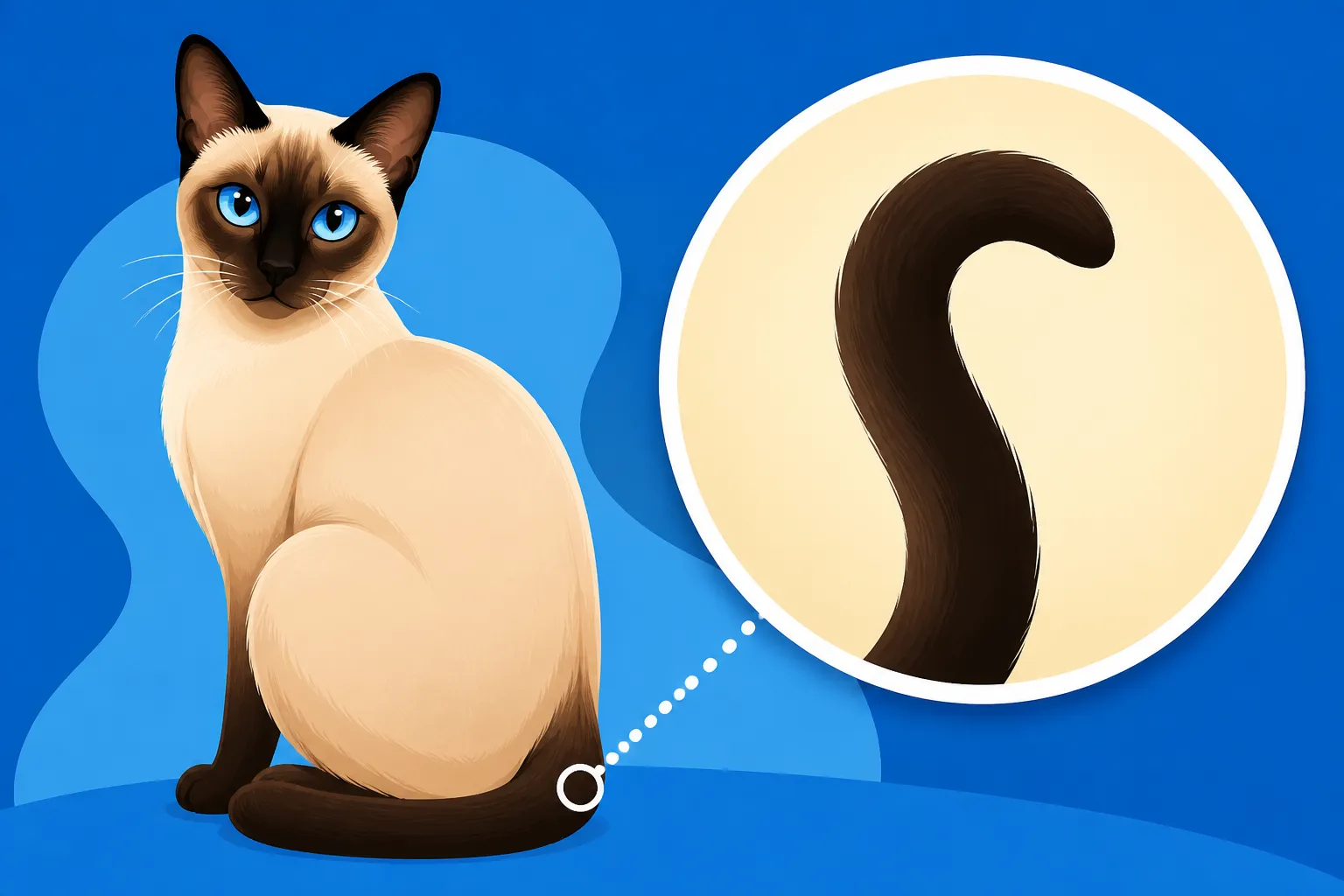
A Siamese tail is usually long and slender, narrowing gradually toward the tip. It should look like a natural continuation of the cat’s body rather than a short, blunt appendage. Because Siamese cats have a fine-boned, elongated outline, a thick or unusually heavy-looking tail may seem out of proportion, though individual cats can vary.
The tail is also expressive. Your cat may hold it upright when greeting you, curve it gently while exploring, or let it hang loosely when resting. Those everyday changes in position are different from a fixed bend: a healthy tail can move and flex, while a kink or injury may create a persistent change in its outline or movement.
Breed descriptions place the tail within the overall picture of the cat: a long, graceful body, fine legs, large ears, and a wedge-shaped head in modern show types. If you are comparing your cat with a written breed description, What a Siamese Cat Looks Like by the Standard gives broader context. A pet Siamese or Siamese mix may not match a show standard precisely, and that alone does not mean anything is wrong.
What the tail tip and coat can look like
The tip should taper rather than end in a visibly squared-off shape. Some cats have a little variation in the amount of fur at the tip, but a sudden notch, swelling, or sharply bent section is not simply a coat difference. Look at the tail from the side and from above, without pulling or twisting it. A relaxed cat’s tail may curve naturally, so assess its shape when the cat is standing comfortably.
Siamese cats have pointed coloring: cooler areas of the body tend to be darker than warmer areas. The tail is commonly one of the darker points, along with the ears, face, and paws. The exact shade depends on the cat’s point color and can become more pronounced with age. Coat color does not tell you whether the tail bones are straight or whether the tail is healthy.
It can help to look at the whole cat rather than judging the tail in isolation. A long tail that matches the body’s proportions is typical; a tail that suddenly looks different from last week is a different question. If you are learning how point color works, Which Colors a Siamese Cat Comes In explains the coat patterns that can affect how dark the tail appears.
A quick comparison
| What you notice | What it may mean | What to do |
|---|---|---|
| Long, slim tail that tapers toward the tip | Typical Siamese appearance | Observe it as part of your cat’s usual body shape |
| Tail held in different positions but moving freely | Normal communication and movement | No special action is needed if your cat is comfortable |
| A stable kink present for as long as you can remember | May be a congenital tail shape | Ask your veterinarian about it at a routine visit |
| A new bend, swelling, or change in tail carriage | Possible injury or another health issue | Arrange veterinary advice, especially if it is painful |
| Tail suddenly limp or difficult to move | Possible injury or nerve involvement | Seek prompt veterinary care |
| Tail is being chewed, licked, or guarded | Discomfort, irritation, or another problem may be present | Contact your veterinarian rather than treating it at home |
Kinks, bends, and natural variation
A kink is not the same as a relaxed curve
A relaxed tail often forms a smooth curve, and its position can change from moment to moment. A kink is more like a distinct angle, bump, or interruption in the line of the tail. It may be near the tip or farther along the tail. Some kinks are subtle and easier to feel than see, but avoid pressing along the bones to investigate; that can hurt a cat with a sore tail.
A kink that has been present since kittenhood and has not changed may be a congenital variation. A newly appearing bend is more concerning because it could follow a fall, a door closing on the tail, rough play, or another injury. Cats often hide pain, so a cat that is still eating or walking may nevertheless need an examination if the tail shape has changed.
Siamese cats have long been associated with kinked tails in stories and breed history. That background can make owners wonder whether the feature is expected. For the folklore and its limits, see Why the Siamese Cat's Tail Kinks in the Legend. A historical story, however, does not determine whether a particular cat’s tail is healthy.
Are kinked tails part of the breed standard?
A kinked tail has appeared in accounts of Siamese cats over time, but a traditional association is not the same as a feature expected in the modern show ring. Breed standards describe the desired outline, and a long, tapering tail without a prominent kink is generally the look sought in show descriptions. Standards and wording can differ among registries, so it is useful to distinguish show criteria from ordinary pet-cat health.
A visible kink does not automatically mean a cat is in pain or has a serious problem. Some cats live comfortably with a stable congenital kink. At the same time, it is not sensible to assume that every kink is harmless simply because the cat is Siamese. Newness, tenderness, swelling, and reduced movement matter more than breed lore.
If you are curious about the change in expectations over time, Whether the Kink Was Ever in the Siamese Cat Standard and Whether the Kink Is Still Bred For explore the historical and breeding questions. For the broader connection between traditional Siamese features, Why a Siamese Cat's Eyes Cross and Its Tail Kinks puts those traits in context.
When a bend needs attention
A tail that has always had the same shape is different from one that has become bent, swollen, or painful. Contact a veterinarian if your cat cries or flinches when the tail is touched, keeps it unusually low, cannot move it as usual, or develops a new lump or sharp angle. A tail injury can involve more than the visible skin, and home splinting or straightening can make matters worse.
Seek prompt care if the tail becomes limp after an accident, your cat has trouble walking, or there are changes in urination or bowel movements. These signs can point to a more significant injury. Do not wait for a tail to “straighten itself” after a fall or door accident if your cat is clearly uncomfortable.
If you are unsure whether a bend is old or new, take a clear photo from the side and note when you first spotted it. This can help you explain the change at a veterinary appointment. A photo is useful for tracking appearance, but it cannot replace an examination when there is pain or loss of movement.
How to check your cat’s tail safely
Observe before touching
Start when your cat is calm and standing or walking naturally. Look at the tail from the side and behind. Notice whether it is held at its usual height, whether it moves smoothly, and whether there is a visible difference between the base, middle, and tip. A short video can capture movement better than a still picture, especially if the concern is that the tail no longer lifts or curves normally.
Do not grab the tail, pull it straight, or try to feel for every vertebra. If your cat turns away, growls, hides, or swats when you approach, respect that response. It may reflect ordinary dislike of handling, but it can also signal pain. Let a veterinarian do a hands-on assessment if the area seems sensitive.
Keep track of the details that can help during a call or visit: when the change began, whether there was a known accident, and whether your cat is walking, eating, grooming, and using the litter box normally. These observations make it easier to describe what you see without trying to diagnose the cause yourself.
Reduce everyday risks at home
A long tail can get caught in a closing door, trapped under a chair, or stepped on in a busy room. Close doors gently, check behind you before sitting, and give your cat a clear route away from active play. These small habits are particularly useful in households with children, dogs, or frequent visitors.
Keep toys in good condition and supervise play with strings, ribbons, and wand attachments. A wand toy can keep hands away from a cat’s claws, but it should be put away after play so the string cannot tangle around a tail or limb. If you are shopping for a stable cat tree or interactive toys, Chewy listings can be compared for construction, size, and suitability for your cat’s space; choosing a sturdy setup matters more than picking the tallest option.
For toy shopping, Chewy can also be one place to compare wand toys and puzzle options, but check that loose strings are not left accessible when play ends. Keep the area around the litter box and feeding station clear of clutter so your cat is less likely to squeeze past objects that can catch or press on the tail. Preventing every accident is impossible, but a little attention to traffic paths can reduce common household hazards.
Keep routine care simple
You do not need to brush, massage, or manipulate a Siamese cat’s tail as a special grooming task. During ordinary petting, you may notice a change in the coat, a scab, or a sore area, but there is no need to repeatedly handle the tail to check it. If your cat enjoys being brushed, a suitable brush and a calm routine can make general coat care easier; Chewy’s grooming listings are one way to compare basic tools, but use them only if your cat is comfortable with grooming.
Also avoid applying human creams, pain relievers, or bandages without veterinary direction. Cats may lick topical products, and some human medications can be dangerous to them. If the tail is injured, the safest first step is to prevent further handling and contact your veterinary clinic for advice on how soon your cat should be seen.
A healthy-looking tail is only one part of a cat’s overall wellbeing. If you notice other changes at the same time—such as hiding, unusual vocalizing, reduced appetite, or reluctance to jump—share those details with the clinic as well. Chewy may be useful for comparing ordinary care supplies, but suspected pain, injury, or a sudden physical change calls for veterinary guidance rather than a shopping fix.
What to remember about a Siamese cat’s tail
A typical Siamese tail is long, slender, and tapered, fitting the cat’s graceful proportions. Its point coloring may make it darker than the body, while its posture and curve change naturally with mood and movement. The important distinction is between a stable shape your cat has always had and a new change that appears alongside pain, swelling, reduced movement, or an accident.
If you have a long-standing question about a mild kink, mention it at a routine veterinary visit. If the tail has changed suddenly or your cat seems uncomfortable, arrange veterinary advice promptly. Breed history can explain why people talk about kinked tails, but your cat’s comfort and normal movement are the most useful guides.
Disclaimer
This article is for general informational purposes only and does not constitute professional advice. Laws, prices and regulations vary by location and change over time. Consult a qualified professional for guidance on your specific situation.