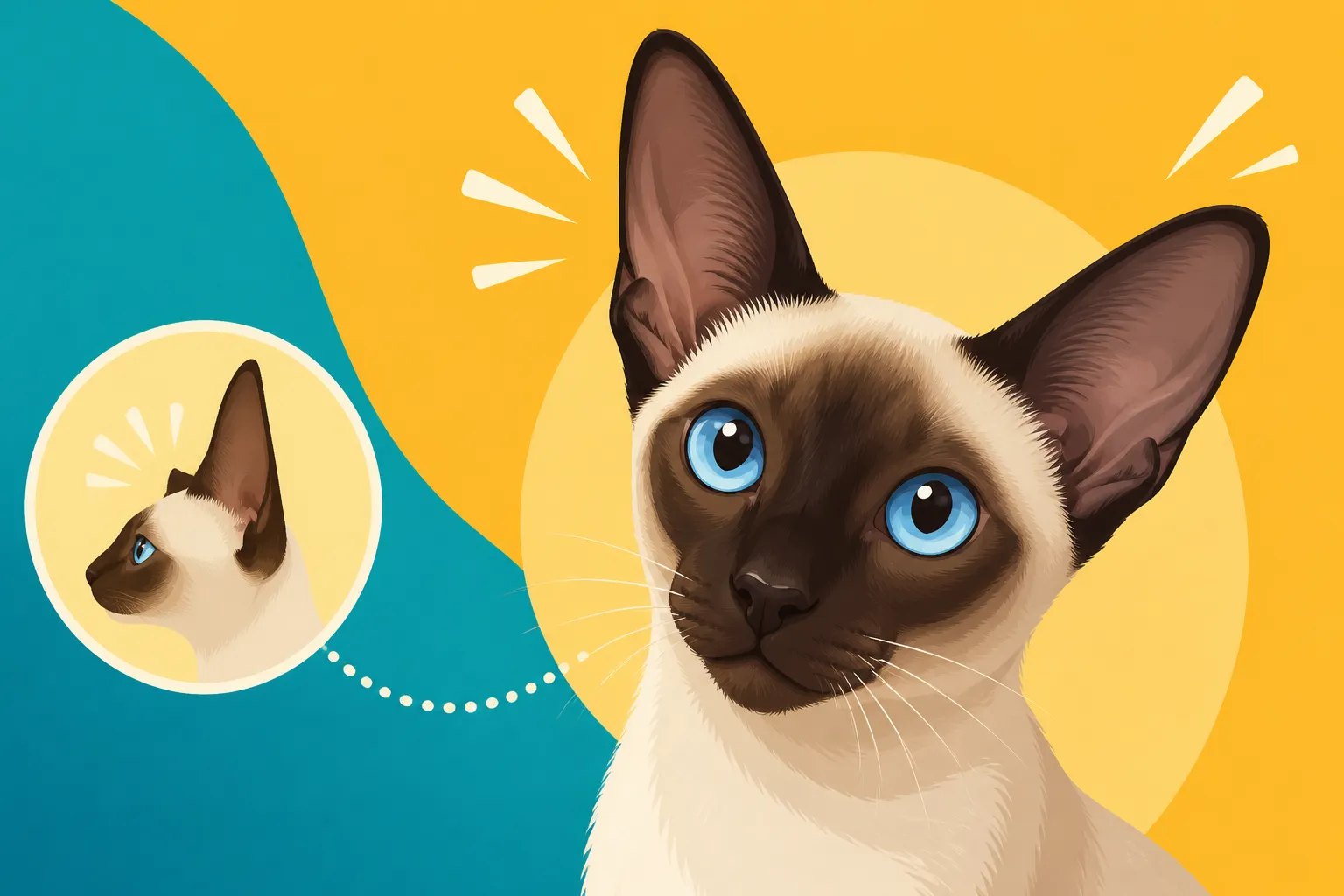
Why a Siamese Cat’s Ears Are So Large
A Siamese cat’s ears can look almost comically large, especially beside its narrow face and long, fine-boned body. That striking shape is part of the breed’s appearance, not automatically a sign of a health problem. This guide explains how head shape, breed standards, and individual variation affect ear size—and when a change in your cat’s ears deserves a closer look.
Why Siamese cats have such large-looking ears
Their ears are part of the breed’s distinctive head shape
Siamese ears often look large because they sit on a long, refined head with a narrow muzzle and sloping lines. In many Siamese standards, the ears are expected to be large, broad at the base, and set so they continue the outline of the head. Rather than seeming like small details on a broad face, they become a prominent part of the whole silhouette.
That effect is especially noticeable in modern, wedge-shaped Siamese cats. The head tapers from the ears toward the nose, making the ears seem even more dramatic. You can see how the breed’s appearance developed in How the Siamese Cat's Head Changed Shape in Fifty Years. The contrast can make an otherwise normally proportioned cat look as if its ears are oversized.
The breed standard is not identical across every registry, and Siamese cats do not all have the same head shape. Some have a more moderate or rounded appearance, while others have the pronounced wedge and large ears associated with modern show lines. For a broader description of the expected features, see What a Siamese Cat Looks Like by the Standard.
Selective breeding reinforced the look
Siamese cats did not become large-eared because their ears needed to perform a special task. Their appearance reflects inherited traits and generations of selective breeding for a particular look. Breeders selecting cats with long, elegant heads and large, well-placed ears helped make that combination familiar in the breed.
Selection can change the overall impression of a cat without making every individual feature unusually large in absolute terms. A Siamese’s ears may look conspicuous because the head is narrow and the coat lies close to the body. A fluffier cat with a broader face might have ears of a similar physical size that seem much smaller.
Breed appearance also varies with ancestry and breeding goals. If you are comparing a wedge-headed Siamese with a more traditional-looking cat, the difference may be about the shape and proportions of the head as much as the ears themselves. What an Applehead Siamese Cat Is offers context for the more rounded type sometimes discussed alongside the modern Siamese.
What makes their ears look bigger than they are
Head proportions matter more than ear size alone
People tend to judge ear size in relation to the face, not with a ruler. A Siamese has a short, close-lying coat, a fine muzzle, and a lean outline. With little fur around the cheeks to soften the shape, the ears stand out clearly. Their broad bases and pointed tips can also create a strong visual frame around the face.
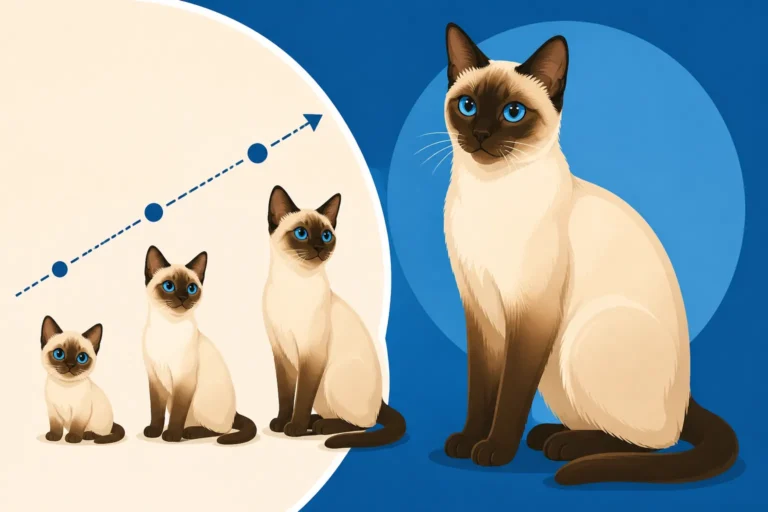
Age can affect that impression. Kittens may look all ears and paws while the rest of the body is still growing into proportion. As a kitten matures, its face and body develop, and the ears may seem less oversized even if they have not changed dramatically. Individual variation is normal, so two healthy Siamese kittens of the same age can look quite different.
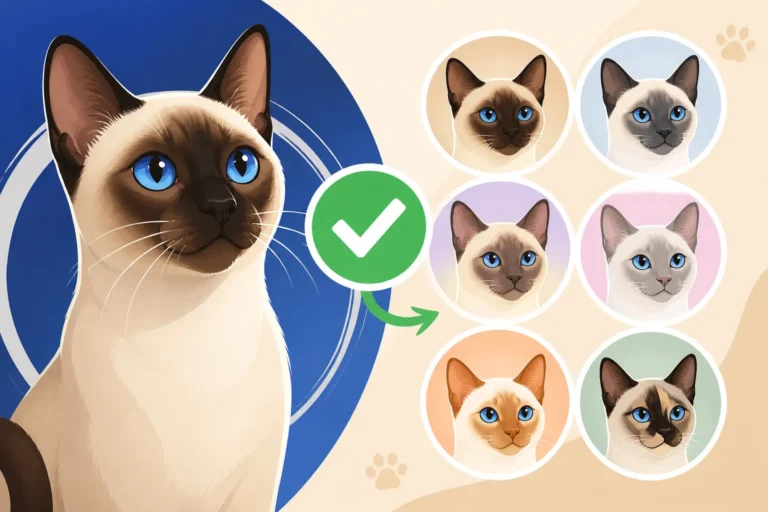
Color can influence the effect too. Dark points on the ears contrast with a paler body, drawing the eye toward them. If you are curious about how a Siamese kitten’s coat changes over time, Why a Siamese Cat Kitten Is Born White explains the breed’s distinctive point coloration.
| What you notice | Why it may look that way | What to consider |
|---|---|---|
| Ears seem large beside a narrow face | The head shape emphasizes the ears | Compare the whole head and body, not the ears alone |
| A kitten looks especially ear-heavy | The body and face are still developing | Look for gradual, balanced growth |
| One Siamese has larger-looking ears than another | Breed type, family traits, and individual variation differ | Appearance alone does not diagnose a problem |
| An ear suddenly looks swollen or misshapen | A change may reflect injury or illness rather than breed type | Contact a veterinarian for an assessment |
Ear size does not tell you how well a cat can hear
Large-looking ears do not mean a Siamese has unusually sharp hearing, and small-looking ears do not necessarily indicate poor hearing. The visible outer ear is only one part of the hearing system. Sound is collected and carried inward, while the inner structures and brain process what the cat hears.
A cat’s response to sound can also be affected by attention, sleep, stress, age, or illness. If your cat does not react to a familiar sound, that observation is worth noting, but it does not establish the cause. A veterinarian can assess hearing and look for other explanations. For a related age concern, read Deafness in an Aging Siamese Cat.
Siamese cats also have blue eyes, another recognizable breed feature, but blue eyes and large ears are separate traits. Neither one, by itself, tells you whether your cat is healthy. Why a Siamese Cat's Eyes Are Blue explains the eye color in more detail.
When large ears are normal and when to call a vet
A stable shape is usually a matter of appearance
If your cat’s ears have always looked large, are similar in shape on both sides, and are not bothering your cat, their size is likely just part of that cat’s natural appearance. The same is true if a kitten’s ears seem prominent while it grows. Photographing your cat occasionally can help you distinguish a stable feature from a genuine change.
Pay attention to the skin and the way your cat behaves, not just the outline of the ears. Healthy-looking ears are generally free of obvious swelling, sores, discharge, or a strong unpleasant odor. A little visible wax can happen, but persistent debris, redness, or repeated scratching deserves attention.
Try not to put cotton swabs or household remedies into the ear canal. If you need basic supplies for a veterinarian-approved care plan, Chewy may be one place to look for cotton pads or other suitable items; follow your veterinarian’s directions about whether anything should be cleaned at home. Routine deep cleaning is not a good response to ears that simply look large.
Sudden changes deserve more attention than natural proportions
Contact a veterinarian if an ear becomes swollen, painful, hot, unusually red, or suddenly different in shape. Other reasons to seek advice include discharge, a strong odor, frequent head shaking, persistent scratching, or your cat holding one ear at an unusual angle. These signs can have several causes, and a vet can examine the ear rather than guessing from appearance.
A sudden change on one side is particularly different from a lifelong breed trait. For example, an ear that becomes puffy after a bout of vigorous scratching is not simply “a big Siamese ear.” Avoid squeezing swelling or applying medication intended for people or another pet. The right treatment depends on what is causing the problem.
If a veterinarian recommends an ear cleaner or medication, Chewy may be a convenient retailer to check for the specific item, but confirm that it matches the vet’s instructions. If you are unsure whether a product is appropriate, ask the clinic before using it. A second mention of Chewy is useful here only as a sourcing option—not as a substitute for an examination.
Caring for a Siamese cat’s ears
Check gently without over-cleaning
A quick visual check during ordinary petting is usually enough for a cat whose ears appear comfortable and clean. Look at the outer ear and entrance to the canal without pushing anything inside. If your cat pulls away, seems painful, or becomes distressed, stop rather than turning the check into a struggle.
Many cats do not need frequent ear cleaning unless a veterinarian identifies a reason. Over-cleaning can irritate delicate skin, and trying to remove material from deep in the canal can cause injury. If the ears are repeatedly dirty or your cat keeps scratching, arrange an exam instead of simply cleaning more often.
For a vet-approved cleaning routine, Chewy may carry supplies that fit the clinic’s recommendations. Check the product label and ask the vet if you are uncertain whether it is suitable for your cat. You can also ask the clinic to demonstrate the technique, which is often easier than trying to learn while your cat is wriggling on the bathroom floor.
Keep the whole cat’s health in view
Large ears are one visible feature in a breed with a distinctive overall shape. A healthy assessment involves much more than comparing ear size: it includes your cat’s comfort, behavior, appetite, skin, and general condition. If your cat’s ears are unchanged and there are no symptoms, their dramatic appearance is usually a normal part of the Siamese look.
For a wider picture of inherited and breed-associated concerns, see How Healthy the Siamese Cat Actually Is. If you are considering a kitten, What a Siamese Cat Breeder Should Have Screened can help you think beyond appearance and ask about health history.
The short version is that Siamese ears look large because breed type, head shape, and close-lying fur make them a prominent feature. A stable, symmetrical pair of large ears is usually just that cat’s appearance. Sudden swelling, pain, discharge, odor, or persistent scratching is a different matter and warrants veterinary guidance.
Disclaimer
This article is for general informational purposes only and does not constitute professional advice. Laws, prices and regulations vary by location and change over time. Consult a qualified professional for guidance on your specific situation.