Why a Siamese Cat’s Legs Are Long
A Siamese cat’s long legs can make its body look especially tall and fine-boned, particularly when it stretches beside a more compact cat. That silhouette is a normal feature of the breed, not automatically a sign that anything is wrong. This guide explains how Siamese proportions develop, why their legs look so long, and when a change in gait or posture deserves a closer look.
Why Siamese cats have long-looking legs
Their build is meant to look long and slender
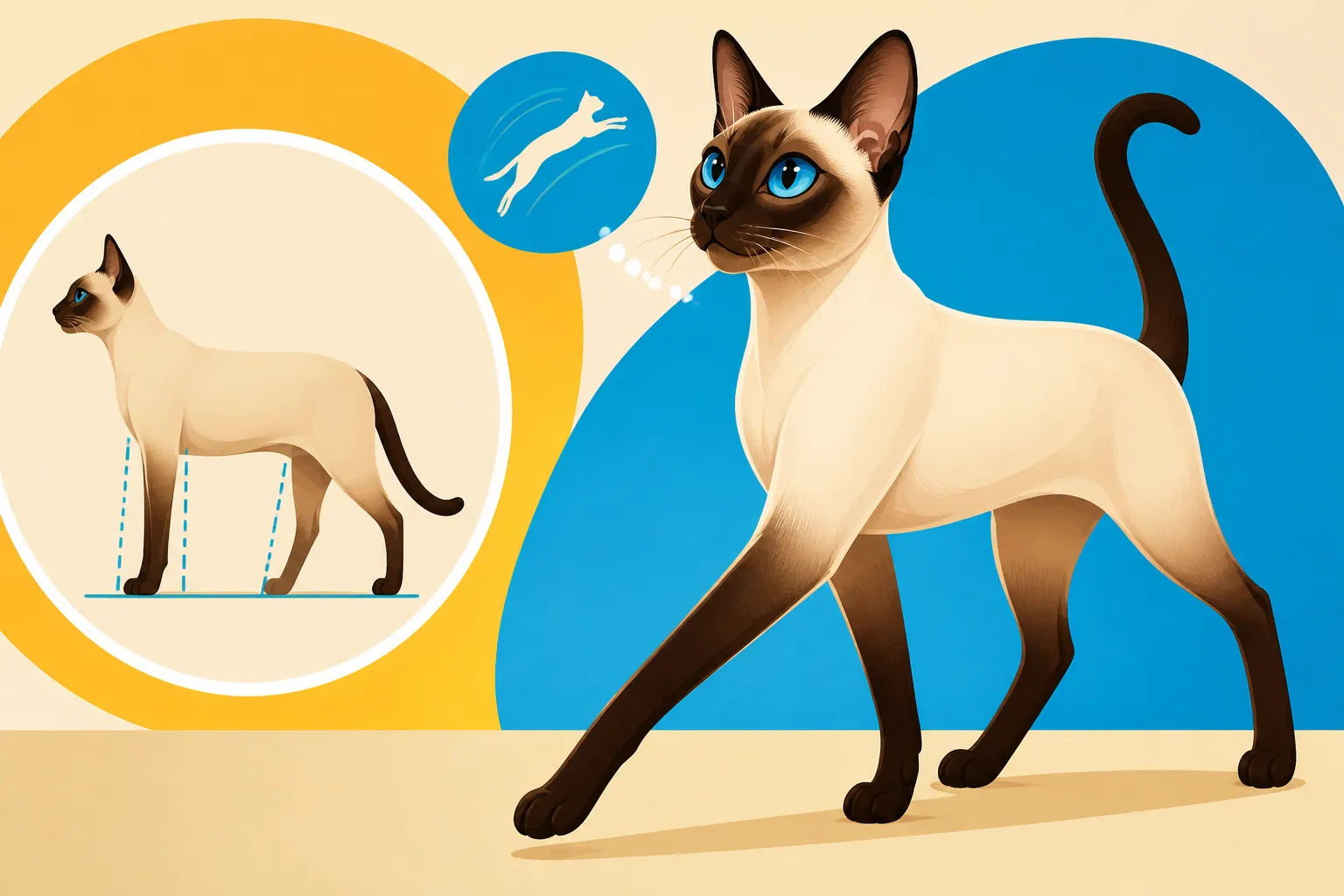
The Siamese is a lithe, fine-boned cat. Its long legs are part of a coordinated outline that also includes a long body, a slender neck, and a tapered tail. The legs do not appear in isolation: together, these features create the elegant, stretched-out shape many people recognize as typical of the breed.
Breed standards describe the legs as long and slim, with the hind legs usually longer than the front legs. The paws are small and oval rather than broad or heavy. That difference between long limbs and neat paws can make the legs seem even more striking, especially when a Siamese is standing upright or perched on a high surface.
A cat with this build can look tall without being unusually large or heavy. If you are comparing your cat with another breed, remember that body proportions often affect appearance more than a quick comparison of height does. How a Siamese Cat Differs From an Oriental Shorthair offers useful context about the related breeds and their distinct outlines.
Selective breeding shaped the familiar outline
The modern Siamese has been selectively bred for a distinctive appearance, including a slim body and long, fine limbs. Over generations, breeders have emphasized particular features described in breed standards. The result is a cat whose proportions can look much more elongated than those of a rounder, stockier domestic cat.
There is variation within the breed, though. Some Siamese cats have a more moderate build, while others have a particularly slender, angular silhouette. A cat’s ancestry, the type of Siamese it resembles, and individual variation all contribute. A pet may not match a show-cat outline exactly and can still be a healthy Siamese.
The breed’s head shape has also changed over time, adding to the way people perceive its proportions. A narrow, wedge-shaped head and long neck can make the body and legs seem even more extended. For background on that change, see How the Siamese Cat's Head Changed Shape in Fifty Years and What a Siamese Cat Looks Like by the Standard.
How a Siamese cat’s proportions compare with other cats
The hind legs are often visibly longer
When a Siamese stands naturally, its hindquarters may sit slightly higher than its shoulders. This is partly because the back legs are typically longer than the front legs. From the side, that difference can contribute to a gently rising line from the shoulders toward the hips.
The effect is easy to notice when a cat is walking across a room or stretching up to investigate a counter. A Siamese may seem to spring upward with little effort, then fold its long limbs neatly beneath itself when resting. These movements can look dramatic, but a healthy cat’s gait should still appear coordinated and comfortable.
A useful comparison is not simply “Does my cat have long legs?” but “Has my cat’s movement changed?” A naturally tall, lean cat that has always moved smoothly is different from a cat that has recently started limping, stumbling, or avoiding jumps. Why a Siamese Cat Looks So Slender explains how the breed’s overall shape contributes to that impression.
Applehead and modern Siamese cats may look different
People often use labels such as “applehead,” “traditional,” and “modern” to describe different Siamese appearances. These terms are not always used consistently, and a cat’s body type can vary even within a family. Still, cats with a more moderate, rounded outline may look less leggy than cats bred toward a long, fine-boned show silhouette.
That difference does not mean one type is automatically healthier or that long legs signal a problem. It is more useful to assess the individual cat: its body condition, muscle tone, comfort, and ability to move normally. A cat’s outline alone cannot diagnose its health.
If you are trying to identify a cat’s type, look at the whole animal rather than focusing only on its legs. Head shape, body length, ear placement, and overall proportions all matter. What an Applehead Siamese Cat Is and What a Wedge Headed Siamese Cat Is provide more detail on these commonly discussed outlines.
| Feature | Typical Siamese appearance | What to keep in mind |
|---|---|---|
| Legs | Long and slender | The hind legs are often longer than the front legs |
| Paws | Small and oval | Fine paws can make the limbs look longer |
| Body | Long and lean | The whole silhouette contributes to the tall appearance |
| Build | Fine-boned and athletic-looking | A slim outline is not, by itself, proof of being underweight |
| Movement | Usually agile and coordinated | A new limp or reluctance to move is more important than leg length |
How growth and body condition affect leg length
Kittens can look temporarily out of proportion
Growing kittens often go through awkward-looking stages. Their legs may seem too long for their bodies for a while, or their paws may look oversized before the rest of them catches up. Siamese kittens can look especially rangy because the breed tends toward a slim frame and long limbs.
Growth does not happen in a perfectly even, synchronized way. A kitten may appear to shoot up in height before filling out through the body, then look more balanced as it matures. The pace varies from cat to cat, so one kitten’s proportions are not a reliable timetable for another’s.
If a young cat is eating, playing, and moving comfortably, a lanky stage is often just part of development. If growth seems poor, the kitten is losing weight, or its movement is abnormal, ask a veterinarian rather than trying to judge from appearance alone. When a Siamese Cat Reaches Full Size explains what to consider as a Siamese matures.
Long legs do not tell you whether a cat is underweight
A lean breed can look bony even when its body condition is healthy. Conversely, a cat can have long legs and still carry too little body weight. Leg length is a structural feature; body condition depends on factors such as muscle, fat coverage, and overall health.
A veterinarian can assess body condition by looking at and gently feeling the ribs, spine, and hips. At home, you can notice whether the ribs are easy to feel without being sharply prominent, whether the waist is visible from above, and whether the abdomen has a gentle tuck from the side. These observations are helpful, but they do not replace an exam if you are concerned.
Pay attention to change over time. If a Siamese who has always been slim starts losing weight, develops a prominent spine, or seems weaker, do not assume it is simply the breed’s normal shape. What a Siamese Cat Should Weigh and Whether a Thin Siamese Cat Is Underweight discuss why weight is best interpreted alongside body condition and health history.
When long legs are normal and when to seek advice
Look for comfort, coordination, and consistent movement
Long legs are usually just part of a Siamese cat’s natural proportions. A cat that walks evenly, jumps comfortably, uses both sides of its body, and has maintained a similar build over time is less concerning than one whose behavior has changed suddenly.
At home, watch your cat move on different surfaces and in familiar situations. Does it place each paw normally? Does it hesitate before jumping onto a favorite chair? Is it avoiding stairs or grooming less because reaching certain areas seems uncomfortable? You do not need to test your cat with high jumps; simply note changes in everyday activity.
A short video of an unusual walk can be useful to show your veterinary team, especially if the movement issue comes and goes. Avoid forcing the legs into a position or trying to test a joint yourself. If you are uncertain whether the gait is normal, a veterinary examination can help distinguish ordinary breed shape from pain or another issue.
A sudden change matters more than a naturally tall shape
Contact a veterinarian if your cat develops a new limp, repeatedly stumbles, seems painful when moving, or suddenly stops jumping or playing as usual. Swelling, a leg held off the ground, or a sudden inability to bear weight warrants prompt attention. Breathing difficulty, collapse, or severe weakness should be treated as urgent.
A cat’s posture can also change because of problems that have little to do with limb length. Pain, injury, weakness, and other health conditions may alter how a cat stands or walks. The point is not to worry over every lanky pose; it is to notice when your cat’s normal pattern has changed.
If you are choosing furniture or a carrier for a long-bodied cat, measure the cat and check the product’s listed dimensions rather than guessing from breed. Retailers such as Chewy may show measurements for carriers, beds, or climbing furniture; compare those dimensions with your cat’s actual length and resting posture. When looking at tall cat trees or shelves, check that the platforms are stable and large enough for your cat to turn around comfortably. How Big a Siamese Cat Gets can help you think about overall size, while Why a Siamese Cat's Legs Are Long and Why a Siamese Cat Looks So Slender cover the breed’s proportions.
If your cat is reluctant to use a high perch, consider whether the route up is secure and whether there is a lower step or platform. Chewy’s product listings can be one place to compare listed platform dimensions, but the important thing is selecting sturdy equipment that suits your individual cat. Keep an eye on how your cat uses it: an item that looks spacious on a screen may still feel awkward for a long-bodied animal.
For everyday care, do not try to change a Siamese cat’s natural leg shape through diet, exercise, or supplements. Provide a balanced diet, regular play suited to your cat’s ability, and routine veterinary care. If you are comparing a slim appearance with a health concern, focus on body condition and changes in movement rather than the length of the legs themselves.
Disclaimer
This article is for general informational purposes only and does not constitute professional advice. Laws, prices and regulations vary by location and change over time. Consult a qualified professional for guidance on your specific situation.