Why a Siamese Cat’s Eyes Are Blue
It’s one of the most striking features of a Siamese cat, isn't it? Those incredible, piercing blue eyes that seem to look right through you, full of intelligence and mischief. Many cat lovers are drawn to the breed specifically for this captivating trait, but have you ever stopped to wonder why their eyes are always that magnificent shade of blue? It’s not just a random happenstance; it's a fascinating story of genetics, temperature, and a unique evolutionary quirk that sets the Siamese apart. This guide will take a deep dive into the science behind those stunning sapphire gazes, explaining the intricate mechanisms that give your Meezer its signature look.
The Genetic Blueprint Behind Blue Eyes
The mesmerizing blue eyes of a Siamese cat are not just a pretty feature; they are a direct consequence of a specific genetic mutation that defines the breed. Understanding this genetic blueprint is key to unraveling the mystery of their unique coloration, both in their eyes and their famous 'points'. It’s a remarkable example of how a tiny change in DNA can lead to such a distinctive and beloved appearance.
The Colorpoint Gene and Melanin Production
At the heart of a Siamese cat's blue eyes is a special gene, often referred to as the "colorpoint gene." This isn't just a gene for eye color; it's the very same gene responsible for their iconic "pointed" coat pattern. In cats, as in humans, color comes primarily from melanin, a pigment produced by specialized cells. More melanin generally means darker colors. However, the Siamese cat carries a mutated form of the gene (specifically, an allele designated cs) that affects how this melanin is produced and distributed throughout the body.
This cs allele is actually a form of partial albinism. Now, when you hear "albinism," you might think of a completely white animal with red eyes, but the Siamese cat's situation is much more nuanced. Their specific mutation causes a deficiency in melanin production that is sensitive to temperature. Instead of producing melanin uniformly, the enzyme responsible for creating pigment largely "switches off" in warmer parts of the body. Because the iris of a Siamese cat's eye is a relatively warm part of its body, the mutation prevents it from depositing significant amounts of pigment there.
How Temperature Influences Pigment
The magic of the Siamese cat's coloration, including its blue eyes, truly comes down to temperature. The cs gene produces a defective enzyme that can only function effectively in cooler temperatures. This is why the 'points' – the ears, paws, tail, and face – which are naturally cooler extremities of the body, develop darker pigment. Conversely, the warmer core of the cat's body remains a lighter cream or white color.
Consider a Siamese cat kitten. They are born completely white or very pale, because they develop in the uniform warmth of their mother's womb. It's only after birth, when exposed to the cooler ambient temperature, that their points begin to darken as the temperature-sensitive enzyme becomes active in those cooler areas. This same principle applies to their eyes. The warmth of the head and eye area generally inhibits the enzyme, preventing the development of any significant pigment in the iris. The lack of pigment in the iris is the fundamental reason their eyes appear blue. It's a gorgeous visual side effect of their unique temperature-dependent pigmentation. You can see this temperature effect in action if you've ever seen Why a Siamese Cat Darkens Every Winter.
Understanding the Albino Allele (cs)
To truly appreciate why a Siamese cat has those stunning blue eyes, we need to delve a little deeper into the specific mechanics of this fascinating genetic mutation. It’s not just about "less pigment"; it's about how a critical enzyme responsible for color creation behaves under different conditions. This unique genetic quirk is what makes the Siamese cat, and its close relatives, so instantly recognizable.
Tyrosinase: The Enzyme That Makes Color
At the heart of all melanin production is an enzyme called tyrosinase. Think of tyrosinase as the tiny, efficient factory worker whose job it is to convert amino acids into melanin. Without a properly functioning tyrosinase, the assembly line for pigment grinds to a halt. In most cats, this enzyme works consistently throughout the body, producing varying shades of black, brown, red, or diluted versions of these colors, which then combine to give us the vast array of feline coat and eye colors.
However, in Siamese cats, the cs allele (the colorpoint gene) carries a mutation that causes the tyrosinase enzyme to be abnormal. This altered tyrosinase is unstable and highly sensitive to temperature. It’s like that factory worker who only shows up for work and performs well when the factory floor is below a certain temperature. Above that threshold, they just can't get the job done effectively. This means that in the warmer parts of the cat's body, including the iris, the tyrosinase enzyme is largely inactive, and consequently, very little melanin is produced.
The Temperature-Sensitive Mutation
This temperature-sensitive mutation is truly the cornerstone of the Siamese cat's distinctive look. The modified tyrosinase works best in temperatures typically below 95-100 degrees Fahrenheit (around 35-38 degrees Celsius). When the body temperature is higher, the enzyme denatures or loses its functional shape, becoming inefficient at producing pigment. Since the core body, including the eyes, maintains a higher temperature than the extremities, melanin production is severely curtailed in these areas.
This is precisely why a Siamese Cat Kitten Is Born White. In the warmth of the womb, the ambient temperature is consistently above the functional threshold for their mutated tyrosinase, so no pigment develops at all. Once they are born and exposed to the cooler outside world, the enzyme in their extremities (ears, nose, paws, tail) can start to function, leading to the gradual darkening that forms their points. The eyes, nestled within the warmer skull, remain largely devoid of melanin. This critical lack of pigment in the iris is what physically allows the blue color to manifest, a direct result of this fascinating genetic adaptation.
Why Blue, Specifically?
It's one thing to understand why there's a lack of pigment, but it's another to grasp why that lack of pigment results in blue eyes. Blue isn't an actual pigment in animal eyes; rather, it's an optical illusion, a trick of the light. This phenomenon is why the Siamese cat’s eyes are consistently blue, regardless of their point color, and it’s a beautiful lesson in how light interacts with structures in nature.
Light Reflection and the Tapetum Lucidum
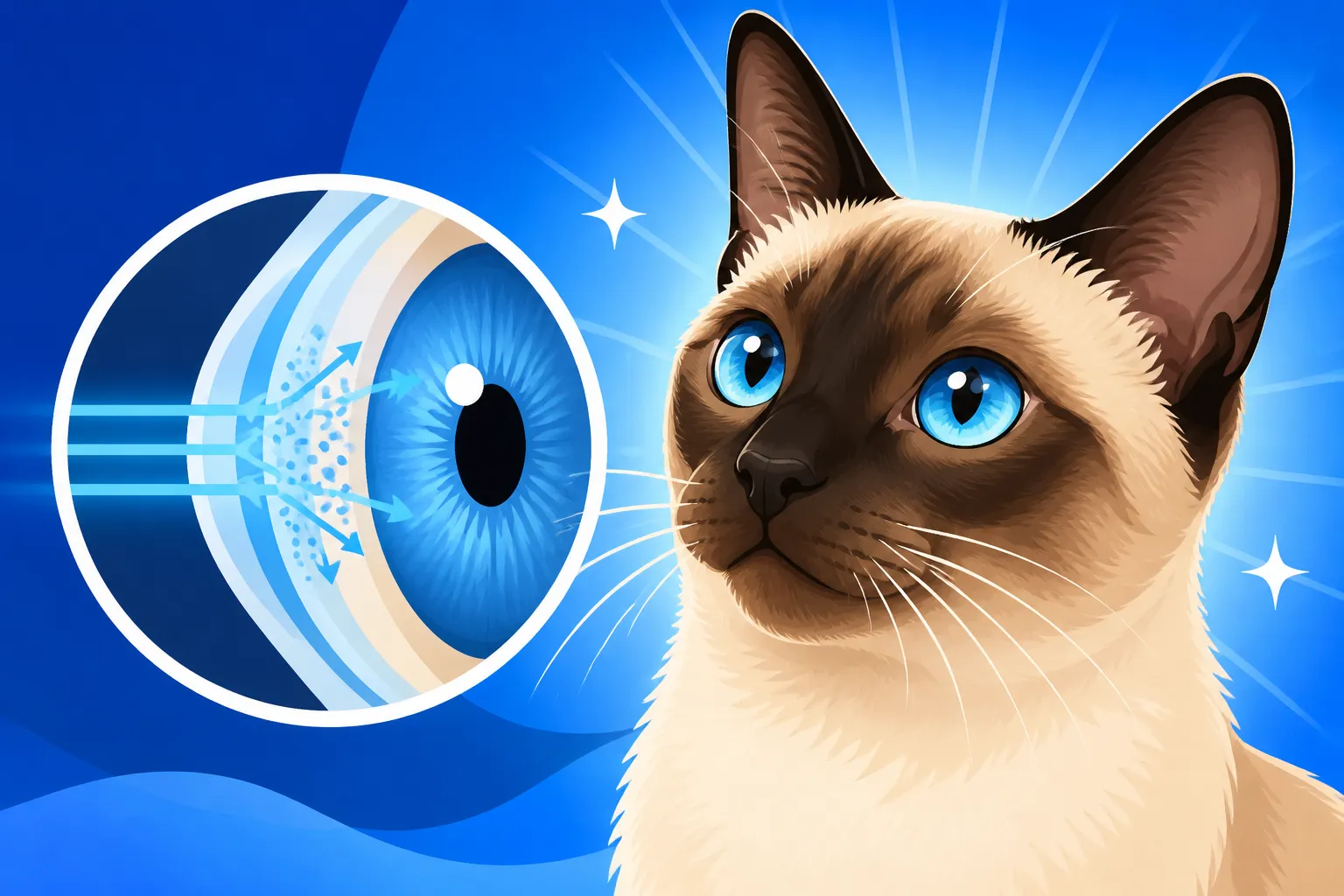
The reason we perceive Siamese cat eyes as blue lies in a process called Rayleigh scattering, the same phenomenon that makes the sky appear blue. In the absence of melanin in the iris, the stromal layer (the connective tissue layer) of the eye is largely transparent. When light enters the eye, it passes through this clear stroma. The shorter, blue wavelengths of light are scattered more effectively by the microscopic fibers and particles within this transparent tissue than the longer, red and yellow wavelengths. This scattering causes the blue light to be reflected back out, making the eyes appear blue to our perception.
Additionally, cats, including Siamese cats, possess a special reflective layer behind the retina called the tapetum lucidum. This layer enhances their night vision by reflecting light back through the retina, giving the photoreceptor cells a second chance to absorb the light. While the tapetum lucidum is primarily for vision enhancement, its reflective properties can influence how light is perceived, especially in photos where the eyes might seem to "glow" or appear red due to camera flash. It's an intricate dance of light and structure that creates that unmistakable blue hue. This also explains Why a Siamese Cat's Eyes Look Red in Photos.
The Absence of Other Pigments
To really drive home why Siamese cat eyes are blue, it’s important to understand that blue is not a pigment. Unlike green or yellow eyes, which contain varying amounts of yellow lipochrome pigment (in addition to some melanin), blue eyes are simply a reflection of light where pigment is absent. If there were even a small amount of melanin or other pigments present in the iris, the eyes would appear green, yellow, or amber, depending on the concentration and type of pigment.
Because the temperature-sensitive tyrosinase in Siamese cats is so inefficient at warmer body temperatures, it fails to produce any significant amount of melanin in the iris. This complete lack of pigment is what ensures that the eyes are always blue. It’s a clean slate, allowing the structural properties of the eye to scatter blue light. This consistent absence of pigment means that no matter if your Siamese is a Seal Point, Blue Point, Chocolate Point, or Lilac Point, their eyes will always be that signature shade of blue. It's a hallmark of the breed, directly stemming from their unique genetic heritage.
The Visual Connection to Other Siamese Traits
The colorpoint gene isn't just responsible for the Siamese cat's striking blue eyes and elegant point coloration; it's also intricately linked to some other physical characteristics that many Siamese cats exhibit. These additional traits, such as crossed eyes and nystagmus, are less about pigment and more about how the same genetic mutation affects the development of the visual system itself. It's a fascinating example of pleiotropy, where one gene influences multiple, seemingly unrelated traits.
Crossed Eyes and Nystagmus Link
One of the lesser-known but historically common traits associated with the Siamese colorpoint gene is strabismus, more commonly known as crossed eyes. This trait, along with nystagmus (a rapid, involuntary oscillation of the eyeballs), is often connected to the same genetic mutation that gives them their unique coloring. The cs allele, which affects melanin production, also has an impact on the development of the optic nerve pathways in the brain. In many Siamese cats, the optic nerves, which carry visual information from the eyes to the brain, are partially misrouted.
Normally, visual information from each eye crosses over to the opposite side of the brain, and some pathways stay on the same side. In Siamese cats with this misrouting, more nerve fibers cross over than usual. To compensate for this altered wiring and to achieve proper depth perception, their brains often adapt by causing the eyes to turn inward, resulting in the characteristic crossed-eye appearance. Nystagmus, a rhythmic eye movement, can also arise from these same neurological quirks, as the eyes try to stabilize their gaze. While once very common, Why a Siamese Cat's Eyes Cross and even What Nystagmus Looks Like in a Siamese Cat are traits that breeders have largely worked to minimize over the years, but they remain a fascinating legacy of their unique genetics.
The Paradox of a Siamese Cat's Vision
Despite the intriguing developmental anomalies in their visual pathways, the vast majority of Siamese cats actually have excellent vision. It might seem like a paradox that an animal with misrouted optic nerves and sometimes crossed eyes can see perfectly well, but their brains are remarkably adaptive. They learn to interpret the visual information received through these altered pathways, effectively compensating for the unusual wiring.
For an owner, this means there's generally no need to worry that your Siamese cat is struggling to see the world around them. While the crossed eyes or slight nystagmus might look a little unusual to us, they rarely impede a Siamese cat's ability to hunt, play, or navigate their environment with grace and precision. Their keen intelligence, combined with their adaptable brains, ensures that their unique genetic makeup doesn't compromise their quality of life. In fact, many people find these traits, particularly the crossed eyes, to add to the charming and distinct personality of the Siamese.
What This Means for Siamese Cat Owners
Understanding the "why" behind your Siamese cat's blue eyes isn't just a fun fact; it helps you appreciate the profound genetic uniqueness of your feline companion. It also offers reassurance about the consistency of certain traits and gives you insight into what to expect as your cat grows and changes, and what will always remain the same.
Point Coloration and Eye Color Consistency
One of the most reassuring aspects for Siamese cat owners is the absolute consistency of their eye color. No matter which of the beautiful point colors your Siamese cat displays – whether it's the rich Seal Point, the frosty Blue Point, the warm Chocolate Point, or the delicate Lilac Point – their eyes will always be blue. This is because the mechanism that prevents pigment from forming in the iris is universal across all traditional Siamese point variations. The specific shade of brown, grey, or cream on their body points comes from subtle variations in the amount and type of melanin that does manage to be produced at cooler temperatures. However, for the eyes, the warmth is constant enough that the pigment production is always inhibited to the same degree, resulting in that consistent blue.
This is a defining characteristic of the breed, so much so that any cat presented as a purebred Siamese without blue eyes would immediately raise questions about its lineage. The blue eyes are as fundamental to a Siamese cat's identity as their distinctive vocalizations or their sleek, athletic build. It's a genetic promise that their piercing blue gaze will always be there, a direct link to the Which Gene Makes a Siamese Cat's Points.
The Unchanging Beauty of Blue Eyes
Unlike their coat, which can darken over time with age or exposure to cooler temperatures, the blue color of a Siamese cat's eyes will remain remarkably constant throughout their lives. While the intensity of the blue might appear slightly different in various lighting conditions, the underlying lack of pigment ensures that the eyes always reflect that striking hue. This means that from a playful kitten to a dignified senior, your Siamese will always possess those captivating blue windows to their soul.
This unchanging beauty is part of what makes the breed so special. It's a constant amidst the subtle shifts in their coat color and the natural progression of aging. Knowing the intricate science behind it – the temperature-sensitive enzyme, the lack of melanin, and the magic of Rayleigh scattering – only deepens the appreciation for this stunning feature. So next time you find yourself lost in your Siamese cat's gaze, take a moment to marvel at the complex genetic ballet that makes those brilliant blue eyes possible, a truly unique aspect of The Fifteen to Twenty Years a Siamese Cat Gets.
Disclaimer
This article is for general informational purposes only and does not constitute professional advice. Laws, prices and regulations vary by location and change over time. Consult a qualified professional for guidance on your specific situation.