Which Breeds the Siamese Cat Helped Create
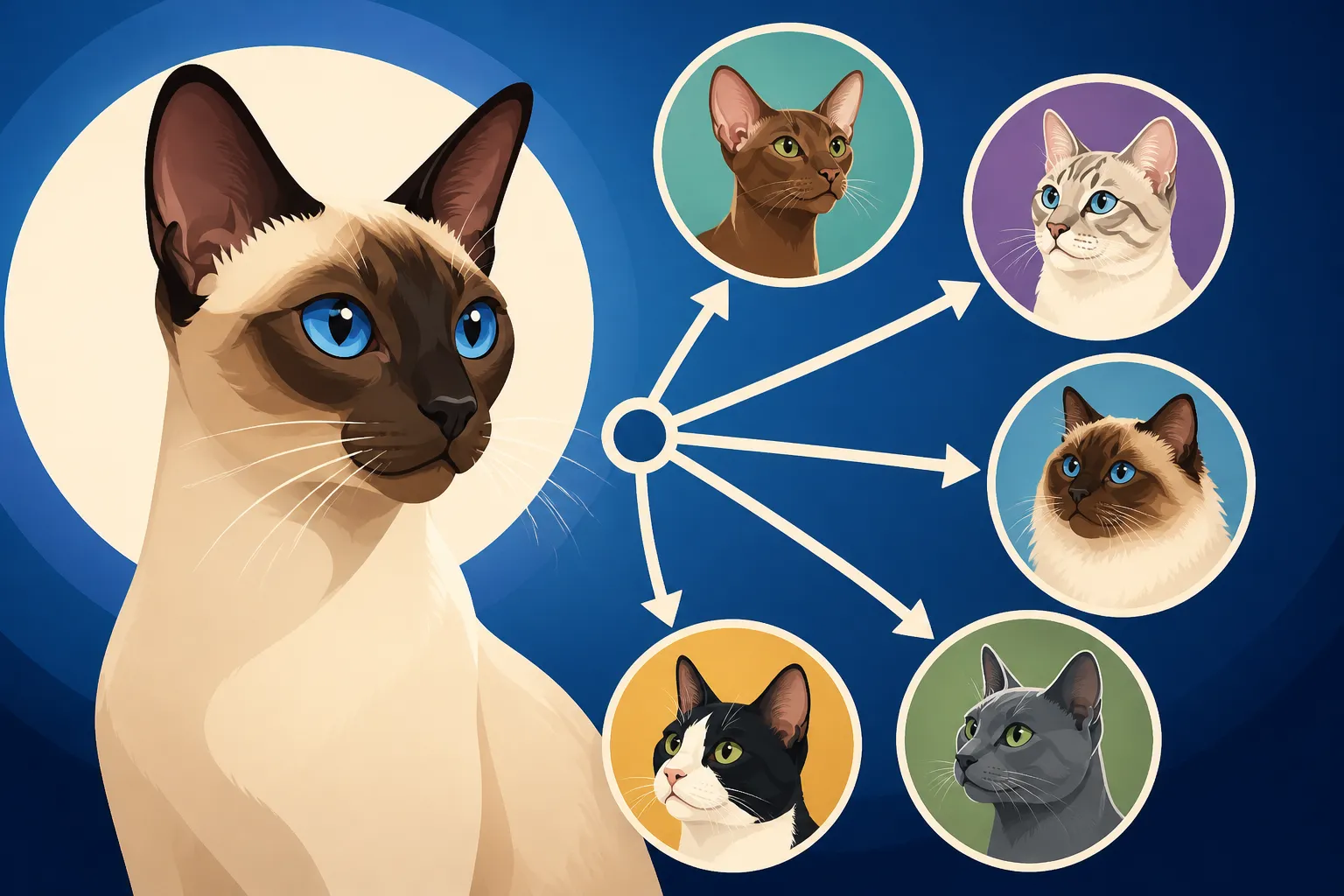
A Siamese cat’s influence reaches well beyond the familiar color-pointed breed. Crosses involving Siamese cats helped establish several recognizable breeds, including the Balinese, Oriental Shorthair, Tonkinese, and Colorpoint Shorthair. But “helped create” can mean different things: some breeds came from deliberate crosses, while others were developed by selecting for a trait that appeared in Siamese ancestry.
What it means for a breed to come from Siamese cats
Breed creation is a process, not a single cross
A breed rarely begins with one planned pairing and immediately becomes a distinct, consistent population. Breeders may cross cats with different backgrounds to introduce a particular coat, pattern, body type, or trait. They then select offspring with the features they want and continue breeding those cats over generations. A breed may be recognized only after those characteristics become predictable.
That matters when tracing Siamese influence. A breed can have Siamese cats in its foundation without looking exactly like a Siamese or behaving just like one. Conversely, a cat can share the Siamese color-point pattern without having recent Siamese ancestry. Appearance alone doesn’t tell the full story.
The phrase “Siamese-derived breed” can therefore cover several kinds of connection: a breed developed by crossing Siamese cats with another breed, one shaped by selecting a Siamese trait, or one whose early breeding program used Siamese cats among several contributors. Those are related histories, but they are not interchangeable.
The color-point gene traveled farther than the breed name
Siamese cats are well known for color points: darker fur on cooler parts of the body, such as the face, ears, legs, and tail, against a lighter body. The pattern is associated with a temperature-sensitive form of the pigment-producing enzyme tyrosinase. That genetic feature became important in breeding programs because it could be introduced into other cat populations through crosses.
But a color-point pattern does not automatically make a cat a Siamese. Breed identity also involves ancestry, a breed standard, and the rules of the registry concerned. Some registries classify certain color-pointed cats as Siamese; others recognize a separate breed or color division. For a deeper look at that distinction, see Which Breeds Came Out of the Siamese Cat.
This is one reason the family tree can seem confusing. A breed may carry a Siamese-associated color pattern while having a different build, coat length, or accepted color range. And a breed may have been shaped by Siamese crosses even if today’s cats don’t all look like the cats used in its early development.
Foundation history and present-day breeds are not the same thing
When people ask which breeds the Siamese “created,” they often want a simple list. The most useful answer is a list with context: some connections are direct and well known, while others are more complicated or indirect.
The table below gives a quick comparison. It describes broad historical relationships, not a guarantee that every individual cat in a breed has the same ancestry.
| Breed | General connection to Siamese cats | What became distinctive |
|---|---|---|
| Balinese | Longhaired cats appeared in Siamese breeding lines and were selected as a separate type | A semi-long coat with Siamese-style points |
| Oriental Shorthair | Developed using Siamese cats and other breeds to broaden coat colors and patterns | A Siamese-like outline with a wider range of coat colors and patterns |
| Oriental Longhair | Developed within the Oriental family, with longhair ancestry selected alongside Oriental traits | Oriental type with a longer coat |
| Colorpoint Shorthair | Developed through Siamese crosses with other cats, including American Shorthairs | Siamese type in additional point colors |
| Tonkinese | Developed from Siamese and Burmese ancestry | A medium build and coat colors often described as intermediate between the parent types |
| Snowshoe | Developed using Siamese cats and bicolor American Shorthairs | Pointed coloring combined with white feet and facial markings |
| Havana Brown | Its development included Siamese cats among the foundation crosses | A solid brown coat and a distinct breed type |
| Burmese | Early breeding included a cat crossed with Siamese cats, though the breed has its own distinct history | A compact, muscular cat with a short, close coat |
Breeds with a close Siamese connection
Balinese cats came from longhaired Siamese lines
The Balinese is the longhaired counterpart most closely associated with the Siamese. Longhair kittens sometimes appeared in Siamese breeding lines, and breeders who valued their flowing coats began developing them as a distinct type. The result kept the familiar pointed coloring and much of the Siamese outline, while adding a longer, silky coat.
“Longhaired” can be a little misleading if you picture a very full, dense coat. Balinese coats are generally described as semi-long, and they often lack the thick undercoat seen in some other longhaired breeds. That doesn’t mean grooming is unnecessary, but the coat may behave differently from the dense, easily matted fur of some cats. Breed history and day-to-day grooming needs are separate questions.
Balinese and Siamese cats are closely related, but they are not simply interchangeable names. The Balinese has its own breed identity, and registries may set out separate standards for coat length and appearance. If you’re comparing the two, How a Siamese Cat Differs From a Balinese offers a focused look at the distinctions.
Oriental Shorthairs broadened the Siamese look
The Oriental Shorthair was developed from Siamese-type cats and other cats, with the goal of producing a wider range of coat colors and patterns while retaining a similar elegant outline. Where the Siamese is strongly associated with point coloring, Orientals can come in many more colors and patterns, depending on the breed standard and registry.
This is a good example of how “Siamese influence” doesn’t mean “a Siamese in a different color.” Breeders shaped a separate breed with its own permitted appearance. The Oriental Shorthair may share features such as a slender body, large ears, and a wedge-shaped head, but it is recognized as a distinct breed in systems that register it separately. For details on those differences, see How a Siamese Cat Differs From an Oriental Shorthair.
A longhaired counterpart also developed within the Oriental family. The Oriental Longhair shares the family’s general type but has a longer coat. Names and classification can vary among registries, so it’s worth checking the specific registry’s terminology rather than assuming every organization uses the same label.
Colorpoint Shorthairs expanded the range of Siamese points
The Colorpoint Shorthair was developed to preserve a Siamese-style appearance while adding point colors beyond the limited set accepted for Siamese in some registries. Crosses with other cats helped introduce those additional colors. The aim was not simply to produce a pointed cat, but to establish a recognizable type under its own classification.
This can create a common point of confusion: the same-looking cat might be classified differently depending on its color and the registry’s rules. In some systems, a cat with a particular point color may be registered as a Colorpoint Shorthair rather than a Siamese. In others, accepted colors may differ. When pedigree or registration matters, the registry’s standard is more useful than a casual label based on appearance.
For anyone choosing between a Siamese and a related breed, compare more than coat color. Ask about the cat’s ancestry, typical activity level, grooming needs, and health history. If you’re preparing for a new cat, a general supplies retailer such as Chewy may be one place to look for basics like a carrier, litter box, or scratching post, but those purchases won’t tell you how the cat was bred or what care it needs.
Breeds shaped by Siamese and other ancestry
Tonkinese cats combine Siamese and Burmese roots
The Tonkinese developed from Siamese and Burmese ancestry. Its history is often described through cats with traits between the two parent types, though modern Tonkinese breeding follows its own standards and breeding practices. The breed is not simply a half-Siamese, half-Burmese cross in every individual case; established breeds become more consistent through generations of planned selection.
Tonkinese coats are commonly associated with three broad patterns: pointed, mink, and solid. These patterns reflect differences in how pigment appears across the coat, and the mink pattern is often described as visually intermediate between classic Siamese points and the more even coloring associated with Burmese cats. Exact terminology and accepted colors depend on the registry.
The comparison can be useful for prospective owners who like Siamese cats but want to understand related temperaments and appearances. No breed description predicts an individual cat perfectly, though. Meet the cat if possible, ask how it responds to people and other animals, and learn about its health and socialization rather than choosing on ancestry alone. See How a Siamese Cat Differs From a Tonkinese for a more direct breed comparison.
Snowshoe cats combine points with white markings
Snowshoe cats were developed by crossing Siamese cats with bicolor American Shorthairs. Their appearance combines pointed coloring with white markings, especially on the feet, which inspired the breed’s name. The white pattern can vary from cat to cat, so not every Snowshoe has identical markings.
This breed illustrates why a breed’s name and appearance don’t always explain its full ancestry. The Siamese contribution is associated with the pointed coloring and parts of the overall type, while the bicolor contribution helped establish the white markings. Breeding for a particular pattern can be challenging because markings may not appear evenly or predictably in every kitten.
If you’re considering a Snowshoe, look at the individual cat rather than expecting a precise mask, white blaze, or set of “snowshoe” feet. Practical preparations still come down to the cat in front of you: its size, activity, coat care, and comfort with handling. Chewy or another pet-supply retailer can help with ordinary items such as food bowls and toys, but it’s sensible to ask the cat’s breeder, rescue, or veterinarian about diet and health needs.
Havana Brown and Burmese histories involve Siamese crosses
The Havana Brown’s development included Siamese cats among foundation crosses, alongside other cats selected to establish the breed’s distinctive solid brown coat. Its history is not simply a case of taking a Siamese and changing its color. Breeders aimed for a separate, consistent type, and the breed’s identity depends on more than coat shade.
The Burmese has a more complicated relationship to Siamese ancestry. In the breed’s early development, an imported cat known as Wong Mau was crossed with Siamese cats. That history contributed to the foundation of Burmese breeding, but Burmese cats became a distinct breed with their own characteristics and standards. It would be inaccurate to say that today’s Burmese are just Siamese cats with a different coat.
These examples are useful reminders that breed histories can overlap without making the breeds equivalent. Historical crosses help explain where certain traits may have entered a breeding program, but they do not mean that every modern cat in that breed has a recent Siamese parent or the same physical or behavioral profile.
How to use Siamese breed history when choosing a cat
Separate ancestry from appearance and temperament
A pointed coat may suggest a link to Siamese-associated genetics, but it cannot confirm a cat’s breed. Likewise, a slender build, large ears, or talkative personality does not establish a pedigree. If a cat’s breed identity is important to you, ask for registration documents and a clear explanation of the lineage rather than relying on photos or a seller’s shorthand.
Temperament deserves the same care. Siamese cats are often described as social and vocal, and some related breeds can also be highly interactive. Still, individual cats vary. A kitten raised in a busy home may respond differently from one with limited early social contact; an adult rescue may have a well-developed personality that you can observe before adopting.
If you are comparing breed types, How the Siamese Cat Differs From an Oriental Shorthair, How a Siamese Cat Differs From a Balinese, and How a Siamese Cat Differs From a Tonkinese can help clarify the distinctions without treating all related breeds as one. For wider background on the family tree, see The Breeds a Siamese Cat Founded.
Ask specific questions about the cat’s background
Whether you’re speaking with a breeder or rescue, ask what is known about the cat’s parents and close relatives. A responsible source should be willing to explain the cat’s history and provide the records it has. For a rescue, the previous home may be unknown; that uncertainty is normal, and it simply means you should base decisions on the cat’s observed needs rather than assumptions about breed.
Ask about health history, veterinary care, behavior around other pets, and the cat’s comfort with grooming and handling. If a breeder describes a cat as Siamese, Oriental, or another related breed, ask which registry’s classification they use. This can help clear up differences in accepted colors or breed names.
It also helps to plan for the specific cat rather than the category. A longhaired cat may need more coat care than a shorthaired one. A very active cat may benefit from regular interactive play. Before bringing a cat home, you can gather everyday supplies from a local shop or a retailer such as Chewy, but consult the cat’s current caregiver or veterinarian if you’re unsure what food or care routine to continue.
Understand the limits of breed history
Breed histories can explain how breeders developed certain traits, but they cannot reliably tell you exactly what an individual cat will be like. Even littermates can differ in confidence, sociability, play style, and tolerance for change. The same is true of health: a breed connection may offer useful context, but it does not replace veterinary care or a review of the individual cat’s medical records.
It’s also worth distinguishing a breed’s origin from its current breeding practices. A historical cross may have helped establish a breed, while today’s registered cats are bred within a defined population. Breed standards and recognition can vary among cat registries, so a claim that sounds definitive in one setting may not match another organization’s classification.
The clearest answer is that Siamese cats helped shape several breeds, but they did not create every pointed cat or determine every modern breed on their own. The Balinese, Oriental Shorthair, Colorpoint Shorthair, and Tonkinese have especially clear connections; the Snowshoe, Havana Brown, and Burmese also have histories involving Siamese cats, each in a different way. Knowing the distinction makes it easier to appreciate the family tree without mistaking shared ancestry for identical cats.
Disclaimer
This article is for general informational purposes only and does not constitute professional advice. Laws, prices and regulations vary by location and change over time. Consult a qualified professional for guidance on your specific situation.