Why a Siamese Cat’s Eyes Cross
It's incredibly common for people new to the Siamese breed, or even seasoned owners, to notice that their beloved cat's eyes sometimes seem to drift inward, creating that distinctive "cross-eyed" look. This unique ocular trait can sometimes raise concerns about vision or general health, leading to questions about whether it's normal or if something needs to be done. This guide aims to thoroughly explain why a Siamese cat's eyes cross, delving into the fascinating genetics and neurology behind this charming characteristic, and reassuring you that for most Meezers, it's just part of their delightful charm.
Understanding the Unique Siamese Eye Structure
The hallmark crossed eyes of many Siamese cats aren't a random quirk; they're intrinsically linked to the very genes that give them their striking point coloration. It's a fascinating biological tapestry where coat color, eye color, and eye alignment are all woven together by the same genetic thread. Without understanding this connection, it's easy to misunderstand why their eyes appear the way they do.
The Genetics Behind the Cross
At the heart of a Siamese cat's distinctive features, including its crossed eyes and stunning blue eyes, lies a specific genetic mutation. This isn't just about surface-level appearance; it's about the intricate wiring of their visual system. The gene responsible for the Siamese cat's colorpoint pattern is a form of partial albinism, a temperature-sensitive enzyme that limits pigment production to the cooler extremities of the body – the "points." While this gene primarily affects melanin production, it also plays a significant, if less obvious, role in the development of the optic nerves.
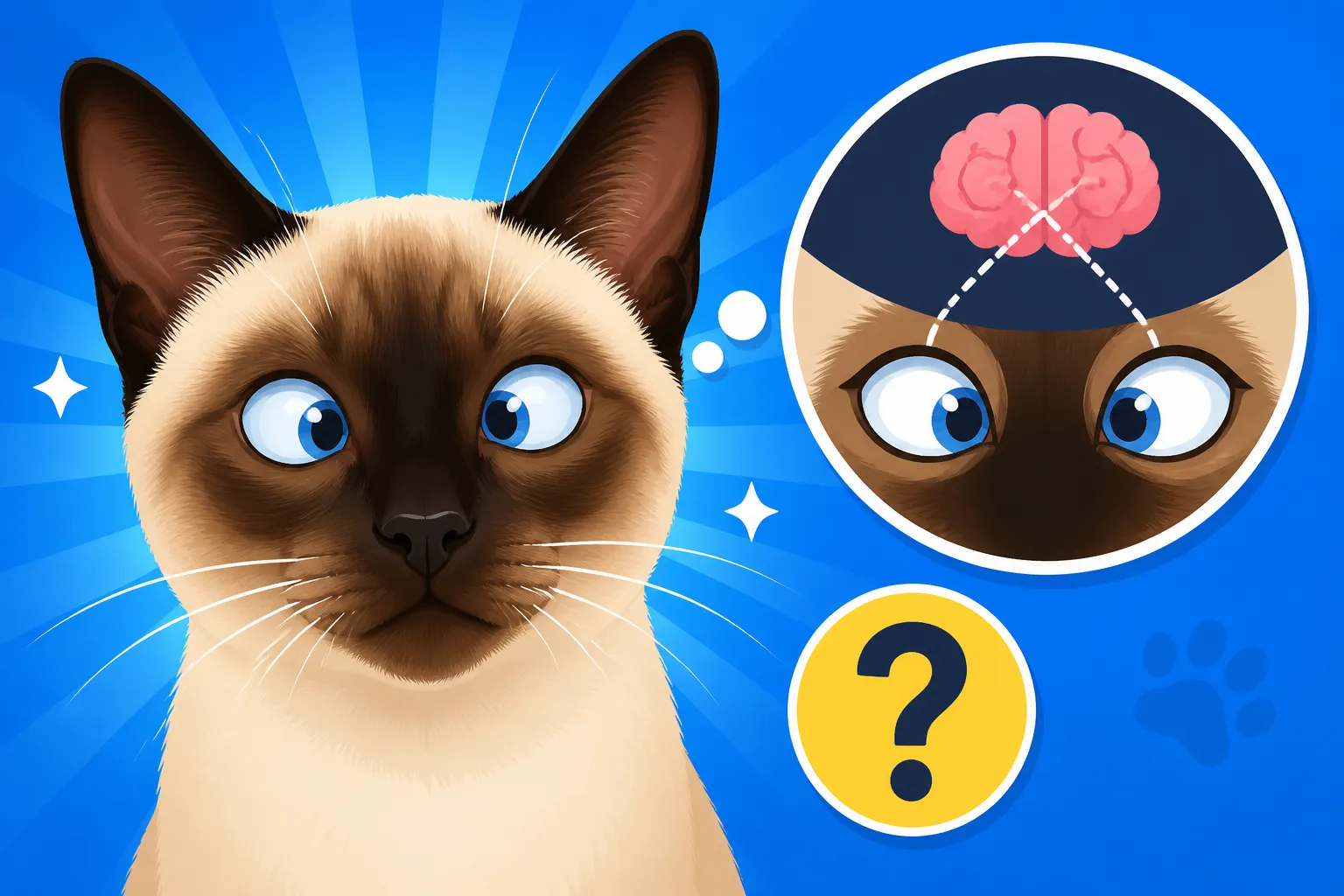
Imagine the complex pathways light takes from the eye to the brain for processing. In most mammals, including other cat breeds, the optic nerves from each eye cross over at a point called the optic chiasm, with some fibers going to one side of the brain and some to the other. This ensures that both sides of the brain receive visual information from both eyes, crucial for proper depth perception and a wide field of view. However, in Siamese cats, this partial albinism gene causes a slight miswiring at this critical junction. More optic nerve fibers from each eye cross over to the opposite side of the brain than would typically happen. This means their brain receives a slightly jumbled or distorted input compared to a non-Siamese cat. It's a subtle but profound difference in how their brains interpret the world they see.
How Nerve Pathways Cause the Strabismus
So, what does this misrouting of optic nerves actually do? Well, the brain is an incredibly adaptable organ, constantly striving to make sense of the information it receives. When the visual input is a bit off-kilter due to these misrouted nerves, the Siamese cat's brain has to work harder to align the images and prevent double vision. Its solution is quite elegant: it adjusts the position of the eyeballs themselves.
This adjustment manifests as convergent strabismus, which is the medical term for crossed eyes. Essentially, the muscles controlling the eyes pull them slightly inward to compensate for the abnormal nerve crossover. This inward turning helps the brain merge the two images more effectively, allowing the cat to perceive a single, coherent picture. It's a natural, built-in mechanism that allows them to function normally despite their unique wiring. Think of it less as a "defect" and more as an ingenious workaround that evolution has provided. For more on this fascinating trait, you might be interested in delving into why a Siamese cat's eyes turn inward. This physiological adaptation ensures that while their eyes may look crossed to us, they are actually seeing quite clearly, in their own Siamese way.
Is Crossed Eyes a Vision Problem for Siamese Cats?
When you see those beautiful blue eyes converging, it's natural to wonder if your Siamese is walking around in a blurry world or struggling to see clearly. The image of a human with crossed eyes often brings to mind impaired vision, but it's crucial to understand that a Siamese cat's experience with strabismus is quite different from what a human might experience. For the vast majority of Siamese cats, this characteristic is not a detriment to their daily lives.
The Impact on Depth Perception and Field of View
The main area where the unique optic nerve routing could theoretically impact a Siamese cat's vision is depth perception and, to some extent, their field of view. Binocular vision, where both eyes work together to create a single image with depth, relies on precise alignment and brain processing. Because more optic nerves cross over to the opposite side of the brain than normal, the brain receives slightly different signals from each eye. Without the compensatory crossing of the eyes, a Siamese cat might struggle more with depth perception, making things like judging distances for jumps or tracking fast-moving toys a bit trickier.
However, the key here is the brain's compensation. By crossing their eyes, the Siamese cat's brain effectively "realigns" the visual input, allowing them to achieve a functional level of binocular vision. While their depth perception might not be identical to a non-Siamese cat, it is certainly sufficient for them to lead full, active lives. They are not bumping into furniture or constantly misjudging jumps. In fact, many Siamese owners find their cats to be incredibly agile and coordinated, proving that their vision, while unique, is perfectly adequate. It's important to differentiate this natural, inherited condition from other causes of strabismus which can indeed be problematic for a cat. A comprehensive article on whether crossed eyes hurt a Siamese cat further clarifies this distinction.
How Siamese Cats Compensate for Their Vision
Cats are masters of adaptation, and Siamese cats with crossed eyes are no exception. They develop a suite of behavioral strategies that allow them to navigate their world with remarkable ease. Firstly, they don't solely rely on their eyes for visual information. Cats have an incredible array of senses. Their highly sensitive whiskers, or vibrissae, provide crucial information about their immediate surroundings, detecting air currents and the proximity of objects. Their acute hearing allows them to pinpoint prey or obstacles even in darkness, and their keen sense of smell helps them map out their territory and find familiar pathways.
When it comes to pure vision, Siamese cats often use subtle head movements to gain different perspectives, essentially "scanning" an area to gather more visual data. They quickly learn the layout of their environment, memorizing pathways, furniture arrangements, and the location of their food bowls and litter boxes. This spatial memory is incredibly strong. If you have a Siamese with crossed eyes, you might notice they're exceptionally good at navigating familiar spaces, even in low light. Any initial minor difficulties with depth perception or tracking are quickly overcome as they learn to combine their visual input with other sensory information. It's truly a testament to their intelligence and resilience that they adapt so seamlessly, making their crossed eyes a charming trait rather than a handicap. This adaptability is echoed in discussions about how a blind Siamese cat manages, showing just how resourceful felines can be when it comes to vision challenges.
The Historical Perspective: Breeding and Standards
The story of the Siamese cat's crossed eyes is not just a biological one; it's also deeply intertwined with the history of the breed itself and the ever-evolving standards set by cat fanciers. What was once a universally accepted, even celebrated, trait has undergone significant changes in how it's viewed and bred for over the decades.
The Origin of Crossed Eyes in the Breed
When Siamese cats first arrived in the Western world from their native Siam (modern-day Thailand) in the late 19th century, crossed eyes were a common and defining characteristic. These early imports, often referred to as "Traditional" or "Applehead" Siamese, almost universally exhibited the convergent strabismus. Far from being seen as a flaw, it was often considered part of their exotic charm, adding to their mysterious allure. In fact, ancient legends from Siam frequently depicted these cats with physical quirks. One popular legend tells of Siamese cats guarding royal chalices, their tails kinking from gripping them tightly and their eyes crossing from staring intently at the precious objects. This legend, though fanciful, highlights how deeply ingrained these traits were in the perception of the breed.
These early Siamese cats captivated audiences at cat shows with their striking appearance, vocal personalities, and unique eye alignment. The initial breed standards often simply noted the presence of crossed eyes without penalizing it, acknowledging it as a natural part of their genetic makeup. It was simply how a Siamese cat looked, a reflection of their distinct heritage that came from Siam, not Thailand. Many photographs and illustrations from the early 20th century clearly show these beautiful felines with eyes that converged, cementing it as an iconic feature of the breed's initial presentation to the world.
Modern Breeding Practices and the Decline of the Trait
As the Siamese breed gained popularity and formal cat registries like the Cat Fanciers' Association (CFA) and The International Cat Association (TICA) began to establish more rigid breed standards, attitudes towards certain physical traits started to shift. The original, more robust "Applehead" Siamese began to give way to a preference for a more refined, elongated, and elegant "Wedge" head type. Along with this aesthetic evolution came a desire for what was considered "perfect" ocular alignment.
Breeders, driven by the evolving show ring standards, began actively selecting against the crossed-eye trait. The goal was to produce Siamese cats with perfectly straight eyes, believing this represented a more "ideal" and refined specimen. Over generations of selective breeding, the incidence of pronounced strabismus in show-line Siamese cats significantly decreased. Today, while you might still encounter a Siamese with slightly convergent eyes, it's far less common in cats bred to modern show standards than it was historically. Many modern breed standards explicitly state that crossed eyes are a fault or a disqualifying trait in the show ring, effectively making it undesirable for championship cats. However, it's worth noting that the genetic predisposition for crossed eyes still exists within the breed's gene pool, and occasionally, a kitten with perfectly aligned parents might still exhibit the trait. This ongoing discussion about whether crossed eyes are still bred out of Siamese cats continues to shape the breed's appearance. For a deeper understanding of current expectations, exploring what a Siamese cat looks like by the standard can be quite illuminating.
Recognizing and Diagnosing Strabismus
Understanding what constitutes "normal" for a Siamese cat's eyes versus something that might be concerning is important. While the charming crossed eyes are often benign, it’s always wise to be observant and know when a professional opinion from your veterinarian is needed.
What Normal and Crossed Eyes Look Like
A typical Siamese cat, even one without pronounced strabismus, often has very striking blue eyes that give them an intense, intelligent gaze. Their eye shape can vary slightly depending on the specific head type (e.g., more almond-shaped in modern wedges, rounder in appleheads), but the color is almost always a vibrant blue. When a Siamese cat has the characteristic crossed eyes, you’ll notice that one or both eyes appear to turn inward, towards the nose. This can range from a very subtle, almost imperceptible turn, to a more pronounced convergence where the pupils seem to point distinctly towards each other. It might be more noticeable when the cat is focusing intently on something nearby, or when they are tired or relaxed.
It's helpful to observe your cat in different situations and lighting. Sometimes, the angle of a photo or a particular expression can make the eyes appear more crossed than they truly are. A slight "squint" or inward drift that is consistent since kittenhood, especially if both eyes are affected, is generally indicative of the genetic strabismus common to the breed. The important thing is whether this appearance is constant or if it's a new development, which is where careful observation becomes crucial.
When to Consult a Vet About Your Cat's Eyes
While the inherited crossed eyes in Siamese cats are typically harmless and don't require medical intervention, there are certainly instances when a visit to the veterinarian is absolutely necessary. The primary concern is distinguishing between the benign, genetic strabismus and other, potentially serious, medical conditions that can also cause the eyes to cross or misalign.
If your Siamese cat develops crossed eyes suddenly, or if an existing mild strabismus suddenly becomes much more severe, this is a red flag. Sudden onset strabismus could indicate an underlying issue such as:
- Neurological Problems: Conditions affecting the brain or the nerves controlling eye movement, like inflammation, infection, or tumors.
- Trauma or Injury: A head injury or direct trauma to the eye socket can disrupt eye muscle function.
- Inner Ear Infections or Vestibular Disease: Problems with balance can sometimes manifest as eye movement abnormalities, including nystagmus (involuntary eye movements) or a head tilt accompanied by strabismus.
- Toxins: Exposure to certain toxins can also affect neurological function and eye coordination.
- Tumors Behind the Eye: A mass growing behind the eyeball can push it out of alignment.
During a veterinary visit for eye misalignment, your vet will perform a thorough physical examination, including a detailed ophthalmic exam to check the structures of the eye and a neurological assessment to evaluate nerve function. They might also recommend blood tests, imaging (like X-rays, ultrasound, or even an MRI if a neurological cause is suspected) to get a clearer picture of what's happening. Even if it turns out to be nothing serious, catching an issue early is always the best course of action. Having pet insurance, like a policy from Healthy Paws, can provide immense peace of mind, knowing that you're prepared for unexpected veterinary costs associated with diagnostic tests or treatments for any sudden eye issues. A good policy from Healthy Paws can help ensure you don't hesitate to seek professional advice when your cat's health is in question.
Living with a Cross-Eyed Siamese Cat
Welcoming a Siamese cat into your home, especially one with that charming cross-eyed gaze, means embracing their unique personality and physical traits. Living with a Meecer who has strabismus is rarely a challenge, but understanding their world from their perspective can help you provide the best environment.
Special Considerations for Their Environment
For most Siamese cats with genetic strabismus, no special environmental modifications are strictly necessary because they adapt so well. However, being mindful of a few things can enhance their comfort and confidence, especially if their strabismus is more pronounced. Consistency is key. Cats are creatures of habit, and this is even more true for those with unique visual processing. Try to keep furniture arrangements stable and avoid frequently moving essential items like food and water bowls, litter boxes, and favorite sleeping spots. This allows them to create a detailed mental map of their home, relying on spatial memory rather than solely on their eyes for every movement.
Providing clear pathways and avoiding clutter can also be beneficial, ensuring they don't unexpectedly bump into things. While many Siamese cats enjoy supervised outdoor time in a catio or on a leash, an indoor-only lifestyle is generally safer for all cats, and especially those with any slight visual differences. It eliminates potential hazards like fast-moving vehicles or territorial disputes with other animals, where quick visual assessments are critical. Remember that these cats are incredibly intelligent and resilient. They will find their way, and their other heightened senses will compensate beautifully. When you understand how a Siamese cat finds the litter box, you truly grasp their remarkable ability to navigate.
Debunking Myths and Celebrating Uniqueness
One of the most important aspects of living with a cross-eyed Siamese cat is to debunk any lingering myths or misconceptions about their condition. It's easy for people unfamiliar with the breed to assume that crossed eyes signify poor vision, pain, or even a lack of intelligence. Nothing could be further from the truth. For the vast majority of Siamese cats, their strabismus is simply a physiological variant, a charming genetic hallmark, and not a cause for concern or "correction." There's no need to feel that this trait needs to be "fixed" or that it diminishes their quality of life.
Instead, let's celebrate their uniqueness! A cross-eyed Siamese cat is often a distinctive and memorable companion. Their quirky gaze is part of their individual character, just like their demanding vocalizations or their sleek, athletic build. These cats are known for their strong personalities, their intelligence, and their deep bonds with their human families. Their visual adaptation is a testament to the marvels of nature, allowing them to thrive just as well as their straight-eyed counterparts. So, embrace that charming, slightly convergent gaze. It's a reminder of their ancient heritage and a truly endearing part of what makes a Siamese cat, well, a Siamese cat. Indeed, understanding the overall health and lifespan of the breed often puts these minor cosmetic variations into proper perspective.
| Feature | Typical Cat Vision | Crossed-Eye Siamese Cat Vision |
|---|---|---|
| Optic Nerve Routing | Normal crossover at optic chiasm (fibers distribute evenly) | More optic nerve fibers cross to the opposite side of the brain |
| Brain Compensation | Minimal muscle adjustment needed for clear vision | Eyes turn inward (strabismus) to help brain merge images and prevent double vision |
| Depth Perception | Excellent, relies heavily on binocular vision | Functional, achieved through eye crossing and sensory adaptation |
| Visual Field | Wide, with good overlap from both eyes | Can be slightly altered, but compensated by head movements and other senses |
| Impact on Life | No specific impact | Generally none; cats adapt fully and lead normal lives |
| Hereditary? | No (unless underlying medical cause) | Yes, directly linked to the colorpoint gene |
Disclaimer
The information provided in this article is for general informational purposes only and does not constitute veterinary advice. Always consult with a qualified veterinarian for any health concerns or before making any decisions related to your pet's care.