What the First Siamese Cat Standard Said
The first formal Siamese cat standard was not a timeless description of every cat from Siam. It was a show-breeding guide, shaped by the cats available to British fanciers and the preferences of the period. Understanding what it described—and what it left open—helps explain why the Siamese of early photographs can look different from the sleek show cats many people picture today.
What “the first Siamese cat standard” means
Early descriptions came before a settled standard
Siamese cats were being shown and described in Britain before breeders had a single, widely established written standard to guide their judging. Early show reports and breed accounts noted features such as the cats’ pointed coloring, blue eyes, and distinctive appearance. Those descriptions are useful historical clues, but they are not necessarily the same thing as an official standard with a consistent set of judging criteria.
That distinction matters because the word standard can refer to different things: a short description of the ideal cat, a list of traits for judges to assess, or an organization’s formal document. Accounts of the breed’s early history often point to the Siamese Cat Club, founded in Britain in 1901, and its early standard as a key step toward organized breed judging. The club’s standard is commonly dated to the early twentieth century.
Before that, cats could be praised as excellent examples of the breed without being measured against one universally applied checklist. A judge might value the same broad qualities as another judge—such as clear points and a graceful build—while disagreeing about how much emphasis to place on head shape, body proportions, or color.
The standard reflected a particular time and place
The first organized standard was created in a British show-breeding context. It was not a complete record of every type of Siamese cat living in Siam, nor was it a description of every cat that had traveled from there. It set out an ideal for breeders and exhibitors to work toward within the emerging fancy.
That ideal drew on a limited pool of cats available to British breeders. Early imported Siamese were uncommon, and the breed’s appearance was still being interpreted and refined by people who were establishing its place in the show world. The document therefore tells us as much about early British cat fancy as it does about the breed’s longer history in Southeast Asia.
For more background on the breed’s roots, see Where the Siamese Cat Comes From. It is also helpful to compare the early show ideal with What the Siamese Cat Standard Asks For, which explains how a breed standard functions as a judging guide rather than a complete account of a breed’s history.
What the early Siamese standard emphasized
A slim, graceful cat with a short coat
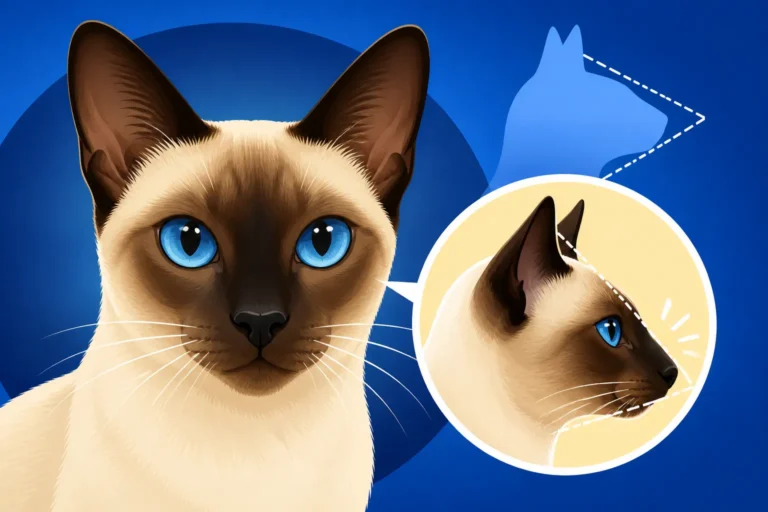
Early Siamese descriptions emphasized an elegant, fine-boned cat rather than a heavy or compact one. The ideal was graceful and active in appearance, with a body that looked lithe and balanced. The coat was expected to be short and close-lying, contributing to the cat’s neat outline rather than obscuring it with length or volume.
These broad features remain central to how many people recognize a Siamese. But words like graceful and slender leave room for interpretation. They do not specify one exact body shape, and different breeders can favor different degrees of refinement while still describing their cats as elegant.
That’s one reason old photographs can feel surprising. A cat may clearly have the pointed coat and familiar blue eyes, yet look sturdier or rounder than a modern show Siamese. A standard describes an ideal, but the actual cats in a breeding population vary—and the ideal can shift as breeders select for particular traits.
Blue eyes and contrasting points
The Siamese’s striking contrast was another defining feature: a lighter body with darker color on the face, ears, legs, and tail. The eyes were described as blue, a trait closely associated with the breed’s pointed coloring. These features helped distinguish the Siamese in the show ring and in public descriptions of the breed.
However, early standards and breed descriptions should not be read as if they used today’s exact terminology or color expectations. The range of accepted colors has changed across cat organizations and over time. Early attention was especially focused on the familiar seal-brown points, while later breeding and registry rules recognized additional colors and patterns in different ways.
The familiar points are produced by a temperature-sensitive form of pigment expression, so cooler areas of the body tend to become darker. For a deeper look at that process, see Why a Siamese Cat Has Dark Points. The standard, though, was concerned with what judges could see: the color pattern, its contrast, and how it contributed to the cat’s overall appearance.
| Feature | What early descriptions emphasized | Why it matters when reading old records |
|---|---|---|
| Body | Slim, fine-boned, and graceful | “Lithe” did not set one exact size or shape |
| Coat | Short and close-lying | Coat texture helped define the cat’s outline |
| Eyes | Blue | Eye color was a distinctive breed feature |
| Pattern | Pale body with darker points | The pattern was central to Siamese identity |
| Overall impression | Elegant and distinctive | Judges still had room to interpret the ideal |
What the first standard did not settle
It did not describe every Siamese cat
A breed standard is not a census. It does not tell us precisely what every Siamese looked like, and it cannot represent every cat from the breed’s place of origin. It selects traits that an organization considers desirable for breeding and showing.
That means a cat could be unmistakably Siamese yet differ from the show ideal in some detail. A broader head, a less dramatic profile, or a slightly different body proportion would not erase the cat’s identity. It might simply place the cat outside the preferences of a particular show standard.
This is especially important when looking at early photographs or historical descriptions. A picture may show a cat that seems unlike the modern wedge-headed Siamese, but the difference does not automatically mean the cat was not Siamese. It may reflect natural variation, the smaller breeding population of the time, or a show ideal that had not yet become as narrowly defined as later ones.
It did not freeze the breed’s appearance
Standards are revised, interpreted, and applied by people. Once breeders begin selecting cats that match a written ideal, the population can gradually shift toward the traits judges reward. Over time, those choices may affect head shape, body lines, and the overall look of a show-bred cat.
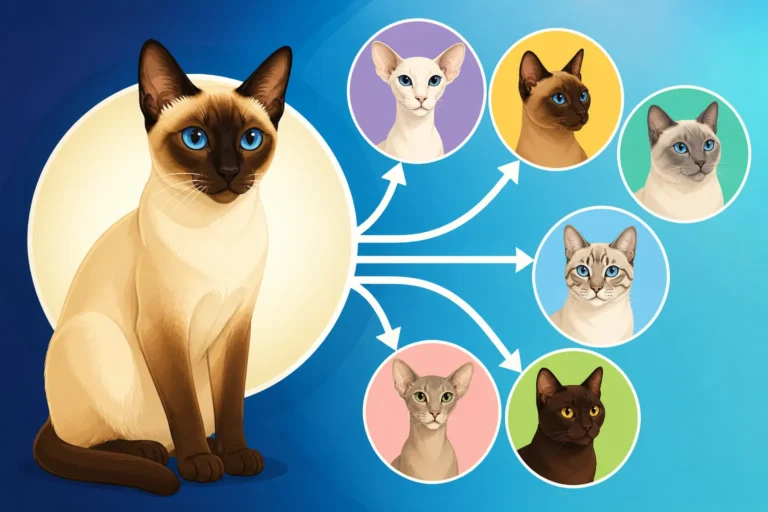
The standard itself is only one part of that process. Breeder preferences, the cats available for mating, and the priorities of different registries all influence how a breed develops. As a result, two cats both called Siamese may look noticeably different while coming from different breeding traditions.
The changing silhouette is explored in How the Siamese Cat's Head Changed Shape in Fifty Years and How the Applehead Siamese Cat Became the Wedge. Those changes are easier to understand when the first standard is seen as an early framework—not a promise that the breed’s appearance would remain unchanged.
How to read the early standard today
Treat it as a historical document, not a modern checklist
When reading about the first Siamese cat standard, keep three questions in mind: who created it, when it was used, and what purpose it served. A show standard was written to help people judge and breed cats according to an ideal. It was not intended to settle every question about the Siamese’s origin, health, temperament, or natural variation.
It also helps to separate the general features that have endured from the details that evolved. The pointed pattern, blue eyes, and short coat remain closely associated with the Siamese. The precise outline of the head and body, and the ways different organizations describe acceptable colors, have been shaped by later standards and breeding choices.
For a present-day comparison, What a Siamese Cat Looks Like by the Standard is a useful companion topic. Read it alongside early descriptions rather than treating either one as the only valid picture of the breed. The contrast reveals how the definition of an ideal show cat can change while the breed’s recognizable features persist.
Keep breed history separate from everyday care
A standard tells you how a cat may be judged in a show context; it does not tell you what that individual cat needs at home. A slender outline is not, by itself, proof that a cat is underweight, and a darker coat does not automatically indicate a health problem. For questions about weight, appetite, dental care, or changes in behavior, the cat’s health history and a veterinarian’s assessment matter more than a historical show description.
The same distinction applies to supplies. Someone reading about the breed might also be choosing food, litter, or grooming tools. Chewy may be one place an owner browses for everyday pet supplies, but a retailer’s product descriptions are not evidence about the history of the Siamese or the meaning of its standard. If ordering from Chewy, use the product information to compare practical details and ask a veterinarian about medical or nutritional concerns. A Siamese’s care needs come from the individual cat, not simply from a show ideal recorded more than a century ago.
The first Siamese standard is best understood as an early snapshot of organized breeding and judging: a description of the kind of cat British fanciers hoped to recognize and cultivate. It helped establish a shared show ideal, but it did not capture every Siamese cat, nor did it keep the breed’s appearance fixed. Read in that context, the standard is both a useful historical document and a starting point for understanding how the modern Siamese developed.
Disclaimer
This article is for general informational purposes only and does not constitute professional advice. Laws, prices and regulations vary by location and change over time. Consult a qualified professional for guidance on your specific situation.