Whether Old Style Siamese Cat Breeders Use the Thai Standard
If you are looking for an old-style Siamese kitten, a breeder’s reference to the Thai standard can be confusing. Some breeders use it as a guide to a moderate, traditional-looking cat; others breed registered Thai cats under a specific registry’s rules. This guide explains what the label usually means, how standards differ, and what to ask before choosing a breeder.
What breeders mean by old-style Siamese
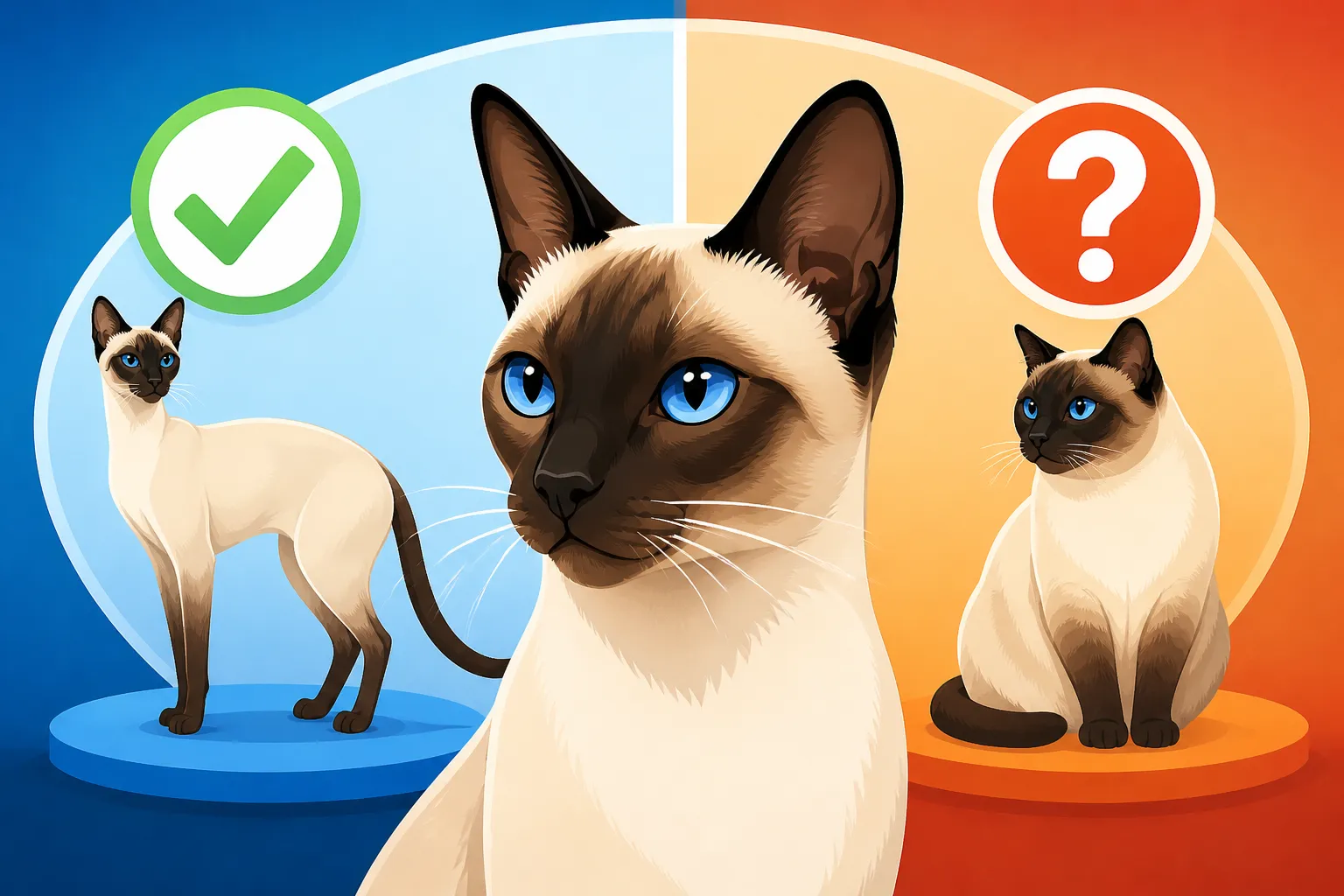
“Old-style Siamese” is generally a descriptive label rather than a universally defined breed name. Breeders may use it to distinguish cats with a more moderate body and head shape from the long, fine-boned, wedge-headed look associated with many modern show-line Siamese. The phrase can mean different things from one cattery to another, so it is worth asking what the breeder means by it.
Some breeders use “traditional Siamese” in a similar way. Others use “Applehead Siamese,” a familiar term for cats with rounder head shapes. Those labels do not automatically tell you which registry the cats are registered with, what standard the breeder follows, or how the cat’s ancestry is documented. The terms can describe appearance without establishing a separate, recognized breed.
Why a breeder might refer to the Thai standard
The Thai breed is associated with preserving a more moderate type of cat connected to the older appearance of the Siamese. A breeder who wants that look may use a Thai standard as a practical reference, especially when they feel that a contemporary Siamese standard rewards a more extreme wedge-shaped head or a more slender overall silhouette.
But using a standard as a reference is not the same as breeding registered Thai cats. A Siamese breeder may consult Thai descriptions of proportion, head shape, or body type while registering kittens as Siamese under another registry. Another breeder may register cats as Thai and follow the standard accepted by the registry they belong to. The distinction affects how you should interpret claims about breed, pedigree, and show eligibility.
For an overview of the distinction between the two names, see What the Thai Cat Is Next to a Siamese Cat. The histories and breed categories are related, but a shared history does not mean that every old-style Siamese is a Thai or that every Thai is registered as a Siamese.
What “old-style” does and does not tell you
The label can give you a rough idea of the breeder’s preferred appearance, but it is not a complete description. One breeder may mean a rounder head, a sturdier frame, and a less exaggerated profile. Another may use “old-style” simply to mean that their cats do not have the most extreme show-line features. Without a written description, the term leaves room for interpretation.
It also does not establish health, temperament, or ancestry. A cat can look moderate without having a documented pedigree, and a registered cat can have a moderate appearance while still being bred under a particular registry’s Siamese standard. If you are trying to understand the historical shift in appearance, How the Siamese Cat's Head Changed Shape in Fifty Years offers useful context. For a broader explanation of how the breed is described today, see What a Siamese Cat Looks Like by the Standard.
Do old-style Siamese breeders use the Thai standard
Sometimes, but not as a universal rule. There is no single practice followed by every breeder who advertises old-style Siamese cats. Some use a Thai standard informally to describe the type they aim for. Some register their cats as Thai and follow the rules of a registry that recognizes the Thai as a breed. Others breed registered Siamese cats and follow the Siamese standard of their chosen registry, even if their cats have a more moderate appearance.
The key question is not simply whether a breeder says “Thai standard.” It is how that standard relates to the cats being bred, their registration, and the breeder’s stated goals. A credible answer should be specific enough that you can understand what the breeder is doing rather than leaving you with a broad label.
Standards depend on the registry
Cat registries publish standards to describe the appearance and characteristics expected of cats entered in their shows. Those standards are not necessarily identical. A breeder who shows cats will usually work with the standard and registration rules of the registry where they exhibit. A breeder who does not show may still use a registry’s standard as a guide, but that does not make the cats showable under that registry’s rules.
This is why “the Thai standard” can be an imprecise phrase. Ask which registry’s standard the breeder means and whether the cats are actually registered as Thai or as Siamese. If you want to compare how registries treat the breed distinction, see Which Registries Recognize the Thai Separately From the Siamese Cat. You can also read What the Siamese Cat Standard Asks For to understand why a Siamese standard may not describe the same desired look as a breeder’s informal “old-style” goal.
A breeder should be able to explain the difference in plain language. For example, they might say, “Our cats are registered Siamese, and we prefer a moderate look,” or, “Our cats are registered as Thai under this registry.” Those statements give you something concrete to check. “We follow the Thai standard” without further detail does not.
A useful comparison of the labels
| Term used by breeder | What it may mean | What to verify |
|---|---|---|
| Old-style Siamese | A descriptive label for a more moderate or traditional-looking Siamese type | What physical traits the breeder means and how the cats are registered |
| Traditional Siamese | Often used to describe a less extreme appearance, but usage varies | Whether the term is informal or tied to a specific registry |
| Applehead Siamese | A common appearance-based label, often referring to a rounder head shape | Whether the cats have registry paperwork and what breed name appears on it |
| Thai | A breed designation in registries that recognize the Thai separately | Which registry recognizes the cats and what standard applies |
| Siamese | A registry-defined breed name with a standard that depends on the registry | The registry, pedigree, and whether the breeder shows or registers the cats |
The table is a starting point, not a substitute for documentation. If a breeder’s wording seems to promise a formal breed status, ask for the registration papers or the registry’s description of how the cats are classified. For background on the terminology, Whether the Traditional Siamese Cat Still Exists explains why familiar labels and formal breed categories are not always the same thing.
How to assess a breeder’s claims
You do not need to be a show judge to evaluate whether a breeder is being clear. You do need to separate three issues that are often blended together: the cat’s appearance, its registration, and the breeder’s breeding choices. A careful breeder should be willing to discuss all three without implying that one automatically proves the others.
If you are comparing two catteries, ask the same questions of both. That makes it easier to compare their answers rather than being swayed by a label or a polished description. A breeder who uses the phrase “old-style Siamese” should be able to explain what the phrase means in their program and whether it has any formal relationship to the Thai breed.
Questions worth asking
Start with the basics:
- How are the kittens registered? Ask for the breed name shown on the registration paperwork and the registry involved.
- Which standard do you follow? If the breeder mentions the Thai standard, ask which registry’s standard they mean.
- Are your cats registered as Thai or Siamese? This helps clarify whether “Thai” is being used as a formal breed designation or as a description of appearance.
- What does old-style mean in your breeding program? Ask the breeder to describe the traits they intentionally select for.
- Can I see the parents and their paperwork? A breeder should be able to explain how the adults relate to the claimed breed or type.
- Are your cats shown? If so, ask where they are shown and under what registration category. If they are not shown, ask how the breeder evaluates type.
Notice whether the answers are consistent. If a breeder says the cats are registered Siamese but also says they are Thai, ask them to explain the registration and how they use each term. There may be a reasonable explanation, such as “Thai-like” being used to describe appearance. But if the breeder avoids explaining the paperwork or suggests that a particular label guarantees quality, slow down and ask for clarification.
Look beyond a head shape
A rounder head or moderate body may be what draws you to an old-style cat, but appearance alone is not a measure of responsible breeding. Ask about veterinary care, socialization, the kittens’ living environment, and the breeder’s approach to matching kittens with homes. It is also sensible to discuss the parents’ health history and the screening practices relevant to the breeder’s lines.
Breed standards describe desired traits; they are not health certificates. A cat that fits a standard can still develop health problems, and a cat that does not match a show ideal can still be a healthy, well-cared-for companion. If health testing is important to your decision, ask what tests are appropriate for the family and what the results do and do not establish. How Healthy the Siamese Cat Actually Is provides broader context on the breed’s health, while What a Siamese Cat Breeder Should Have Screened can help you prepare more focused questions.
Choosing between a Thai and an old-style Siamese
For many pet homes, the most important factors are a healthy kitten, transparent records, thoughtful socialization, and a temperament that suits the household. Whether the cat is called Thai, old-style Siamese, or traditional Siamese may matter if you want a particular registry classification or hope to show the cat. If you mainly want a companion with a moderate appearance, the name alone may matter less than the breeder’s clarity and care.
Think about what you want before contacting breeders. If registration as a Thai is important to you, look for a breeder who can explain the registry classification and provide the relevant paperwork. If you want a Siamese with a less extreme appearance, ask Siamese breeders how they define “moderate” and how their cats are registered. If you are open to either, compare breeders on their practices rather than assuming one label is automatically more reliable.
When the formal breed distinction matters
A formal distinction matters if you plan to enter shows, want a specific breed on the pedigree, or are choosing a cat for a breeding program. In those cases, the applicable registry rules are central. Confirm directly with the registry that the cat’s registration category and pedigree meet your plans. Do not rely on a breeder’s informal use of “old-style” or “Thai-like” as proof of eligibility.
If your goal is simply to adopt a companion, a precise registry category may be less important, but you should still understand what you are being told. A responsible breeder should not present a descriptive term as formal registration if it is not. When in doubt, request the registration information and ask the registry to explain what the paperwork means.
When appearance matters more than the label
If what you love is the more moderate look, evaluate the actual cats. Meet the mother when possible, look at photographs of adult relatives, and ask how the kittens’ appearance may change as they mature. Kittens can look different from their adult relatives, and a breeder cannot promise an exact final appearance simply by applying a label.
A good conversation should leave you with a clear picture of the breeder’s goals: the type they aim for, the registry they use, and the limits of what they can guarantee. You should also feel comfortable asking practical questions about the kitten’s care and background. A breeder who takes time to explain the difference between type and registration is usually more helpful than one who relies on impressive-sounding terminology.
In short, some old-style Siamese breeders use the Thai standard as a reference, but there is no universal rule that they do. Others breed registered Thai cats, while many breed Siamese cats under a registry’s Siamese standard and simply prefer a more moderate look. Ask which registry and standard the breeder means, what breed name appears on the paperwork, and what “old-style” means in that specific breeding program.
Disclaimer
This article is for general informational purposes only and does not constitute professional advice. Laws, prices and regulations vary by location and change over time. Consult a qualified professional for guidance on your specific situation.