Which Cartoon Siamese Cats People Remember
A few animated cats have made the Siamese instantly recognizable to generations of viewers, but some of those memories are fond, some are uncomfortable, and a few characters are often misidentified. This guide looks at the best-known cartoon Siamese cats, what made them memorable, and how their screen portrayals compare with real cats and the culture around them.
The cartoon Siamese cats viewers remember most
Si and Am from Lady and the Tramp
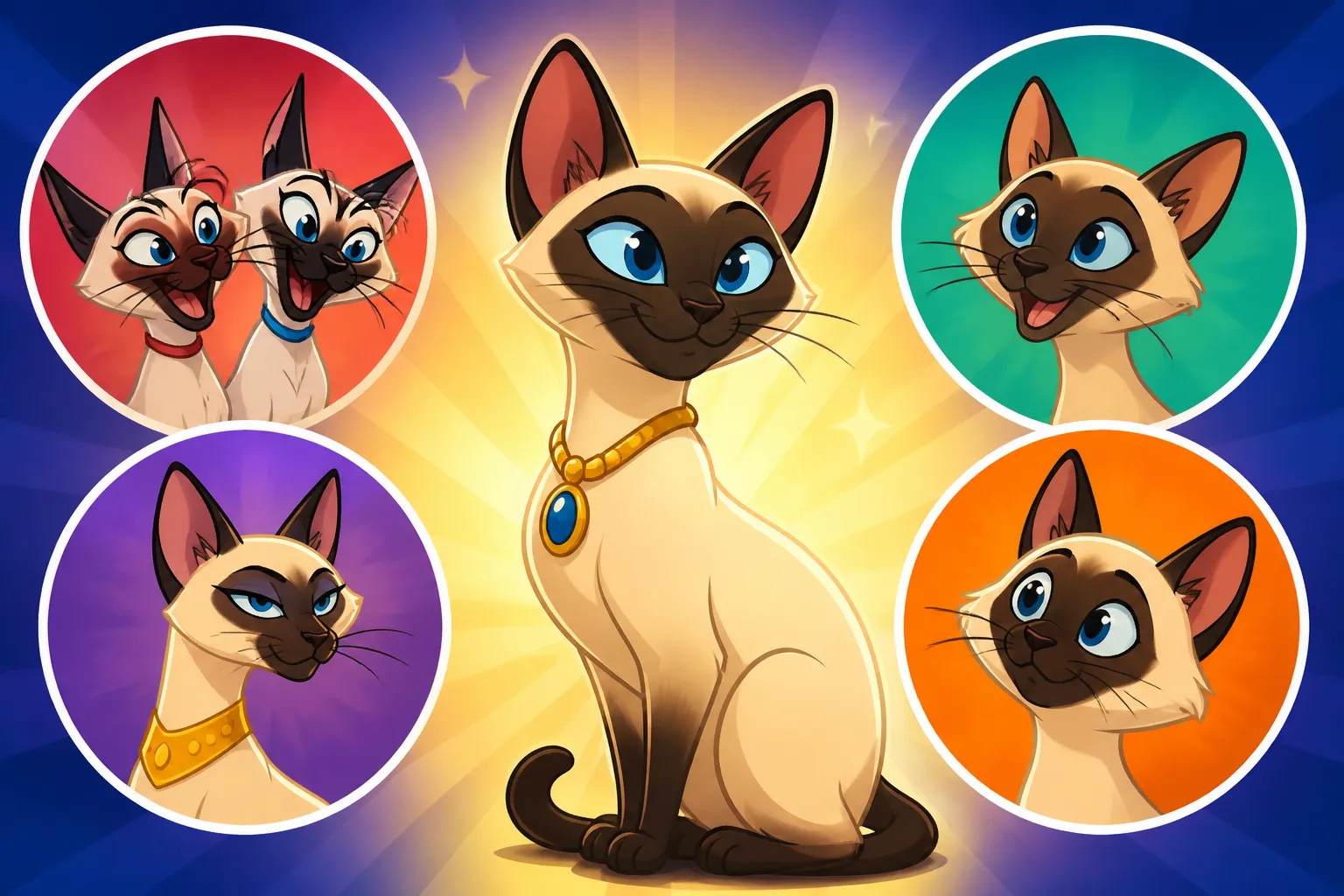
For many people, the first cartoon Siamese cats that come to mind are Si and Am, the troublemaking pair from Disney’s Lady and the Tramp. The 1955 film gives the cats a striking appearance, a memorable musical number, and a role in a scene where their mischief creates trouble for Lady. Their song, “We Are Siamese (If You Please),” helped make them recognizable well beyond the film itself.
That recognition came with a cost. Si and Am are framed as scheming intruders, and their exaggerated behavior draws on racial stereotypes that can make the scene uncomfortable for modern viewers. It is possible to remember the song and the characters’ place in animation history while also acknowledging that the portrayal relies on caricature. Nostalgia does not require pretending that every part of an old film has aged well.
The cats are memorable partly because the movie uses them to move the plot along: their actions lead to confusion and consequences for Lady. They are not developed as complicated characters with motives beyond causing trouble. That narrow role helped turn them into an instantly legible pair, but it also reinforced a familiar animated shortcut: a breed’s distinctive look becomes a visual signal for a personality type.
If you are wondering whether the characters are actually meant to be Siamese, Whether Classic Movie Cats Were Really Siamese looks more closely at their breed portrayal. The broader question of how movies have shaped public assumptions about the breed is explored in Whether the Siamese Cat Has a Bad Screen Reputation.
Sagwa from Sagwa, the Chinese Siamese Cat
Sagwa is a very different kind of animated Siamese. The central character in Sagwa, the Chinese Siamese Cat, she appears in a children’s series set in China and based on Amy Tan’s book of the same name. Rather than functioning mainly as a comic menace, Sagwa is part of a family and a community. The stories use her experiences to explore relationships, rules, mistakes, and everyday life.
That difference matters. A Siamese character can be more than a striking coat pattern or a dramatic voice. Sagwa’s identity as a cat is part of the show, but the series also gives her a setting and relationships that shape the stories. Viewers encounter her as a character with a point of view, not simply as a visual shorthand for “mischievous Siamese.”
The show is also a useful reminder that “cartoon Siamese cat” does not refer to one single style of portrayal. Si and Am are a famous film duo whose humor depends on trickery; Sagwa is the lead of a family-centered children’s series. Both are remembered, but for very different reasons. The history behind the breed’s name and origins is explored in Where the Siamese Cat Comes From, while What People Get Wrong About the Siamese Cat addresses common assumptions that can follow the breed from screen to real life.
Other cartoon cats often included in the conversation
When people list famous animated Siamese cats, they sometimes include characters whose breed is uncertain or whose appearance is being read from a few visual traits. A pointed coat can suggest a Siamese, but pointed coloration alone does not prove that a character is meant to represent the breed. Animation often simplifies markings, combines design features, or uses a stylized look without naming a precise breed.
Shun Gon from The Aristocats is one character who can enter this conversation because of his appearance and the film’s portrayal of him. But it is worth separating questions about breed identification from questions about cultural caricature. A character can be discussed as part of a film’s broader history of racialized depictions without treating every pointed cat in animation as a clearly defined Siamese.
The same caution applies when someone recalls a cat from a short, a television episode, or a movie watched decades ago. Memory often keeps the strongest details—the dark face, pale body, blue eyes, or distinctive voice—while losing the character’s name and the story around them. That is why lists of cartoon Siamese cats can differ, even when people are remembering the same era of animation.
| Character or portrayal | Where viewers may know it from | Why it is remembered | A useful point of context |
|---|---|---|---|
| Si and Am | Lady and the Tramp | Their musical scene and troublemaking role | The portrayal uses stereotypes that deserve acknowledgment |
| Sagwa | Sagwa, the Chinese Siamese Cat | She is the lead character in a family-centered series | Her stories give the Siamese character more context and agency |
| Shun Gon | The Aristocats | His musical scene and stylized design | Discuss the film’s cultural caricature separately from uncertain breed labels |
| Other pointed cartoon cats | Various animation | Their coloring can resemble a Siamese coat | Pointed markings by themselves do not confirm a character’s breed |
For a wider look at Siamese appearances across film, see Which Films Feature a Siamese Cat. It helps to distinguish a character’s actual role in a story from the way audiences may remember its coat or voice.
Why these characters stayed in viewers’ memories
A striking appearance is easy to recognize
Siamese cats have a distinctive color pattern: a lighter body with darker areas on the face, ears, legs, and tail. Animation can exaggerate those contrasts, making a cat easy to identify even in a quick scene. A character designer can communicate “Siamese-like” with only a few bold shapes and colors, especially when the audience already has a mental image of the breed.
The visual shorthand works particularly well in cartoons, where features are often simplified for clarity. A sharply outlined mask, bright eyes, and contrasting ears can remain legible on a small screen or in a busy scene. Those design choices can make a character memorable, but they can also encourage viewers to treat a real breed’s appearance as a complete personality description.
Real Siamese cats, of course, are individuals. Their looks do not tell you whether a particular cat is mischievous, affectionate, shy, or outgoing. What a Siamese Cat Looks Like by the Standard explains how breed descriptions focus on physical traits, while Why a Siamese Cat Has Blue Eyes covers another feature that often stands out in animated designs.
Music and voice make a character hard to forget
A song, a catchphrase, or a distinctive voice can lodge in memory long after the plot has faded. That is one reason the Lady and the Tramp cats remain such a frequent reference point. Their musical scene gives viewers a sound to associate with the characters, not just a particular color pattern.
But the screen persona is not a reliable guide to a real cat’s temperament. Siamese cats are often described as social and vocal, and some do seek frequent interaction with their people. That does not mean every Siamese will behave like a cartoon character or make noise constantly. A real cat’s behavior depends on its individual personality, health, environment, and experiences. For more on the gap between stereotype and everyday life, see What a Siamese Cat's Temperament Is Really Like.
It is also worth noticing how animation uses voices as a shortcut. A dramatic or unusually expressive voice can make a character seem more mischievous, demanding, or comic than its appearance alone would suggest. When people later describe Siamese cats as “talkative” because of an animated portrayal, they may be blending a real breed tendency with a performance designed for entertainment.
Repetition kept familiar characters in circulation
A memorable scene can be revisited through reruns, home viewing, family recommendations, and conversations about childhood favorites. People who have not watched a film recently may still remember its characters because someone else quotes a song or mentions a scene. A character becomes part of shared cultural memory, even for viewers who recall only a few details.
This repetition also explains why a portrayal can remain influential long after attitudes change. A familiar character is not automatically a fair or accurate one. Viewers can appreciate a film’s place in animation history while asking what assumptions it encouraged and who those assumptions affected. That kind of conversation adds context rather than erasing the memory.
Cartoon Siamese cats compared with real cats
Breed markings are not a personality profile
Animated Siamese cats are often designed to communicate a recognizable “type” at a glance. Real cats do not come with a script attached to their coat. Some are outgoing; others are reserved. Some enjoy being near people, while others prefer to choose when they interact. Even two cats from the same litter can have noticeably different habits.
If a cartoon made you curious about living with a Siamese, it helps to learn about daily care and temperament before assuming the real animal will behave like a character on screen. Read about the breed’s needs, consider the cat’s age and history, and spend time with the individual whenever possible. Whether a Siamese Cat Suits a First Time Owner can help frame that decision without relying on movie stereotypes.
A character’s dramatic behavior also makes good entertainment in a way that may be stressful in a home. A real cat who vocalizes, follows a person from room to room, or gets bored without interaction needs thoughtful care—not a label borrowed from a cartoon. Look at what the cat is communicating and what its routine requires rather than expecting it to match a familiar screen image.
Screen portrayals can shape expectations
A person who has only seen animated Siamese cats may expect a cat that is constantly clever, loudly demanding, or always up to mischief. Those expectations can create frustration when a real cat is quieter, more cautious, or simply different. The opposite can happen too: a person may dismiss a real behavior as “just how Siamese are,” even when a sudden change deserves attention.
It is more helpful to learn the cat in front of you. Notice what it enjoys, how it responds to new people, when it seeks company, and what helps it feel secure. If you want to provide toys and activities that encourage healthy play, compare options suited to the individual cat’s size, play style, and safety needs. Chewy is one retailer where owners may browse general cat toys, but the best choice is the one your cat can use safely and actually enjoys.
Cartoon nostalgia can be a lovely reason to start learning about the breed, but it should be the beginning of that learning, not the whole picture. For a broader perspective on the breed’s traits and common myths, What People Get Wrong About the Siamese Cat is a useful companion read. If a character’s looks prompted questions about coat colors, Which Point Colors Other Registries Accept in a Siamese Cat explains why color labels can vary between breed organizations.
Let the individual cat set the expectations
If you already have a Siamese cat, it can be fun to recognize the resemblance between a real-life habit and an animated scene. Maybe your cat follows you into every room, or perhaps it has discovered that knocking a toy under the sofa reliably gets your attention. Enjoy the comparison, but remember that the cat is responding to its own environment and personality, not acting out a role.
For play, keep the activity interactive and appropriate. A wand toy can give a cat a chance to stalk and chase while keeping hands at a safe distance. Rotate toys if the novelty wears off, and stop play if your cat seems overwhelmed. Chewy and other pet retailers carry many kinds of cat toys, but no toy is a substitute for paying attention to how a particular cat uses it.
If you are choosing supplies because a cartoon made you fall for Siamese cats, focus on everyday needs rather than novelty. A comfortable resting spot, scratching surfaces, a clean litter area, and predictable interaction matter more than a character-themed purchase. Chewy may be one place to compare basic supplies, but check that any item suits your home and your cat’s habits before bringing it home.
How to enjoy the nostalgia with a little more context
Revisit the story, not just the character
When an old animated character comes to mind, try remembering what the story asks viewers to think about that character. Is the cat a fully developed character, or mainly a device to create a joke or conflict? Does the film give the character relationships and motives, or rely on a visual stereotype? Those questions make a rewatch richer, especially when the portrayal has become controversial.
You can also separate personal memory from critical judgment. Someone may remember singing along to a scene as a child and still recognize that its humor depends on stereotypes. Both things can be true. Discussing a portrayal honestly does not mean that a viewer is wrong to have fond memories; it means the memory is being understood in a wider context.
That approach is especially useful for stories passed between generations. A family might introduce Lady and the Tramp as a childhood favorite, then talk about how different audiences interpret the Siamese cats today. The conversation can be age-appropriate and curious rather than scolding: what did the characters do, what made the scene funny to its original audience, and why might some parts feel different now?
Use cartoons as a starting point, not a source of breed facts
Animation can spark curiosity about Siamese cats, but it is not a care guide or a reliable description of every cat’s temperament. For grounded information, look at the breed’s history, physical features, and day-to-day needs. Where the Siamese Cat Comes From offers historical context, and What a Siamese Cat's Temperament Is Really Like helps replace broad screen-based assumptions with a more realistic picture.
If you are considering bringing a cat home, meet the individual and ask about its health, background, and behavior. A rescue or responsible breeder can help explain what is known about the cat’s history, while a veterinarian can advise on its health needs. The right decision should fit the cat and household—not a beloved animated character.
Cartoon Siamese cats remain memorable because they combine clear visual design, strong scenes, and characters people can easily recall. Their legacy is mixed: some portrayals are playful or affectionate, while others rely on stereotypes. Remembering the characters thoughtfully allows the nostalgia to stay, while making room for a more accurate and respectful view of real Siamese cats.
Disclaimer
This article is for general informational purposes only and does not constitute professional advice. Laws, prices and regulations vary by location and change over time. Consult a qualified professional for guidance on your specific situation.