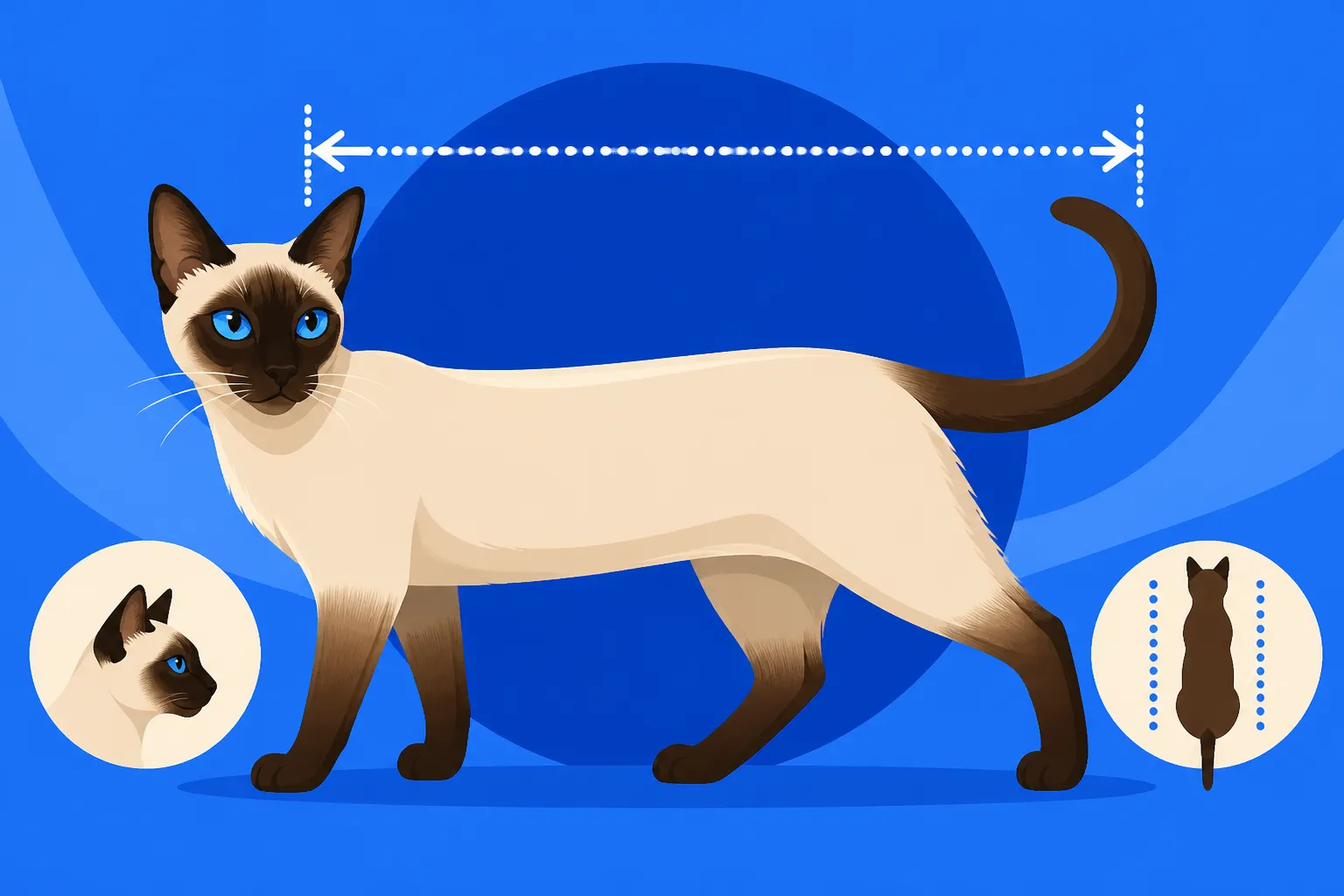
How Long a Siamese Cat’s Body Is
A Siamese cat’s body is often around 11 to 14 inches long, measured from the nose to the base of the tail, but there is no single exact breed-wide measurement. Age, sex, build, and how you take the measurement all matter. This guide explains what “body length” means, how to measure your cat consistently, and when a difference in size may deserve attention.
Typical Siamese cat body length
What body length means
When people ask how long a Siamese cat is, they may be talking about two different measurements: the length of the body alone or the cat’s total length including the tail. For a useful body-length measurement, measure from the tip of the nose to the point where the tail joins the body. The tail is not included.
For an adult Siamese, roughly 11 to 14 inches, or about 28 to 36 centimeters, is a reasonable general range for nose-to-tail-base length. Treat it as an estimate rather than a breed rule. A cat’s pose, the way you find the tail base, and whether the tape follows the curve of the body can change the result.
Total length is longer because it includes the tail. That figure is not interchangeable with body length, and it can vary considerably from one cat to another. For context on overall proportions, see How Big a Siamese Cat Gets and What a Siamese Cat's Tail Should Look Like.
Why individual cats vary
Siamese cats are usually described as medium-sized, slender, and long-bodied, but “slender” does not mean every cat has identical dimensions. Two healthy adults of the same age can have different body lengths because of their frame, sex, family lines, and natural variation. A long, fine-boned cat may look especially stretched out, while another Siamese may have a more compact outline.
Age matters, too. A kitten’s body is still growing, and young cats can look lanky as their legs and torso develop at different rates. Adult size is usually reached gradually, so a measurement taken during kittenhood should not be compared directly with an adult range. If you are tracking a kitten, note its age and repeat measurements over time rather than judging growth from one number.
Body length also does not tell you by itself whether a cat is at a healthy weight. A long cat may be underweight, just right, or carrying extra weight. Use body condition, weight history, appetite, and your veterinarian’s assessment together. What a Siamese Cat Weighs offers useful context for considering weight alongside the breed’s build.
How to measure your Siamese cat at home
A simple measuring method
A relaxed cat is much easier to measure than one trying to turn the tape measure into a toy. Choose a calm moment, perhaps after a meal or a quiet play session, and ask another person to gently keep your cat comfortable if needed. Don’t restrain your cat forcefully; if they are uncomfortable, pause and try again later.
Use a soft measuring tape. With your cat standing naturally on a level surface, place one end near the tip of the nose and follow the body’s topline to the point where the tail begins. Keep the tape close to the body without pulling it tight or pressing into the fur. Write down the measurement and the date so you can compare like with like.
If your cat won’t stand still, take the measurement while they are lying comfortably on their side, keeping the body as straight as possible. This may be less precise, especially if the cat is curled up, so record how you measured. A photograph taken beside a ruler or a familiar object can help you keep track of visible changes, but it is not a substitute for a consistent measurement.
Common measuring mistakes
The most common mix-up is including the tail in one measurement and excluding it in the next. That can make a cat seem to have grown or shrunk when the method simply changed. Always start at the same point and stop at the tail base if you are recording body length.
Measuring a curled cat can also produce a misleading result. A curved tape across the back may follow the cat’s posture rather than the body’s usual length. Likewise, measuring from the shoulders instead of the nose gives a different figure. These measurements can still be useful for a particular purpose, but label them clearly rather than comparing them with nose-to-tail-base measurements.
If you are measuring for equipment, the item’s sizing instructions matter more than a general breed estimate. For instance, when comparing carriers on Chewy, check the manufacturer’s interior dimensions and the cat’s ability to stand, turn around, and lie down comfortably. A cat’s body length alone does not determine whether a carrier will fit well.
How body length relates to the Siamese build
A long outline is part of the breed’s look
The Siamese is known for a lean, elegant outline, with a relatively long body and long legs. That impression can make the cat look larger than its weight suggests. The breed’s overall appearance includes more than length: head shape, leg proportions, coat, and body condition all contribute to the silhouette. What a Siamese Cat Looks Like by the Standard explains how those features fit together.
There is also variation in the type of Siamese people encounter. Some cats have a more moderate or traditional appearance, while others have the more elongated look associated with modern show lines. Those differences do not mean that one specific body length automatically makes a cat a “true” Siamese. A single tape measurement cannot establish breed type or pedigree.
The Siamese is also related to breeds with similar slender outlines, including the Oriental Shorthair. If you are comparing cats by appearance, remember that a long body is only one clue and can’t identify a breed on its own. See How a Siamese Cat Differs From an Oriental Shorthair for a closer look at the similarities and distinctions.
| Measurement | What to include | What it helps describe |
|---|---|---|
| Body length | Nose to base of tail | The cat’s torso and overall body outline |
| Total length | Nose to tip of tail | Body plus tail; useful only when the method is stated |
| Height | Floor to top of shoulders or another stated point | How tall the cat stands |
| Weight | The cat’s mass on a scale | Size and health context when considered with body condition |
Why length alone is not a health check
A measurement can be useful for tracking change, but it cannot diagnose a health problem. If your Siamese seems thinner, heavier, or less muscular than before, note the change and discuss it with a veterinarian rather than relying on length alone. Cats can lose muscle or gain fat without a noticeable difference in their body length.
Pay attention to the pattern over time. A stable adult measurement is usually less concerning than a sudden change in body shape accompanied by reduced appetite, vomiting, increased thirst, low energy, or difficulty moving. Those changes should be assessed in context, especially in an older cat. The guide How a Siamese Cat Hides Pain may help explain why subtle changes in behavior are worth noticing.
For a more useful home record, track weight under similar conditions, note appetite and activity, and take occasional measurements using the same method. Bring those notes to routine veterinary visits. A long-bodied cat that has always been lean may be perfectly healthy; a cat whose shape changes quickly deserves a closer look even if its length remains about the same.
Using body measurements for everyday care
Choosing a carrier, bed, or harness
Measurements are most practical when you are choosing something your cat needs to use. For a carrier, compare the cat’s length and height with the listed interior space, and consider whether the cat can turn around and settle comfortably. Don’t choose based only on an outside measurement or a breed label. When browsing options on Chewy, check the product’s own sizing guidance and measure your cat as instructed.
Beds and resting spots are less exact, but your cat should be able to stretch out without hanging over the edge if that is how they like to sleep. Some cats curl up in a small bed, then sprawl across the largest sofa cushion in the house. Watch how your cat actually rests rather than assuming a particular size based on the breed.
Harness fit depends on more than body length. Chest and neck measurements are often the key figures, and the harness should be secure without restricting movement or breathing. If you are comparing harnesses on Chewy, use the maker’s measurement chart rather than selecting a size based on the typical Siamese range.
Keeping a useful growth or health record
If you are monitoring a kitten, record the date, age, weight, and measurement method each time. A simple note such as “nose to tail base, standing” makes later comparisons more meaningful. Avoid frequent measuring if it stresses your cat; regular weight checks and veterinary examinations are generally more useful than trying to track every small change in length.
For adults, occasional measurements can help when you need to choose equipment or document a change in body shape. The number itself is less important than consistency. If one measurement seems unexpectedly different, repeat it calmly and check that the cat was in a similar position before drawing conclusions.
Ultimately, there is no required body length a Siamese must reach. A healthy cat may fall outside a general estimate and still be completely normal. Consider the whole cat—body condition, comfort, energy, appetite, and veterinary history—rather than treating a tape measure as a pass-or-fail breed test.
Disclaimer
This article is for general informational purposes only and does not constitute professional advice. Laws, prices and regulations vary by location and change over time. Consult a qualified professional for guidance on your specific situation.