Whether the Modern Siamese Cat Is Too Extreme
A modern Siamese cat’s long, angular body, wedge-shaped head, and oversized ears can look strikingly different from the rounder cats many people picture when they hear “Siamese.” That change can raise fair questions: Is the look merely a show preference, or does it affect the cat’s comfort and health? This guide explains how the breed’s appearance evolved and how to assess it without relying on stereotypes.
What people mean by a modern Siamese cat
The phrase “modern Siamese” usually describes the refined, elongated type favored in many contemporary show rings. It is not a separate breed name in every registry or conversation, and people may use it differently. That makes online descriptions confusing: one person’s “modern Siamese” may be another person’s typical show-style Siamese.
A useful way to understand the term is to separate appearance from identity. Breed standards describe an ideal look for judging; they do not mean every cat of that breed will have the same proportions. Nor does a cat’s angular face alone confirm its pedigree.
The features associated with the modern type
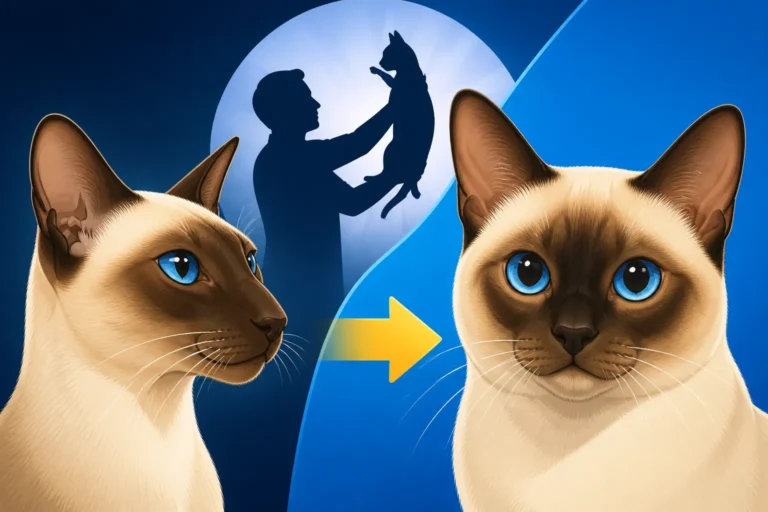
A modern Siamese is commonly described as slender and fine-boned, with a long, tubular body, long legs, a tapering tail, and a narrow wedge-shaped head. The ears are often large and set to continue the lines of the wedge. The coat is short and close-lying, and the familiar color-point pattern gives the face, ears, paws, and tail darker coloring than the body.
Those features can appear exaggerated in photographs, particularly when a cat is posed for a show or photographed close up. A phone camera can make the ears and face seem larger than they look in person, while a very lean coat and body can make the silhouette seem more extreme. A single image is a poor basis for deciding whether a cat is healthy or representative of the breed.
Modern type is also not a personality description. A narrow head does not tell you whether a cat will be outgoing, vocal, or affectionate. If temperament is your main concern, explore What a Siamese Cat's Temperament Is Really Like and How Loud a Siamese Cat Is separately from appearance.
How it differs from the older, rounder look
Many people recognize a rounder-headed cat with a sturdier-looking body as an “old-style” or “applehead” Siamese. That appearance is often associated with earlier photographs and family memories of the breed. The contrast can be surprising: someone who grew up with a broad-faced Siamese may wonder whether today’s narrow-faced cats are even the same breed.
The terms are not always used consistently. “Traditional Siamese” and “applehead Siamese” may refer to cats selected for a less extreme outline, but registration rules and breed labels vary. Some cats may be registered in a different breed category, depending on their ancestry and the relevant registry. For a closer look at the distinction, see How the Siamese Cat's Head Changed Shape in Fifty Years and How the Applehead Siamese Cat Became the Wedge.
It is better to ask what a breeder or rescue means by a label than to assume the label guarantees a particular build. Ask to see the cat in person if possible, or request several ordinary photos and video from different angles. A relaxed side view, a view from above, and a video of the cat walking reveal more than a tightly cropped portrait.
How the Siamese cat’s appearance changed
The modern Siamese did not appear all at once. Breed populations and show preferences changed over time as breeders selected cats they believed matched the standard. This is a familiar pattern in pedigree breeding: when a particular feature is rewarded or admired, it can become more prominent across generations.
The details depend on region and registry. A standard is a written description used to guide judging, while breeders make individual choices about which cats to pair. Neither process means every breeder is aiming for an identical result, and show-winning appearance is not the only goal responsible breeders consider.
Selection and show standards
Siamese cats shown in the West became more distinct in appearance as organized breeding and judging developed. Over many generations, selection for a longer outline and narrower wedge contributed to the look commonly called modern. Changes in standards and preferences helped shape what judges expected to see, but the history is not simply a story of one standard suddenly transforming every Siamese cat.
A breed standard is not a health certificate. It describes physical traits and proportions; it does not establish that an individual cat has been examined for every possible health issue. Conversely, a cat that looks more moderate does not automatically have better health. An owner choosing a companion should consider the cat’s breathing, movement, eyes, weight, behavior, and veterinary history rather than using head shape as a shortcut.
The distinction between a show ideal and a pet-quality cat can also be misunderstood. “Pet quality” generally refers to a cat that is not being sold or evaluated as a show or breeding prospect; it does not mean the cat is unhealthy or less deserving of care. For questions about screening, What a Siamese Cat Breeder Should Have Screened offers useful context.
Why photographs and labels can mislead
Online photos often create a stronger impression than meeting a cat face to face. A close lens, a stretched pose, or a dramatic angle can make an already fine-featured cat seem unusually narrow. Edited images and selective posting add another layer: people tend to share striking portraits, not a neutral photograph of a cat resting beside the sofa.
Labels can be just as imprecise. A shelter, seller, social media post, or retailer may use “Siamese” to describe a pointed cat or a cat with a Siamese-like appearance. That can be helpful shorthand, but it is not proof of registered ancestry. When searching for general pet-care information, a retailer such as Chewy may use breed labels to make content easier to browse; those labels should not be treated as pedigree documentation.
The same caution applies to product descriptions and informal breed summaries on Chewy or other retail sites. They may offer practical starting points for everyday care, but they cannot tell you whether a specific cat meets a registry’s standard or whether its relatives were screened. For a better understanding of appearance and breed descriptions, compare sources with What a Siamese Cat Looks Like by the Standard and What People Get Wrong About the Siamese Cat.
Is the modern Siamese too extreme
“Too extreme” is a judgment, not a diagnosis. Some people find the modern outline elegant and expressive; others prefer a more moderate head and body. Aesthetic preferences are personal. The more useful welfare question is whether a particular cat can breathe, eat, groom, move, play, and rest comfortably.
There is no reliable way to judge those things from breed type alone. Individual cats vary, and health depends on much more than a silhouette: genetics, early care, environment, nutrition, and veterinary attention all matter. A striking appearance should prompt thoughtful questions, not an automatic conclusion that the cat is suffering.
Looking beyond the silhouette
When evaluating a cat, notice how it moves and behaves in ordinary circumstances. Does it walk and jump comfortably? Does it breathe quietly at rest? Can it eat without difficulty? Are its eyes clear, and does it seem alert and engaged? These observations do not replace a veterinary examination, but they help shift attention from fashion to function.
A lean Siamese can be healthy, but “slender” should not be used to dismiss unexplained weight loss or a lack of muscle. Likewise, large ears or a narrow wedge are not, by themselves, proof of a medical problem. Ask for the cat’s medical history and have a veterinarian assess its body condition and overall health, especially if you notice changes in appetite, breathing, energy, or weight.
Look at the whole cat, not just the face. A calm, comfortable cat with a dramatic outline may be thriving; a cat with a more moderate build may still have an unrelated health concern. For the broader discussion of breed health, see How Healthy the Siamese Cat Actually Is.
Questions to ask a breeder or rescue
If you are considering a kitten from a breeder, ask how they balance appearance with health, temperament, and sound movement. Request information about the kitten’s parents and close relatives, including known health problems and the veterinary care the kittens have received. A responsible conversation should leave room for your questions rather than relying only on impressive photos or confident claims.
A rescue may have limited information about a cat’s background, and that is not automatically a reason to rule the cat out. Ask what staff or foster caregivers have observed: how the cat eats, plays, breathes, uses the litter box, and responds to handling. A veterinary exam after adoption can help establish a baseline, even when the cat’s history is incomplete.
Use online breed descriptions as orientation, not a substitute for direct evidence. Chewy and similar retailers can be convenient places to encounter general breed-care material, but a product page or breed label cannot verify lineage, health testing, or a cat’s individual needs. If you are comparing cats, prioritize the animal’s behavior and veterinary information over whether its face matches a particular image you have in mind.
| What you are assessing | Helpful evidence | What not to assume |
|---|---|---|
| Breed or type label | Pedigree records from a recognized registry, when available | A pointed coat or wedge-shaped head proves pedigree |
| General comfort | Normal breathing, eating, grooming, movement, and rest | A modern outline automatically means poor welfare |
| Health background | Veterinary records and clear discussion of family history | A show title or attractive photo means health screening is complete |
| Temperament | Time observing the cat in a calm setting | Appearance predicts personality |
| Online information | Several sources, checked against records and veterinary guidance | A retailer or social media label confirms a cat’s ancestry |
Choosing a Siamese cat without getting stuck on type
It is reasonable to have a preferred look. The key is not letting that preference replace questions about the individual cat. Whether you are drawn to the sleek modern outline or a rounder, more moderate appearance, look for a cat whose needs and temperament fit your household and whose health information is as clear as possible.
If you are uncertain about breed terminology, ask the person responsible for the cat to explain it plainly. You can also compare the exact registry language with how the cat is being described. A label such as “traditional,” “old style,” or “modern” may tell you what someone means aesthetically, but it does not answer every question about registration or health.
A practical decision checklist
Before committing, take time to observe the cat rather than making a decision from one portrait. If it is a kitten, ask to see it with its mother and littermates where appropriate, and learn what veterinary care has been completed. For an adult cat, ask about established routines, behavior, and any ongoing medical needs.
Use these questions to keep the discussion grounded:
- What does “modern” or “traditional” mean in this cat’s case?
- Is the cat registered, and can the seller or breeder provide documentation?
- What health checks have been performed, and can you review the records?
- Are there known health concerns among parents or close relatives?
- How does the cat behave during normal activity, eating, and rest?
- What support is available if a health or adjustment concern appears after adoption?
A straightforward answer is more useful than a promise that a particular look guarantees good health. If a seller focuses heavily on appearance but cannot discuss records, care, or the cat’s needs, pause and gather more information. A responsible choice is one that respects both your preferences and the cat as an individual.
The fairest way to judge the modern look
The modern Siamese is the result of generations of changing preferences, selective breeding, and show standards. Whether its appearance is “too extreme” depends partly on personal taste, but welfare should be assessed through the cat’s function and health rather than a label or photo.
A balanced view leaves room for both truths: people can reasonably prefer a less angular look, and a particular modern-looking cat may still be healthy and comfortable. Focus on individual behavior, veterinary assessment, reliable records, and responsible care. That approach is fairer to the breed—and much more useful when choosing a companion.
Disclaimer
This article is for general informational purposes only and does not constitute professional advice. Laws, prices and regulations vary by location and change over time. Consult a qualified professional for guidance on your specific situation.