Which Consul Sent the First Siamese Cat to Washington
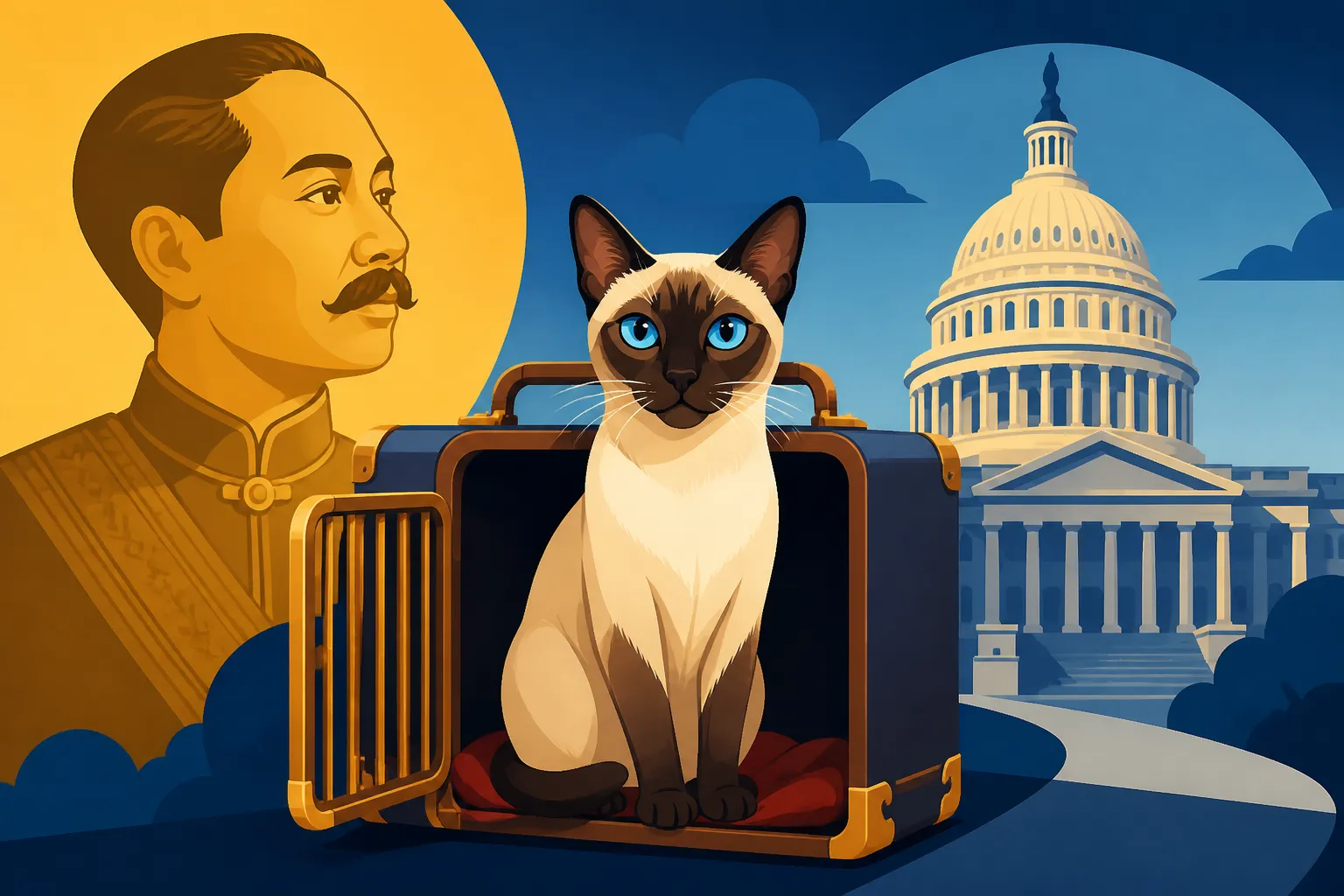
The first Siamese cat sent to Washington was named Siam, and the American consul credited with sending her was David B. Sickels, stationed in Bangkok. He sent the cat as a gift to Lucy Webb Hayes, wife of President Rutherford B. Hayes. The story is often told in a sentence, but the setting, timing, and gaps in the historical record make it more interesting than a simple delivery.
The consul who sent Siam to Washington
David B. Sickels and his post in Bangkok
David B. Sickels was serving as a United States consul in Bangkok, then the capital of Siam. A consul represented American interests in a foreign port or city, helping with official matters and relations with local authorities. Sickels’s post placed him in a position to encounter Siamese cats in the country now known as Thailand.
Sickels is the official associated with sending the cat to Washington. The gift was intended for Lucy Webb Hayes, the First Lady. This detail matters because accounts sometimes blur the roles of sender and recipient: Sickels sent the cat from Bangkok, while Lucy Hayes received her in the United States.
The name “Siam” referred both to the cat and to the country from which she came. Siam was the name used for Thailand at the time, so the cat’s name made her origin immediately recognizable to American readers. For background on the country and its connection to the breed, see Where the Siamese Cat Comes From.
A gift for Lucy Webb Hayes
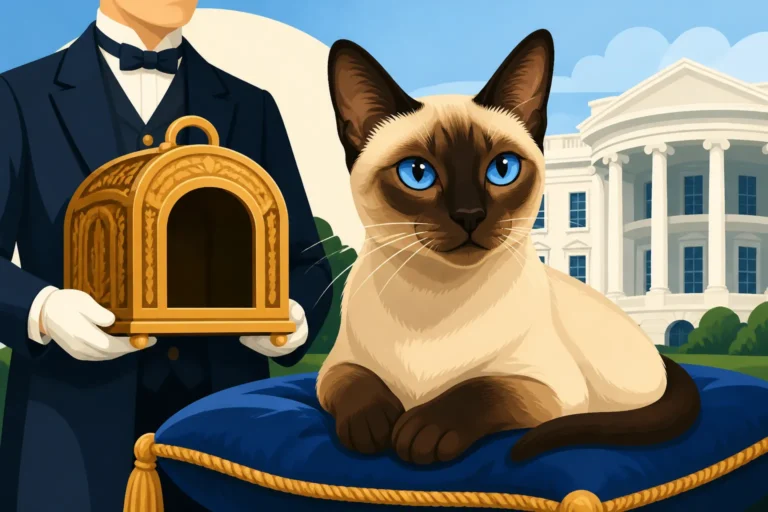
Sickels sent Siam as a gift to Lucy Hayes during Rutherford B. Hayes’s presidency. The gift connected a diplomatic post in Southeast Asia with the White House, giving the cat an unusual path into American public life. Siam was not simply a household pet arriving in a private home; her destination made her story newsworthy.
The First Lady was the recipient, but the cat’s presence at the White House also linked the breed to the presidential household. That association helped make Siam a memorable early example of the breed in the United States. It does not necessarily mean that the breed became widely available or popular immediately. A single celebrated cat and a growing population of pets are two very different things.
To keep the people and events straight, it helps to separate the main roles:
| Person or detail | Connection to Siam |
|---|---|
| David B. Sickels | U.S. consul in Bangkok credited with sending the cat |
| Lucy Webb Hayes | First Lady and recipient of the gift |
| Siam | The cat sent from Bangkok to Washington |
| Rutherford B. Hayes | President during the period of the gift |
The First Lady’s role in the story is explored further in Who Lucy Hayes Was to the Siamese Cat. The cat and her journey are also covered in Who Sent Siam the Siamese Cat to the Hayes White House.
When Siam reached America and what happened next
The gift was sent in 1878 and arrived later
The story is commonly associated with 1878, the year the gift was sent. Siam’s arrival in the United States is often placed in 1879. Those dates can seem contradictory at first, but they describe different parts of the journey: the sending of the cat and her later arrival.
Travel from Bangkok to Washington was not a quick trip. A cat sent across such a distance would have needed to travel by ship and then continue overland. The journey helps explain why a gift sent in one year might be recorded as arriving in the next. It also makes clear that Siam’s arrival was an event rather than a simple transfer from one nearby home to another.
For readers sorting through the dates, the useful distinction is “sent” versus “reached America.” The first date is associated with Sickels dispatching the gift; the second refers to Siam’s arrival. The question of timing is discussed in What Year the First Siamese Cat Reached America.
Siam became an early American reference point
Siam is widely described as the first Siamese cat to reach the United States. That phrasing is best understood as the first known or historically recognized arrival, rather than proof that no cat with similar ancestry had ever entered the country earlier. Nineteenth-century records do not provide the kind of complete tracking system that would let historians account for every privately transported animal.
Her White House connection gave the story a distinctive place in breed history. The Siamese was still an unfamiliar cat to many Americans, and Siam’s arrival helped introduce the breed to a wider audience. But one cat could not, by herself, establish a breed population. That required later imports, breeding, and growing public interest.
If you want to follow the story from the cat’s arrival into the breed’s later American history, Which Siamese Cat Arrived in America First provides a related account. The distinction between an early famous arrival and the later spread of the breed is important: Siam was a notable beginning, not the whole story.
What is known and what remains uncertain
The broad outline is clearer than every travel detail
The central facts are consistent: David B. Sickels was the consul in Bangkok associated with sending Siam, Lucy Webb Hayes was the intended recipient, and the cat arrived in America during the Hayes presidency. These details form the widely repeated outline of the story.
Some smaller details are harder to establish with the same confidence. Accounts may differ in how they describe the precise date of dispatch, the length and route of the journey, or the circumstances of Siam’s arrival. When a story has been retold for generations, a vivid detail can become familiar without being equally well documented. It is sensible to distinguish the established outline from less certain specifics.
That caution does not make the story less meaningful. It simply keeps a historical account honest. A reader can say that Sickels sent Siam to Lucy Hayes and that she became an early, well-known Siamese cat in the United States without claiming certainty about every stop along the way.
Siam’s life at the White House was brief
Siam did not live for many years after arriving in Washington. Accounts report that she died in 1880 following an illness. The surviving story is brief compared with the attention given to her arrival, and detailed veterinary records or a modern-style biography are not available in the commonly repeated account.
That gap can be disappointing if you are hoping for a full picture of her daily life: what she ate, where she slept, or how she behaved around the Hayes family. The historical record does not provide a dependable answer to every personal detail. It is safer to describe the broad account than to fill the silence with invented scenes.
For more on the cat’s short life and the lasting interest in her story, see What Happened to Siam the Siamese Cat. The question of what became of her remains part of the broader history of Where Siam the Siamese Cat Is Preserved.
Why the story still matters to Siamese cat history
A famous arrival is not the same as the breed’s full history
Siam’s arrival offers a clear landmark in the breed’s American history, but Siamese cats had a longer history in their homeland before they became familiar in the United States. Her story is one piece of a much wider movement involving international travel, public interest, cat shows, and breeding.
It is also useful to remember that the word “Siamese” has been used in different ways over time. Breed standards and popular ideas about the Siamese cat’s appearance have changed, and the cats Americans recognize today may not look exactly like every early example. To explore how the breed developed, see How the Siamese Cat's Head Changed Shape in Fifty Years and What a Siamese Cat Looks Like by the Standard.
Siam’s historical importance is therefore not that she single-handedly created the breed in America. Rather, her high-profile arrival gave people a memorable early reference point for a cat that was then unusual in the country. Later imports and breeding established a larger presence.
From historical curiosity to modern ownership
The White House story can prompt a very current question: what would it be like to live with a Siamese cat now? Historical fame does not tell you whether the breed suits your home. A prospective owner should learn about temperament, health, daily care, and the time a social, active cat may need from its people.
If your interest moves from history to practical preparation, a retailer such as Chewy can be one place to compare everyday supplies like carriers, litter, and food. That kind of browsing is useful for making a checklist, but it cannot tell you which diet suits a particular cat; your veterinarian can help with individual feeding and health questions. Chewy is a modern shopping resource, not a source for the history of Siam or a substitute for advice from a veterinarian or rescue organization.
For the historical question itself, the answer remains straightforward: David B. Sickels, the U.S. consul in Bangkok, sent Siam to Lucy Webb Hayes. The details around the journey and the cat’s life are less complete, but her arrival became a lasting marker in the story of Siamese cats in America.
Disclaimer
This article is for general informational purposes only and does not constitute professional advice. Laws, prices and regulations vary by location and change over time. Consult a qualified professional for guidance on your specific situation.