Whether Siam Was the Only Siamese Cat at the White House
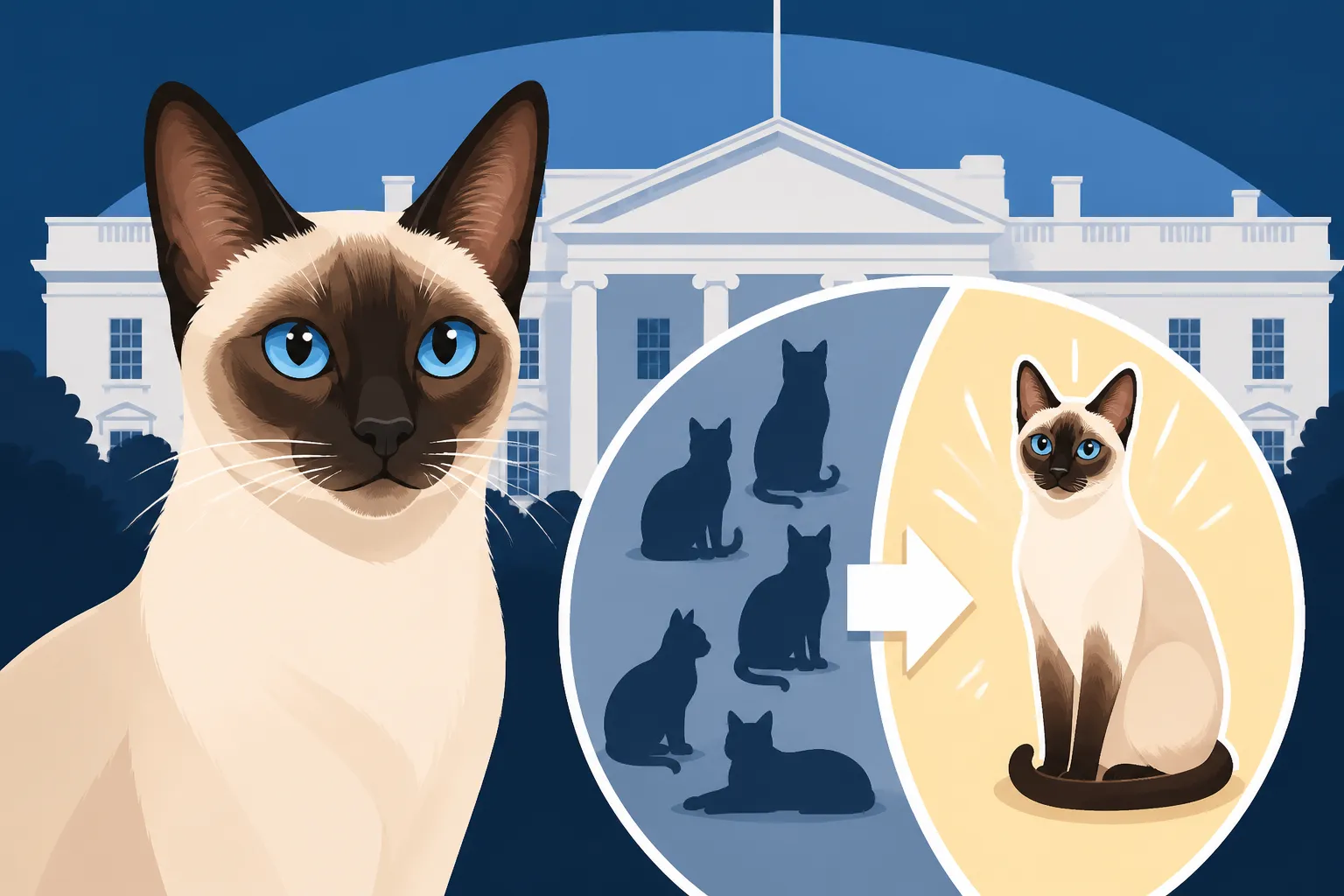
Siam was not the only Siamese cat ever associated with the White House. The cat sent to President Rutherford B. Hayes’s family in 1878 was the first well-known Siamese there, but later presidents’ families also kept Siamese cats. The confusion comes from Siam’s unusual place in White House history and from stories that sometimes blur “first,” “only,” and “first documented.”
Siam was the first famous Siamese cat at the White House
How Siam came to the Hayes family
Siam arrived at the White House in 1878 as a gift to Lucy Hayes, the president’s wife. The gift came from David B. Sickels, an American diplomat serving in Siam, the country now known as Thailand. Siam was female, and her arrival attracted attention because Siamese cats were still rare in the United States.
The story is often told as though Siam were simply a family pet who happened to live in a famous house. But her presence also represented a striking cultural exchange: a cat from a distant country had become part of the daily life of the presidential household. For people who had never seen a Siamese cat, her appearance and origin made her especially memorable.
That history is why Siam is frequently described as the first Siamese cat in America or the first Siamese cat at the White House. Those claims should be read carefully. Siam is widely recognized as the first Siamese cat to reach the United States in the historical record, but that does not prove no other Siamese cat had ever been brought into the country or lived at the White House before her. For the background on the gift, see Who Sent Siam the Siamese Cat to the Hayes White House.
What the records tell us about Siam’s time there
Siam’s stay at the White House was short. She became ill and died not long after arriving in the United States. That brief life helped turn her into a historical figure: there was little time for her to become an ordinary, long-lived presidential pet, yet her story was unusual enough to be remembered.
The surviving accounts focus on Siam as a singular arrival, not as one cat among several Siamese cats living with the Hayes family. It is therefore reasonable to call her the only documented Siamese cat in the Hayes White House story. It is less safe to turn that narrower statement into the broad claim that she was the only Siamese ever to live at the White House.
That distinction matters because historical pet records are incomplete. Presidential pets were not always catalogued in a consistent way, and a family cat might be mentioned in a letter, newspaper report, or memoir without appearing in a formal list. Siam’s prominence tells us that she was notable; it does not establish that every animal kept by every family was recorded. More about her short stay is covered in What Happened to Siam the Siamese Cat and How Long Siam the Siamese Cat Lived at the White House.
Siam was not the only Siamese cat ever connected to the White House
Later presidential families also had Siamese cats
Siam was not the last Siamese cat to live at the White House. In the twentieth century, the Ford family had a Siamese cat named Shan. Later, during Jimmy Carter’s presidency, his daughter Amy had a Siamese cat named Misty Malarky Ying Yang. These later cats make the answer to the article’s central question clear: Siam was not the only Siamese cat ever at the White House.
| Cat | Presidential family | What the history shows |
|---|---|---|
| Siam | Rutherford B. Hayes | A prominent early Siamese cat at the White House, arriving in 1878 |
| Shan | Gerald R. Ford | A later Siamese cat associated with the Ford family |
| Misty Malarky Ying Yang | Jimmy Carter | A Siamese cat associated with Amy Carter and the Carter White House |
The names also help prevent a common mix-up. Siam was the cat given to Lucy Hayes, while Shan and Misty Malarky Ying Yang belonged to later presidential families. They were not additional cats in the Hayes household, and the later cats do not change Siam’s place as the first well-known Siamese at the White House.
If a reader encounters the phrase “the White House Siamese cat,” it is worth checking which president’s family the account means. Siam is the name most closely tied to the earliest story, but she was one of several Siamese cats in White House history.
Why Siam is still often described as the only one
Siam’s story is frequently condensed into a simple line: the first Siamese cat in America was sent to the White House. In a short account, that can easily become “the Siamese cat at the White House,” which sounds as if there was only one. The wording may describe her historical importance rather than make a claim about every Siamese cat that followed.
There is another reason the misconception sticks. Siam arrived at a time when Siamese cats were unfamiliar to many Americans, and her connection to the president made the story unusually newsworthy. Later cats may have been beloved household companions, but they did not carry the same “first arrival” significance. The first chapter tends to dominate the retelling.
A useful way to phrase the history is: Siam was the first widely documented Siamese cat at the White House, but not the only Siamese cat ever kept there. For an account focused on her arrival in the United States, see Which Siamese Cat Reached America First. For broader context about the early American story, see Which Siamese Cat Arrived in America First.
What “only” can mean in a historical pet story
One cat in the Hayes account is not one cat in all White House history
When people ask whether Siam was the only Siamese at the White House, they may mean one of two different things. They might be asking whether the Hayes family had another Siamese cat alongside her. Or they might mean whether any later presidential family ever had a Siamese cat. The answer depends on which question they have in mind.
For the Hayes period, Siam is the Siamese cat clearly associated with the family in the well-known historical account. That supports describing her as the only documented Siamese in that particular story. It does not establish that every household animal was recorded, nor does it answer what happened under later presidents.
Across White House history, the answer is no: later Siamese cats, including Shan and Misty Malarky Ying Yang, were also associated with presidential families. Keeping the time period attached to the claim makes it accurate and avoids accidentally erasing those later cats.
Why the “first” label needs a little care
Calling Siam “the first Siamese cat in America” is common, but early records cannot always prove an absolute negative. A cat may have arrived without attracting attention or left no surviving public record. A careful historical description is that Siam is recognized as the first Siamese cat known to have reached the United States, rather than claiming with certainty that no Siamese cat had ever arrived earlier.
The same care applies to White House history. The phrase “first Siamese cat at the White House” reflects the importance of Siam’s arrival in the documented record. It should not be stretched to mean the only Siamese cat the White House would ever see. More on the question of her arrival is available in Who Lucy Hayes Was to the Siamese Cat.
For readers tracing how the story has been preserved, Where Siam the Siamese Cat Is Preserved offers a related angle. Siam’s legacy comes from a combination of the unusual gift, her connection to the Hayes family, and her place in the early history of Siamese cats in the United States.
How to remember Siam’s place in White House history
Keep the timeline and the wording together
A quick timeline makes the distinction easy to remember. Siam arrived during Rutherford B. Hayes’s presidency in 1878 and became the earliest widely documented Siamese cat at the White House. She died not long after arriving. Much later, the Ford family had Shan, and the Carter family had Misty Malarky Ying Yang.
So, if someone asks whether Siam was the only Siamese cat ever at the White House, the answer is no. If they mean whether she was the only Siamese cat in the well-known Hayes account, she is the one clearly documented. The word “ever” changes the scope of the question.
This also explains why different short biographies can seem to contradict one another. One may call Siam “the White House’s first Siamese cat,” while another says she was “the White House Siamese cat.” The first wording describes her place in history; the second can sound exclusive even when it is not intended to be.
A concise answer that stays accurate
The most accurate short version is: Siam was the first well-known Siamese cat at the White House, but not the only one ever associated with a presidential family. The later Siamese cats Shan and Misty Malarky Ying Yang show that the breed appeared in White House households again.
That phrasing preserves what made Siam’s story remarkable without turning a first into a forever. It also recognizes that White House pet histories span many administrations and that families’ animals were not always documented in the same way. When discussing a specific cat, name the president or family and the period rather than relying on “the White House Siamese” alone.
Disclaimer
This article is for general informational purposes only and does not constitute professional advice. Laws, prices and regulations vary by location and change over time. Consult a qualified professional for guidance on your specific situation.