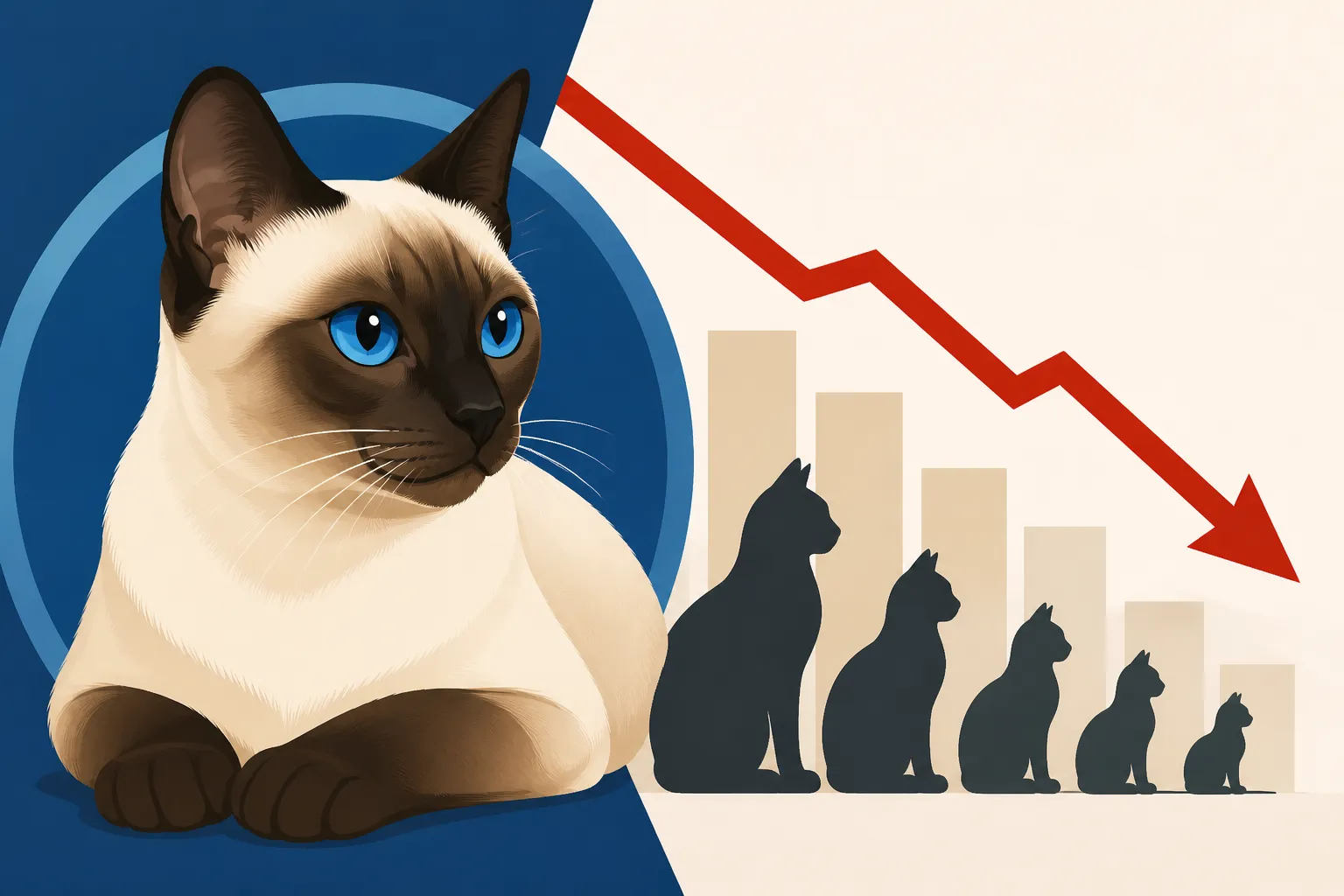
Why Siamese Cat Registrations Fell After the 1990s
Siamese cats remain recognizable and widely loved, so a drop in registrations can sound like a mystery. The key is that registry records track pedigreed cats entered by breeders, not every Siamese or Siamese-looking cat living in homes. This guide explains what the decline can mean, why it may have happened, and how to read the trend without mistaking paperwork for population.
What Siamese cat registrations measure
A registry count is not a count of all Siamese cats
When people talk about Siamese cat registrations, they usually mean pedigree records maintained by cat organizations. A registered kitten has documented ancestry and has been entered into a registry under that organization’s rules. The count can help show activity in the formal breeding and showing world, but it does not capture every cat that looks or behaves like a Siamese.
A Siamese adopted from a shelter may have no papers, even if the cat has the classic blue eyes, short coat, and color-point pattern. A cat with one Siamese parent may also be described as Siamese by its family or rescue, without qualifying for registration as a pedigreed Siamese. Those cats still belong in conversations about the breed’s presence in homes, but they do not necessarily appear in registry totals.
This distinction matters because a fall in registrations does not automatically mean fewer people own Siamese cats, or that the breed is close to disappearing. It may instead reflect fewer registered litters, fewer breeders entering kittens, or a shift in where prospective owners find cats. For background on what registration can and cannot establish, see Whether a DNA Test Confirms a Siamese Cat.
Different registries can tell different stories
There is no single worldwide ledger of every Siamese kitten born. Registries maintain their own records, standards, and categories, so a change in one organization’s figures may not match a change in another’s. Some registries distinguish Siamese from related or colorpoint breeds differently, which can affect what gets counted under the breed name.
For example, point colors accepted in one registry may be treated differently by another. A cat that one organization places in a Siamese category might be recorded in a separate breed category elsewhere. That means a comparison across organizations needs care: the numbers may reflect differences in definitions as well as changes in breeding activity. Which Point Colors Other Registries Accept in a Siamese Cat explains why those distinctions matter.
A useful way to read the trend is to ask three questions: Which registry is being discussed? What does that registry count as Siamese? And are the figures counting kittens registered, litters, breeders, or show entries? Without those details, “registrations fell” can sound more definitive than the evidence really is.
Why registrations may have fallen after the 1990s
Interest shifted across breeds and types of cats
People’s preferences change over time. Some prospective owners may become interested in other breeds, mixed-breed cats, or adopting an adult cat rather than buying a pedigree kitten. Trends in media, social networks, household lifestyles, and housing can all influence which cats people seek. A popular breed does not necessarily keep the same share of attention forever.
The Siamese also has a distinctive look, but not everyone seeking that appearance is looking for a registered pedigree cat. Shelters and rescues may have cats with point coloration or Siamese ancestry, and families may choose them because they fit their home, not because they have a particular lineage on paper. In that situation, real-world interest in Siamese-like cats can remain visible while formal registrations decline.
Changes within the breed’s own presentation may also influence demand. The modern show Siamese is known for a long, slender body and a wedge-shaped head, while some people picture a rounder, more traditional-looking cat when they hear “Siamese.” Those preferences do not always line up with the type favored in a particular show ring. The history behind that split is covered in How the Applehead Siamese Cat Became the Wedge and Whether the Traditional Siamese Cat Still Exists.
The number of active breeders and registered litters matters
Registrations depend on breeder participation. If fewer breeders are producing litters, or if active breeders register a smaller share of their kittens, registry totals can go down even when families still want Siamese cats. Breeders may retire, reduce the number of litters they raise, or decide that the practical demands of breeding and raising kittens no longer suit their circumstances.
Responsible breeding takes time and careful planning. Breeders have to find suitable homes, care for adult cats and kittens, keep records, and make decisions about health and temperament. They may also face difficulty finding experienced veterinary care, managing costs, or maintaining a breeding program while balancing work and family life. These pressures can reduce the number of kittens entering formal registration without any sudden change in the breed’s reputation.
A registry count can also fall if kittens are placed as pets but not registered, or if breeders use a different registry. Registration is a choice and an administrative process, not an automatic reflection of every birth. That makes breeder practices a major piece of the picture. When the Siamese Cat Club Was Founded offers historical context for the organized breed community, while How Many Siamese Cats Are Registered a Year focuses on how annual counts are discussed.
| Factor | How it can affect registrations | What it does not prove by itself |
|---|---|---|
| Fewer active breeders | Fewer pedigreed litters may be entered | That Siamese cats are disappearing from homes |
| Changed buyer preferences | A smaller share of buyers may seek registered kittens | That people no longer like Siamese cats |
| Rescue and mixed-breed adoption | More Siamese-looking cats may be acquired outside pedigree channels | That those cats qualify for breed registration |
| Different registry rules | Cats may be counted under different breed categories | That registries are measuring identical populations |
| Breeders registering fewer kittens | Recorded totals can fall while kittens are still placed | That all unregistered kittens lack Siamese ancestry |
Changes in the breed and the way people find cats
Breed standards can influence what buyers recognize
A breed standard gives judges and breeders a shared description of the ideal show cat. It can influence the look that is most visible at shows, in breed promotion, and in breeder advertising. But the standard does not mean every Siamese cat will have the same head shape, body type, or expression. Families may prefer a look that differs from the one most strongly represented in a particular show context.
That gap between the show ideal and the public’s mental picture can affect interest. Someone who grew up with a rounder-headed Siamese may not immediately identify a more extreme wedge-headed cat as the same breed. Another person may specifically seek the modern show type. As those expectations vary, people can choose different breeds, types, or rescue cats rather than seek a registered Siamese kitten.
Breed categories have also developed and changed over time. The Siamese contributed to the development of related breeds, and registries may distinguish those breeds from Siamese in specific ways. The history is useful context, but it also means that a simple comparison of numbers across decades can hide changes in naming and classification. See Which Breeds Came Out of the Siamese Cat and How a Siamese Cat Differs From an Oriental Shorthair for related breed context.
Adoption has become a more visible route to cat ownership
Many people now consider shelters and breed-specific rescues when looking for a cat. That does not necessarily reduce affection for Siamese cats; it changes how some households acquire them. A person may find an adult Siamese through a rescue, or adopt a mixed-breed cat with the familiar pointed coat and blue eyes, instead of joining a breeder’s waitlist for a registered kitten.
Adoption also appeals to people who want to offer a home to an adult cat, or who prefer to learn about an individual cat’s established personality before bringing them home. Those choices are not recorded as new pedigree registrations. As a result, the official numbers can underrepresent the number of households that have a Siamese or Siamese-like companion.
Breeder supply and adoption supply can coexist. A healthy breed community can include registered breeders, rescue volunteers, veterinarians, and families choosing cats through different routes. A registration decline is one signal about the pedigree sector, not a complete report card on whether the breed is loved or valued.
How to interpret the decline without overreading it
Look for consistent definitions and longer trends
A single comparison can be misleading if it uses different registries, time periods, or counting methods. Before drawing a conclusion, look for the source of the figures and whether the same organization and breed definition were used throughout. A change in classification can make one category appear to shrink while a related category grows.
It is also useful to separate registration totals from rankings and show participation. A breed’s placement among all registered breeds can change because other breeds rise or fall, even if Siamese registrations remain stable. Similarly, a change in show entries may reflect the number of exhibitors or events rather than the number of Siamese cats in private homes. Where the Siamese Cat Ranks in Registrations addresses the difference between raw counts and relative position.
If a report does not explain its method, treat its conclusion as a clue rather than a complete answer. Look for several years of comparable figures, and avoid treating one downward movement as proof of a lasting collapse. A careful account will state what is counted and avoid turning a narrow registry statistic into a claim about all Siamese cats.
Registration decline does not mean the breed has lost its identity
A breed’s identity is carried by more than registration totals. Its history, recognizable appearance, temperament, and the people who care for it remain important even when fewer kittens are entered into a registry. Siamese cats continue to be found in homes, shelters, rescue networks, and breeding programs, though those routes are not all visible in the same dataset.
For a potential owner, the practical question is not whether a breed’s registration count is rising. It is whether a particular cat is a good fit, whether its needs can be met, and whether a breeder or rescue can provide useful information about health and temperament. Someone considering a pedigree kitten can ask about lineage, socialization, and health practices; someone adopting can ask what is known about the cat’s history and daily needs.
Ultimately, the most careful interpretation is modest: lower registrations suggest reduced activity in the formal pedigree-recording system being measured. They do not, by themselves, reveal the total number of Siamese cats, explain every reason for a change, or show that public affection for the breed has vanished. The story is broader than a registry chart—and understanding that distinction makes the numbers much more useful.
Disclaimer
This article is for general informational purposes only and does not constitute professional advice. Laws, prices and regulations vary by location and change over time. Consult a qualified professional for guidance on your specific situation.