How Many Siamese Cats Are Registered a Year
A Siamese cat does not receive one worldwide registration number each year: cat registries keep separate records, use different breed rules, and do not necessarily publish comparable totals. That makes a precise global count difficult to establish. This guide explains what annual registration figures can tell you, why they vary, and how to check a number without mistaking registrations for the total number of Siamese cats.
There is no single annual total for Siamese cats
Separate registries keep separate records
A cat’s registration is recorded by a particular registry, not by a single worldwide authority. Organizations such as the Cat Fanciers’ Association, The International Cat Association, and the Governing Council of the Cat Fancy maintain their own records and rules. They may publish breed rankings or other summaries, but those records do not automatically combine into one complete annual count.
That distinction matters when someone asks how many Siamese cats are registered each year. A figure from one registry describes registrations recorded under that organization’s system. It does not necessarily include cats registered elsewhere, cats whose owners never register them, or cats whose breed designation differs under another registry’s rules.
There is also a difference between a registry report and an estimate of breed popularity. A ranking might show where Siamese cats sit compared with other registered breeds, without stating the number of individual cats. A registration total, when available, is a count for a defined organization and time period. Neither figure should be presented as a worldwide total unless the reporting method genuinely combines all relevant registries.
Breed definitions can change the count
The word “Siamese” does not always cover exactly the same cats in every registry. Breed standards and accepted color patterns can differ. Some cats with pointed coats, such as lynx points or red points, may be recorded in a separate breed or category by one organization while another system groups them differently. For more context, see Which Point Colors Other Registries Accept in a Siamese Cat.
This is one reason two apparently reasonable figures may not match. One report may count only cats that meet a narrower Siamese breed standard. Another may include additional accepted colors or use a different classification. The underlying cats have not necessarily changed; the categories used to record them may have.
The history behind these distinctions can be confusing for owners, too. The modern Siamese and the Thai cat are related but are treated as distinct breeds by some registries. If you are trying to understand which cats a particular count includes, How the Thai Split From the Siamese Cat explains why the breed names and definitions are not always interchangeable.
What annual Siamese registration figures actually measure
Registration is not the same as the number of cats born
A registration figure generally counts cats entered into a registry under its procedures. It does not count every kitten born in a year. Some cats from registered litters may never be individually registered, and many pet cats have no pedigree registration at all. A Siamese-looking cat adopted from a shelter or born in an unregistered litter can be part of the real-world Siamese population without appearing in a registry’s annual total.
Registration figures also do not tell you how many Siamese cats are alive in a particular year. That would require information about births, deaths, age, and ownership over time—not just new registrations. Nor do registrations necessarily equal the number of litters: one litter may produce several registered kittens, while another may produce none that are registered individually.
Think of a registry total as a record of documented entries, not a census. It can help describe activity within a registry, but it cannot answer every question about how common Siamese cats are in homes, shelters, or a particular city. The distinction is similar to the difference between official breed records and everyday use of the breed name. How to Tell a Siamese Cat From a Mixed Breed offers more background on why appearance alone does not establish pedigree registration.
The year and the reporting method matter
A number described as “registered in a year” needs a clear definition. Does it count cats registered during the calendar year, cats born in that year and registered later, or registrations processed in a reporting period that does not match the calendar year? Does it include kitten registrations, adult cats, or both? Without those details, a seemingly precise number can be difficult to interpret.
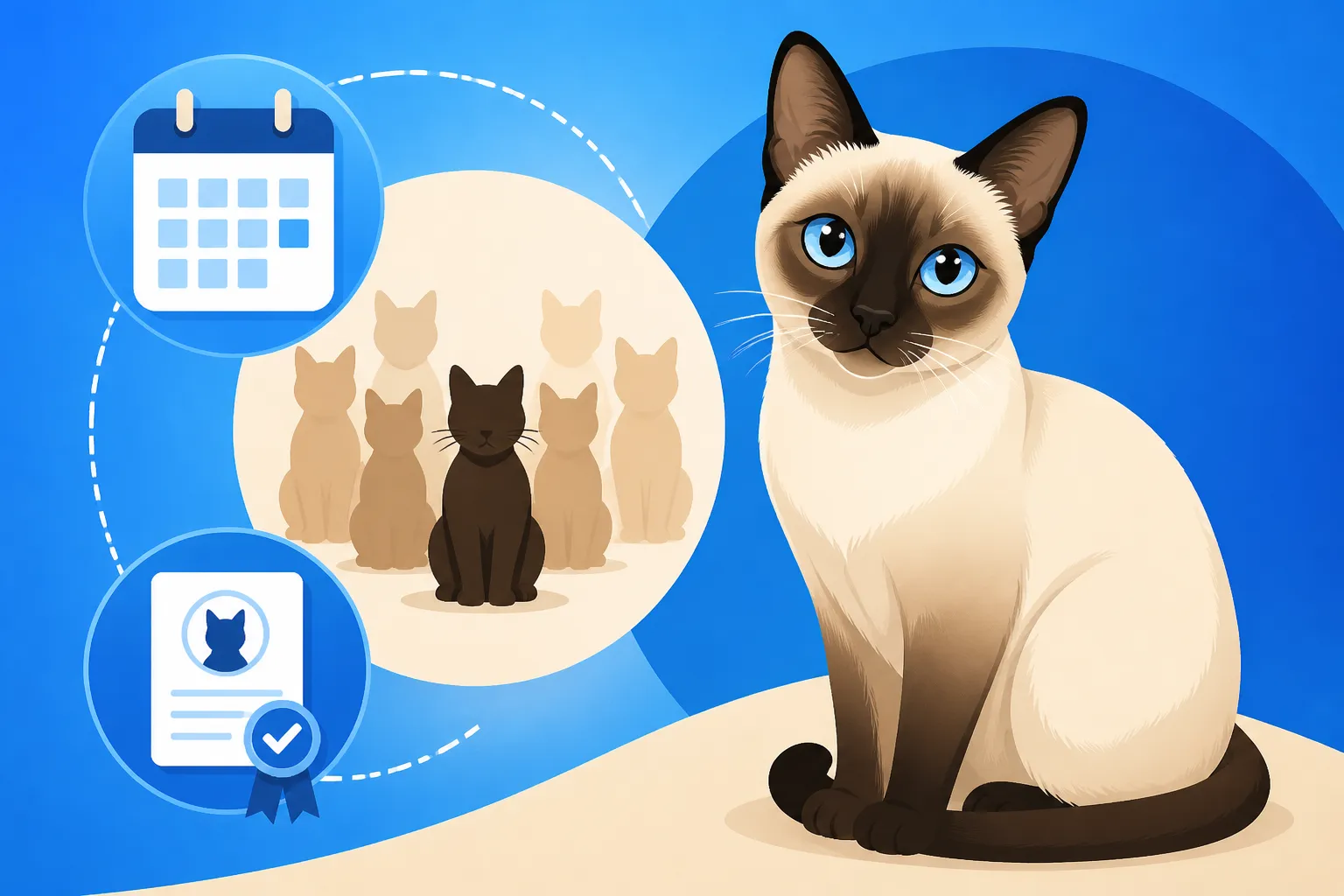
The table below is a useful way to evaluate any figure you encounter.
| What to check | Why it matters |
|---|---|
| Which registry reported it | Each registry maintains its own records |
| Which dates the figure covers | Registrations processed may not match birth year |
| What the registry counts | The total might count cats, litters, or rankings |
| Which cats qualify as Siamese | Breed and color rules can vary |
| Whether the figure is a total or a rank | A popularity position is not a registration count |
| Whether it is a global or registry-specific figure | One registry’s records are not a worldwide census |
When an article gives a number without naming the registry or period, treat it cautiously. Ask whether it refers to a particular organization’s registration records, an estimate, or a ranking. If the answer is unclear, the number may be repeated without enough context to be meaningful.
How to check a Siamese registration number
Start with the registry’s own reporting
For the most dependable figure, begin with the registry said to have produced it. Look for an annual report, breed statistics, a registration summary, or a breed-ranking document. Check whether the document states an actual number of cats, or only lists the breed’s position among other breeds.
If the figure is not shown in a public report, you can contact the registry and ask whether it releases annual Siamese totals. Be specific: ask for the reporting year, the number of cats rather than litters, and the registry’s definition of Siamese. A well-defined question is more likely to get a useful answer than a general request for “how many Siamese cats there are.”
It can also help to compare data from more than one registry, but keep the records separate. A simple combined total may double-count cats registered with multiple organizations, while still missing cats that were never registered. A comparison is useful for understanding each organization’s records; it is not automatically a valid population estimate.
Read rankings as rankings, not counts
A breed ranking can still tell you something. If a registry places Siamese cats high on its list, that suggests the breed has a visible presence among the cats registered through that organization. But a ranking alone cannot tell you the total number of Siamese cats or how much more popular one breed is than another.
The number of registrations can also reflect more than public demand. Breeding practices, the number of active breeders, registration fees, registry rules, and the likelihood that owners complete paperwork can all influence the records. A change in registrations might reflect a change in those factors rather than a sudden change in how many people want a Siamese cat.
Retailer categories are not a substitute for registry data. Chewy may be useful to a cat owner looking for food, litter, or other supplies, but it is a retailer, not a pedigree registry. A product category or breed-related care page does not establish how many cats were officially registered. The same applies to breed labels in adoption listings or online pet profiles.
Why the exact number can be hard to find
Many Siamese cats are outside pedigree records
Registration is optional for many household cats, and a cat can be widely recognized as Siamese by appearance without having formal pedigree papers. Rescue organizations may describe a cat as Siamese or Siamese mix based on its coat, face, or body shape. That description can help prospective adopters understand the cat, but it is not the same as a verified registration record.
This also means registry totals tend to describe a particular part of the cat population: cats entered into formal records under specific rules. They are not a measure of every cat that owners call Siamese. The breed’s background and the way breed categories developed add context; Where the Siamese Cat Comes From and What a Siamese Cat Standard Asks For explain why both history and standards matter when interpreting the name.
If your interest is practical—perhaps you are choosing a pet, researching breeders, or trying to understand the breed’s popularity—a registry count is only one piece of the picture. Breed health, temperament, and responsible breeding practices are separate questions. For example, What a Siamese Cat Breeder Should Have Screened focuses on health considerations that a popularity statistic cannot answer.
Treat unsourced global totals with care
A claim that “this many Siamese cats are registered worldwide every year” should come with a clear method. It should identify which registries contributed, how their categories were matched, what dates were included, and how duplicate registrations were handled. Without that explanation, the number may be a guess, a single registry’s count presented too broadly, or a figure that combines unlike categories.
The most accurate answer, then, is not a single universal annual total. Siamese cats are registered through multiple organizations, and a registry-specific figure may be available when that organization publishes the relevant data. To interpret it correctly, check the registry, the year, the counting method, and the breed definition. If any of those are missing, the number is not enough to establish how many Siamese cats are registered in a year.
Disclaimer
This article is for general informational purposes only and does not constitute professional advice. Laws, prices and regulations vary by location and change over time. Consult a qualified professional for guidance on your specific situation.