Which Registry Splits the Siamese Cat From the Colorpoint Shorthair
When a cat has blue eyes, a pale body, and dark points, it’s easy to assume every registry calls it a Siamese. The confusion usually comes from the Colorpoint Shorthair, a closely related breed with a similar outline. This guide explains how the distinction works, why registry rules differ, and what to check on a cat’s pedigree.
Why the Siamese and Colorpoint Shorthair Are Separate in Some Registries
The distinction is about registration standards
A cat registry is an organization that sets breed descriptions and rules for recording pedigreed cats. It decides which cats qualify for a particular breed name and which coat colors, patterns, and physical traits that name includes. Those rules can differ from one registry to another.
In the Cat Fanciers’ Association, or CFA, the Siamese and Colorpoint Shorthair are treated as separate breeds. The Siamese category is limited to four traditional point colors: seal, blue, chocolate, and lilac. The Colorpoint Shorthair covers additional pointed colors and patterns, such as red, cream, tortoiseshell, and lynx.
That separation doesn’t mean the cats are unrelated or that one is a “real” pointed cat and the other isn’t. The cats share a close breed background and can look remarkably similar. The registry is drawing a line for its records and shows, not making a universal biological distinction that every organization must follow.
The Colorpoint Shorthair was developed from Siamese cats
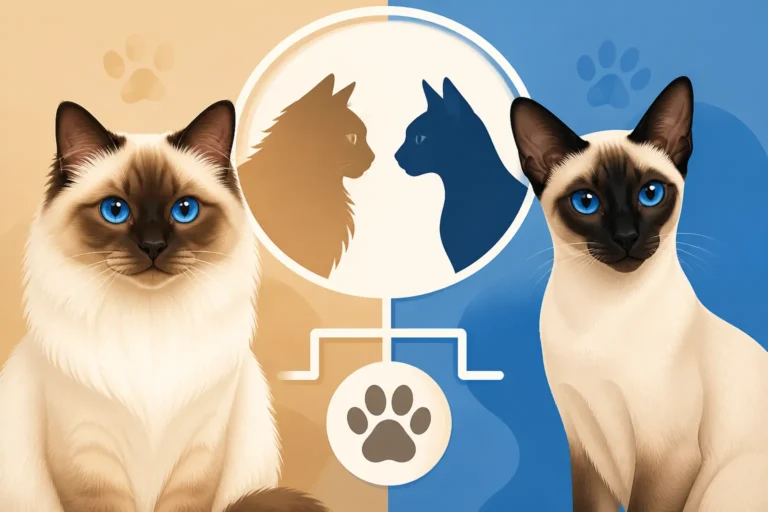
The Colorpoint Shorthair was developed by breeding Siamese cats with other shorthaired cats to introduce additional colors and patterns, then breeding back toward a Siamese-like appearance. The goal was a pointed cat with the familiar lean body, wedge-shaped head, large ears, and blue eyes, but with colors beyond the traditional four.
That history helps explain why the breeds can be hard to tell apart by appearance alone. A red-pointed or lynx-pointed cat may have the same elegant shape and vivid blue eyes associated with Siamese cats, yet be registered as a Colorpoint Shorthair under CFA rules. The name depends on the applicable standard and the cat’s pedigree, not just on a quick visual impression.
If you’re trying to understand the shared traits and differences, What a Colorpoint Shorthair Is Next to a Siamese Cat offers useful context. It also helps to read What the Siamese Cat Standard Asks For, since breed standards explain what registries are actually evaluating.
Which Registry Splits the Siamese From the Colorpoint Shorthair
CFA makes the separation especially clear
CFA is the registry most closely associated with the distinct Colorpoint Shorthair designation. Under its approach, the traditional four Siamese point colors belong in the Siamese breed, while a wider range of pointed colors and patterns is recorded as Colorpoint Shorthair.
For example, a cat with seal points and blue eyes may be a Siamese under the CFA standard if its pedigree and other requirements qualify. A visually similar cat with lynx points may fall under Colorpoint Shorthair instead. Coat color is not the only registration requirement, but it can be the feature that makes the breed label differ.
This is why someone searching for “lynx point Siamese” may find listings, photos, or conversations using the phrase differently. Some people use “Siamese” casually to describe a pointed appearance, while a registry may require a more specific breed designation. For that particular coat pattern, see Whether a Lynx Point Is a Siamese Cat or a Colorpoint Shorthair.
Other registries may organize pointed cats differently
CFA’s terminology is not automatically used by every cat association. Registries can differ in the colors they accept, the names they use, and whether they treat a particular variety as a separate breed or as part of a broader group. Some may use different classifications for cats with Siamese-style points and nontraditional colors.
So if a breeder says a cat is a Colorpoint Shorthair, ask which registry issued or recognizes the pedigree. If another breeder calls a similar-looking cat a Siamese, that doesn’t necessarily mean one person is lying or that one cat is incorrectly described. They may be using different registry standards, informal breed language, or documentation from different organizations.
| Question | What to check |
|---|---|
| Which registry is being used? | Ask for the organization’s full name and the cat’s registration details |
| What breed name appears on the pedigree? | Look at the actual record rather than relying on an advertisement |
| Does the registry accept the cat’s color? | Compare the color and pattern with that registry’s breed standard |
| Is the cat being described informally? | Ask whether “Siamese” is a casual appearance label or a documented breed name |
| Do the parents’ records match the claim? | Request the parents’ registration information and pedigree details |
The practical point is simple: the phrase “Colorpoint Shorthair” is meaningful within the registry that uses it, but it is not a universal label applied identically across all cat organizations. To see how color definitions vary, compare Which Colors a Siamese Cat Comes In with Which Point Colors Other Registries Accept in a Siamese Cat.
How to Tell What Breed Name Applies to a Particular Cat
Check the pedigree before judging by appearance
A pointed coat, blue eyes, and a slender build can suggest Siamese ancestry, but they cannot confirm a registered breed by themselves. Many mixed-breed cats have pointed coats, and a cat’s appearance may resemble a breed without having a pedigree recognized by a registry.
If you are buying from a breeder, ask to see the kitten’s registration paperwork or the documentation that explains how the kitten will be registered. Also ask which registry the breeder uses and what breed name will appear on the record. A responsible breeder should be able to explain the naming clearly rather than relying on a vague phrase such as “pure Siamese” without supporting documentation.
For an adopted cat, records may be incomplete or unavailable. A rescue group might describe a cat as “Siamese,” “Siamese mix,” or “Colorpoint” based on appearance. Those labels can be useful shorthand for likely features, but they are not necessarily proof of a registered pedigree. How to Tell a Siamese Cat From a Mixed Breed explains why appearance alone can be misleading.
Separate breed identity from color and pattern
It helps to keep three ideas distinct: breed, coat color or pattern, and registry label. “Siamese” or “Colorpoint Shorthair” may refer to a registered breed. “Seal point,” “blue point,” “lynx point,” and “tortie point” describe color or pattern. A cat can have a pointed pattern without being registered as either breed.
This distinction matters most when comparing breeder listings or show records. Someone may describe a cat as “a lynx point Siamese” to communicate its look, even if the cat’s registry paperwork uses another breed name. Another person may use “Colorpoint” as a broad description of a pointed cat rather than a formal breed designation. Ask what the term means in that specific conversation.
Registry terminology also shouldn’t be confused with health, temperament, or quality. The breed name on a pedigree does not guarantee that an individual cat will be healthy, quiet, vocal, outgoing, or a particular size. It records how the cat is classified under a particular organization’s rules. If you’re comparing related breeds, How a Siamese Cat Differs From an Oriental Shorthair and How a Siamese Cat Differs From a Tonkinese can help clarify other names that are sometimes mixed into the conversation.
What the Difference Means for Owners and Cat Buyers
It usually doesn’t change everyday care
For a household choosing a companion, the Siamese-versus-Colorpoint label often matters less than the individual cat’s health, behavior, history, and needs. Both may have short coats, active personalities, and a close relationship to the people around them, but no registry label can tell you exactly how one cat will behave at home.
If you are adopting, focus on questions such as how the cat responds to handling, whether it has lived with children or other pets, what medical care it has received, and how it copes with being alone. A pointed rescue cat can be a wonderful companion whether or not anyone can confirm a formal pedigree.
For a breeder purchase, the label matters more if you specifically want a pedigreed cat, plan to show the cat, or need paperwork for breeding decisions. In that situation, verify the registry and documentation directly. Don’t assume that a photo, coat color, or social-media description is enough to establish registration.
Ask clear questions and keep the answers in writing
Breed terminology can feel unnecessarily confusing when you’re simply trying to find the right cat. A few direct questions can make the conversation much easier:
- Which registry recognizes the cat or its parents?
- What breed name is listed on the pedigree?
- Which point color or pattern is recorded?
- Are the kitten’s papers available now, or will they be provided later?
- Is the breeder using “Siamese” as a formal registry label or as a general description?
If the answers shift or remain vague, pause before paying a deposit. A legitimate breeder should be able to explain what the paperwork says and what it does not say. The same careful approach is useful when assessing health history and breeder practices, because a breed name alone cannot confirm that appropriate health questions have been addressed.
Ultimately, the CFA is the clearest example of a registry that separates Siamese from Colorpoint Shorthair: its Siamese category is limited to the four traditional point colors, while additional pointed colors and patterns are classified separately. Other registries may use different naming systems. For an individual cat, the most reliable answer comes from its pedigree and the rules of the registry named on that paperwork.
Disclaimer
This article is for general informational purposes only and does not constitute professional advice. Laws, prices and regulations vary by location and change over time. Consult a qualified professional for guidance on your specific situation.