Which Four Point Colors the CFA Accepts in a Siamese Cat
A Siamese cat may be described online as flame point, lynx point, or even “rare,” but those labels do not all belong to the same CFA color list. The Cat Fanciers’ Association accepts four point colors for Siamese cats: seal, blue, chocolate, and lilac. Here’s how to tell them apart, why a kitten’s coat changes, and what other color names mean.
The four Siamese point colors accepted by the CFA
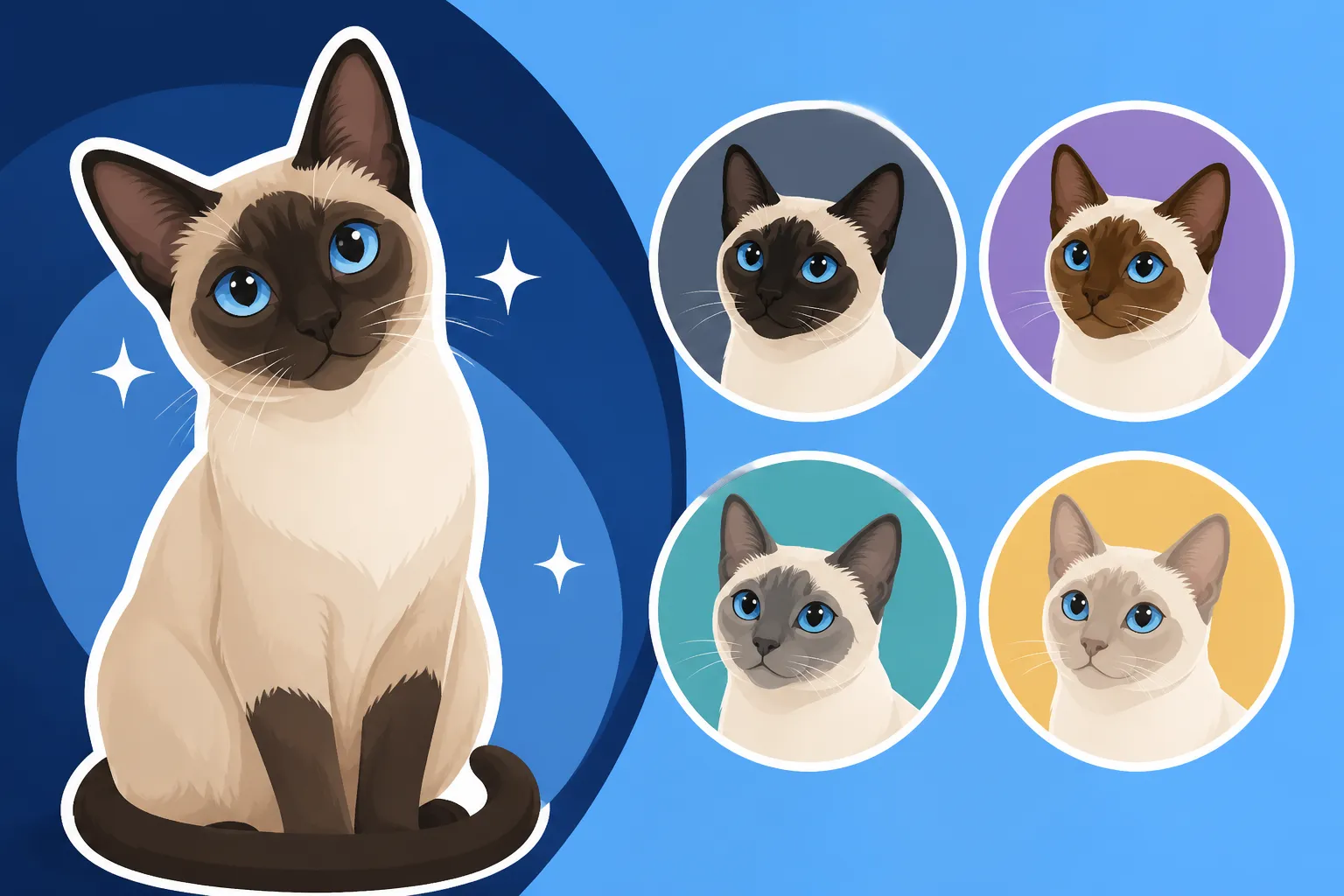
The CFA’s accepted Siamese point colors are seal point, blue point, chocolate point, and lilac point. “Point” refers to the darker coloring on a Siamese cat’s face, ears, paws, and tail. The body is generally lighter, though its shade can vary with age, temperature, and the individual cat.
Color alone doesn’t establish that a cat is CFA-registered as a Siamese. Registration also involves pedigree and breed standards. A cat may look Siamese-type without having the documented ancestry required for registration, and a cat with a point color accepted in another breed or registry doesn’t automatically qualify as a CFA Siamese.
Seal point
Seal point is the familiar dark-pointed Siamese look: deep brown coloring on the face mask, ears, paws, and tail, set against a lighter body. The points may look nearly black from a distance, but the color is usually described as a rich, dark brown rather than true black.
The body is often pale cream or fawn when a cat is young. It may darken as the cat matures, and colder conditions can contribute to darker body coloring. That change can make an adult seal point look noticeably less high-contrast than a kitten. If you’re curious about the mechanics behind it, How Temperature Controls a Siamese Cat's Color explains why temperature affects a pointed coat.
Seal is not simply “the darkest Siamese.” It is a specific color category, and the face, ears, feet, and tail should be considered together. A shadow, indoor lighting, or a phone camera’s color correction can make a brown point look black. When comparing photos, look for natural light and several views of the cat rather than relying on one close-up of the face.
Blue point
Blue point coloring is a cool slate-gray shade on the points, paired with a pale body that may have a bluish or cool-toned cast. “Blue” in cat color terminology means a diluted gray, not a bright blue. In some light, blue points can look silver-gray; in warmer indoor lighting, they may appear darker or browner than expected.
People often mistake a blue point for a pale seal point, especially in low-quality photos. Check the ears, tail, and paws in natural light. A blue point should have a consistent cool gray impression across the points, rather than the warm brown cast associated with seal.
The body color can also make identification tricky. A blue point’s coat may not look icy white, and an adult cat may have a deeper body shade than a young one. Coat color descriptions are useful, but they don’t replace pedigree records or a registry’s own assessment. For a broader look at accepted appearances, see Which Colors a Siamese Cat Comes In.
Chocolate point
Chocolate point Siamese cats have warm, lighter brown points, often compared with milk chocolate. The body is generally ivory or cream, creating a softer contrast than the dark seal point pattern.
Chocolate and seal can be confused because both are brown. The distinction is not just whether the points look “dark” or “light” in one photograph. Seal points are usually deeper and more nearly black-brown, while chocolate points have a warmer, clearer brown appearance. The nose leather and paw pads can offer additional clues, but photos may still be misleading.
Age can affect how distinct the points appear against the body. A young chocolate point may look very pale overall, while the points become easier to recognize as the cat matures. If you’re comparing a kitten’s appearance with its eventual color, How Old a Siamese Cat Kitten Is When Points Show offers helpful context.
Lilac point
Lilac point is a pale, cool-toned color, commonly described as frosty gray with a pinkish or lavender cast. The body is usually very light, so the contrast between body and points may be subtler than it is in a seal point.
This color is particularly easy to misread in photographs. Bright lighting can wash out the points, while warm lighting may make them look beige or pink-brown. Look at several areas—the ears, mask, paws, and tail—and try to judge the overall cool, pale quality rather than expecting a vivid purple shade.
Lilac point is not just a light blue point or a faded chocolate point. It is a distinct color category in the CFA’s Siamese classification. If a listing uses “lilac” as a casual description, that wording alone does not confirm the cat’s registry status or pedigree.
| CFA Siamese color | Typical appearance of the points | Common source of confusion |
|---|---|---|
| Seal point | Deep, warm dark brown | May look black in shadow |
| Blue point | Cool slate gray | Can look like pale seal in poor lighting |
| Chocolate point | Warm, lighter brown | Can be mistaken for seal |
| Lilac point | Pale, frosty gray with a pinkish cast | Can look washed out or beige in photos |
Why Siamese kittens change color
Siamese coloring is temperature-sensitive. The pigment-producing process works differently in cooler areas of the body than in warmer areas, which is why the extremities develop darker points while the torso remains lighter. The same principle explains why a kitten’s color changes after birth and why an adult’s coat may deepen over time.
Why kittens are born pale
A Siamese kitten is generally born very pale because it develops in the warmth of the mother’s body. After birth, its extremities are exposed to cooler air than the warmer central areas, and the points gradually become more visible.
That means a newborn kitten may not yet show the strong face, ear, paw, and tail contrast people expect from an adult Siamese. A breeder may be able to describe the parents’ colors and the kitten’s likely color, but the coat develops over time. For more detail, read Why a Siamese Cat Kitten Comes Out White.
How age and temperature affect the coat
As a Siamese cat grows, its points usually become more apparent. The body may also darken with age, so a mature cat can look less pale than it did as a kitten. Cooler surroundings may contribute to darker fur in some areas, while warmer conditions may be associated with a lighter appearance. These changes happen gradually and do not mean that the cat has changed from one recognized point color to another.
It’s also normal for a cat’s coat to vary somewhat across its body. A cool room, seasonal changes, age, and individual coat characteristics can affect how the color looks. Don’t try to change a cat’s temperature to alter its color; comfort and safe care matter more than achieving a particular shade.
If you notice a sudden, localized change—especially around a shaved patch or medical procedure—it may have a different explanation from the gradual darkening associated with age or temperature. The Shaved Patch That Grows Back Dark on a Siamese Cat explores that particular coat change.
Why photos and labels can be unreliable
Color can look very different depending on the light source, camera settings, and screen. A seal point photographed in dim light may appear almost black. A blue point in warm lighting may look brownish. A pale lilac point photographed in bright sunlight may seem to disappear into the body color.
When identifying a cat from photos, compare more than one image and look at the points in consistent, natural lighting. Be cautious with labels such as “rare,” “pure Siamese,” or “CFA color” when they appear without supporting pedigree information. A color name is a description, not proof of registration.
Colors that are not on the CFA Siamese list
The CFA’s Siamese color list is limited to four point colors. That does not mean other pointed cats are imaginary, unusual, or necessarily less appealing. It means that other color or pattern labels may belong to a different breed classification, a different registry’s standards, or an informal description rather than the CFA’s Siamese category.
Lynx point and tabby-point patterns
“Lynx point” usually describes a pointed cat with tabby-like striping in the colored areas, such as stripes on the legs or face. The term is widely used by cat owners and appears in descriptions of cats from different breed backgrounds. It is not one of the four CFA Siamese point colors listed above.
The word “point” can cause confusion because it describes the location of color, while “lynx” describes a pattern within the points. A cat may have color on the extremities and tabby markings there, but that does not make the color pattern one of the CFA’s four Siamese colors. Breed names and color names are related, but they answer different questions.
For a closer look at the terminology and registry distinctions, see Whether a Lynx Point Is a Siamese Cat or a Colorpoint Shorthair. A label used in a rescue listing or casual conversation may be understandable without being an official CFA Siamese designation.
Flame, tortie, and other point labels
Flame point and tortie point are other labels people may encounter. Flame point commonly refers to reddish or orange points, while tortie point describes a tortoiseshell-like mix of colors in the points. These descriptions may apply to cats recognized under other breed or registry classifications, but they are not among the CFA’s four accepted Siamese point colors.
A common source of misunderstanding is treating “Siamese” as a general term for any cat with a pale body, dark extremities, and blue eyes. Those features can appear in cats with different ancestry. The CFA also has a separate Colorpoint Shorthair breed classification, so a color accepted for one breed should not automatically be assumed to qualify as a Siamese color.
When a breeder or seller describes a kitten as “flame point Siamese,” ask what the registration papers actually say and which registry issued them. You can also ask whether the parents are registered and what color designations appear in their records. Which Point Colors Other Registries Accept in a Siamese Cat explains why the answer can differ between registries.
Appearance does not confirm pedigree
A cat’s looks can suggest a point pattern, but appearance alone cannot confirm a CFA pedigree. A rescue cat may be described as Siamese because it has blue eyes and pointed coloring, even if its ancestry is unknown. That description can be useful shorthand for appearance, but it is different from a documented breed registration.
If you’re considering a kitten from a breeder, ask for the registration information and clarify whether the kitten is being sold as a registered Siamese or simply as a Siamese-type cat. Ask for the exact color designation as well. A breeder should be able to explain what the paperwork represents and what it does not establish. For a useful overview of the breed’s appearance standards, see What the Siamese Cat Standard Asks For.
How to identify a CFA-accepted Siamese color
Start by observing the cat’s points in natural light. Compare the face, ears, paws, and tail rather than judging from one area. Then consider whether the overall point shade is deep warm brown, cool gray, lighter warm brown, or pale frosty gray. These are helpful visual clues, not a substitute for formal registration.
If the cat is a kitten, allow for its coat to develop. A very pale kitten may not yet show clear points, and the adult body color may be darker than the early kitten coat. Ask the breeder about the parents’ colors and the kitten’s registration documents instead of expecting a newborn’s appearance to settle every question.
If the cat is an adult, look for consistent color across the points and remember that lighting can distort what you see. A veterinary professional can help assess a coat or skin concern, but registry classification is a separate matter. If your main question is about whether a cat is officially a Siamese, pedigree documentation is more informative than a photograph or a color label.
The practical takeaway is straightforward: the four CFA-accepted Siamese point colors are seal, blue, chocolate, and lilac. Other point-color names may be used for cats recognized in other classifications or described informally, but they should not be confused with the CFA’s Siamese color list.
Disclaimer
This article is for general informational purposes only and does not constitute professional advice. Laws, prices and regulations vary by location and change over time. Consult a qualified professional for guidance on your specific situation.