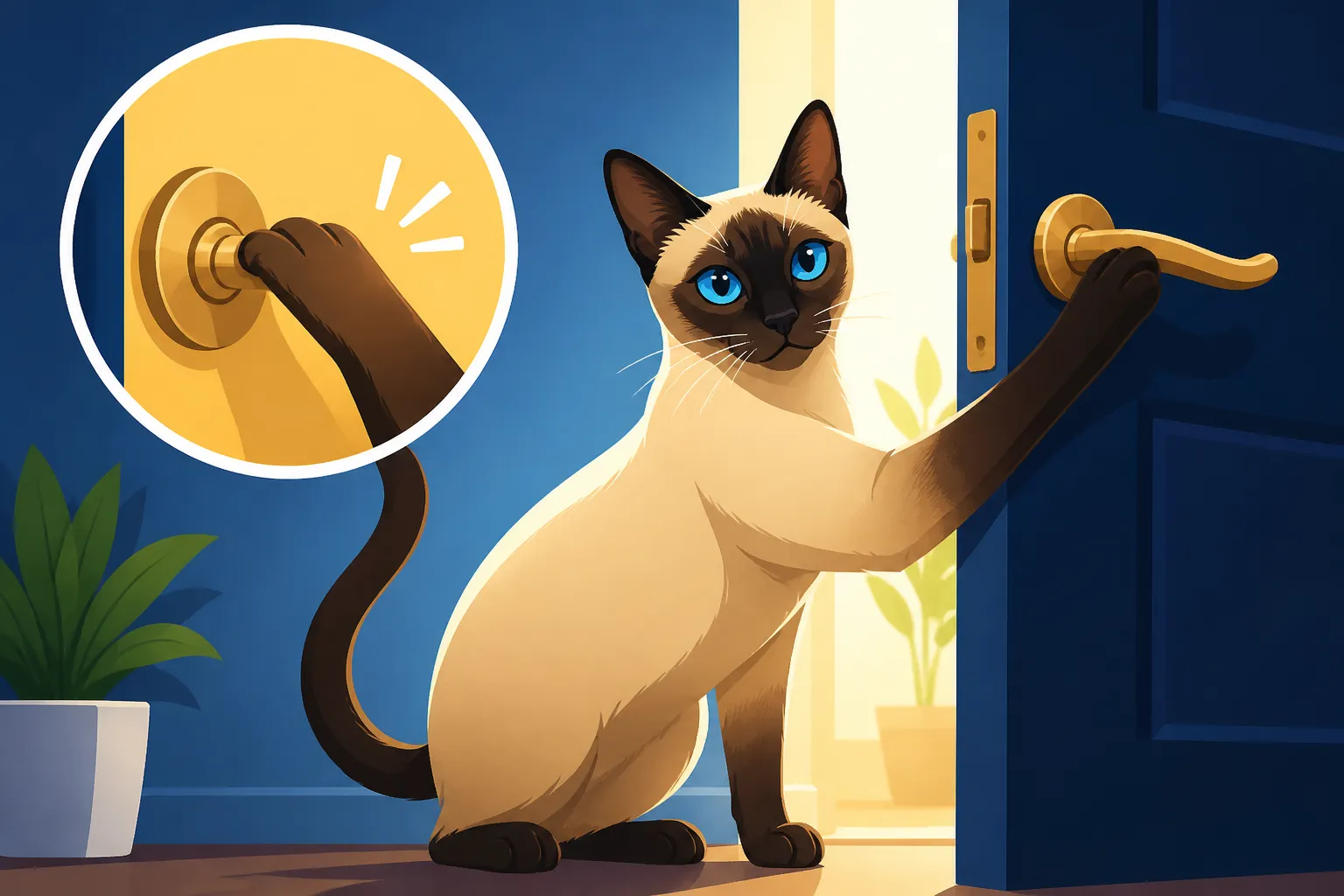
How a Siamese Cat Opens Doors
If you've ever woken up to find a door mysteriously ajar, or walked into a room only to discover your Siamese cat lounging where they absolutely shouldn't be, you're not alone. Siamese cats are notorious for their intelligence and their uncanny ability to navigate human dwellings, often figuring out mechanisms that baffle other felines. This guide will delve into the ingenious methods your Siamese uses to open doors and, more importantly, how you can outsmart your clever companion.
The Siamese Cat's Innate Intelligence and Curiosity
Siamese cats are often hailed as the "dogs of the cat world," and for good reason. They are incredibly intelligent, highly communicative, and possess a boundless curiosity that can often lead them into mischief – or in this case, into rooms they're not supposed to be in. Their minds are constantly whirring, observing, and processing, making them formidable problem-solvers when a closed door stands between them and their desires.
Their Problem-Solving Prowess
It's not just a lucky swipe; Siamese cats are keen observers. They watch you, they learn from you, and they experiment. Think about how many times your Siamese has followed you around, watching your every move. They pay attention to how you turn a doorknob, how you push or pull a door, and even the subtle shift in your weight as you pass through. This isn't just endearing; it's data collection for their next grand escape. They might not understand the full mechanics of a latch, but they understand cause and effect. If swatting at a lever handle makes the door swing open, they'll quickly connect those dots.
For instance, I once had a Siamese named Ming who would sit patiently on the landing, completely still, as my partner opened the bedroom door. He wasn't just waiting to come in; he was studying the angle of the wrist, the pressure applied, the sound of the latch disengaging. A few days later, we found him batting at the same handle, attempting to replicate the motion. It's a testament to their focus and determination. This kind of intelligence is why we often say How Clever a Siamese Cat Is.
The Drive to Explore
A closed door is not a barrier to a Siamese cat; it's a challenge, an unsolved mystery, a forbidden treasure chest. Their intrinsic curiosity is a powerful motivator. If they suspect there's something interesting on the other side – a new sunbeam, a forgotten toy, or simply you – they will dedicate themselves to finding a way through. This isn't out of malice, but pure, unadulterated feline inquisitiveness. They thrive on mental stimulation, and a locked door presents a mental puzzle they're eager to solve.
Imagine the sheer delight for a Siamese who, after minutes of effort, finally pries open a closet door to discover a treasure trove of forgotten sweaters to knead, or a dusty corner to explore. For them, it's a victory, a mental workout, and a new adventure all rolled into one. This constant need for engagement is why providing Enrichment for a Siamese Cat That Gets Bored in an Hour is so crucial. If they're not adequately stimulated, finding ways to open doors can become their primary form of entertainment.
Common Door-Opening Techniques of a Siamese Cat
So, how exactly do these acrobatic, intelligent felines manage to bypass our human defenses? It usually comes down to a combination of observation, dexterity, and sheer persistence. Each type of door handle presents a unique challenge, and your Siamese is probably already a master of one or more of these techniques.
Jumping and Hooking Latches
This is, by far, the most common and effective method for Siamese cats dealing with lever-style door handles. These handles are essentially giant levers for a cat's paws. Your Siamese will jump up, often using their hind legs for leverage against the door or wall, and use a front paw to bat down the handle. They might hook their claw under it and pull, or simply throw their body weight onto it. Once the handle is depressed, the latch retracts, and gravity (or a gentle push from the cat) does the rest.
I recall a client whose Siamese, named Jasper, would literally leap at the bathroom door handle, hanging from it for a split second, just long enough for the latch to give way. The force of his jump and subsequent landing would often be enough to swing the door open. It was less about finesse and more about brute force combined with perfect timing. They learn that a quick, decisive action is what's needed. This is particularly effective with handles that are a bit loose or doors that don't quite catch firmly in the frame.
Pushing and Pulling Standard Knobs
While less common than with lever handles, some truly determined and ingenious Siamese cats can figure out round doorknobs. This usually requires a good grip and rotational force, which isn't easy for a paw. However, I've heard stories (and seen videos!) of cats learning to bat at the knob repeatedly until it turns just enough, or, more likely, pushing and pulling at doors that aren't fully latched.
Picture this: your Siamese stands on their hind legs, front paws scrabbling at the doorknob. They might not be able to twist it, but if the door isn't perfectly closed, they'll push their head into the gap, or wedge a paw in, pulling or pushing with all their might. They learn that a persistent shove or a well-placed claw can sometimes overcome a less-than-secure latch. They also learn that if they can just get a paw under the door, they can then hook and pull with surprising strength. It’s a game of leveraging their body weight and incredible dexterity to exploit any weakness in your home’s defenses.
The Door Frame Shimmy and Scratch
Sometimes, direct manipulation of the handle isn't the primary strategy. Instead, a Siamese cat might employ a more indirect, but equally effective, method: persuasion. They might not open the door, but they'll certainly get you to. This involves a lot of vocalization (we all know What the Siamese Cat's Meezer Yowl Sounds Like), scratching at the door frame, or even a determined shimmying tactic.
My first Siamese, a gorgeous seal point named Coco, never quite mastered the lever handle. Instead, she became a master of the "door frame shimmy." She would wedge her head into the tiniest gap between the door and the frame, then push with her head and body, slowly working the door open. If that didn't work, she'd resort to loud, insistent yowls and vigorous scratching at the bottom of the door, knowing full well that the noise would eventually rouse a human to her service. She knew that A Siamese Cat Will Not Be Ignored, and her persistence often paid off. They quickly learn that if they make enough noise and commotion, you, their devoted staff, will eventually come and grant them access.
Securing Your Home Against Your Clever Feline Burglar
Once you understand how your Siamese is becoming a master locksmith, you can start to implement strategies to keep them contained when necessary. This isn't about punishing their intelligence, but about establishing boundaries for their safety and your peace of mind.
Addressing Lever Handles
Lever handles are undoubtedly the easiest for a Siamese cat to manipulate. The good news is there are several relatively simple solutions. One popular option is to install child-safety locks over the handles. These usually require a human hand to squeeze a trigger or press a button, which is beyond a cat's dexterity. You can find many varieties of these on Amazon. Another approach, if practical, is to replace lever handles with round doorknobs on critical doors. While some highly skilled cats might manage round knobs, they are significantly more challenging.
For doors that don't need to be opened frequently, or in areas where aesthetics aren't paramount (like a utility closet), you could even install a simple hook and eye latch higher up on the door, out of your cat's jumping reach. Sometimes, a simple piece of string or a bungee cord wrapped around both handles, or from a handle to a nearby fixture, can also deter them by preventing the lever from fully depressing. Remember, the goal isn't to make it impossible, but too difficult for their usual tactics.
Tackling Round Doorknobs
If your Siamese has somehow mastered the round doorknob, you're dealing with a truly exceptional feline! While rarer, it's not impossible for their determined nature. For these super-smart felines, special cat-proof doorknob covers exist. Similar to child-proofing devices, these covers encase the doorknob, making it smooth and impossible for a cat to grip and turn. They typically require a human to grasp and compress a specific area of the cover to engage the knob underneath.
Beyond physical deterrents, ensure your doors are always fully latched. A door that's just barely clicked shut is an invitation for a persistent Siamese to push or pull their way through. A solid, well-installed door and frame are your first line of defense. If you find your doors rattling or not quite sealing correctly, a quick adjustment by tightening hinge screws or adjusting the strike plate can make a world of difference.
Reinforcing Door Security and Mental Engagement
Beyond specific hardware solutions, a multi-pronged approach is always best. Make sure all doors, especially exterior ones or those leading to dangerous areas like a basement or garage, are truly secure and can't be jiggled open. But it's not just about locking them out; it's about giving them less reason to want to break in.
A bored Siamese is a mischievous Siamese. If your cat is constantly trying to get into places, it might be a cry for more mental and physical stimulation. Are they getting enough playtime? Do they have puzzle feeders? Enough vertical space to climb? Consider investing in interactive toys, cat trees, and regular dedicated play sessions. A cat wheel can also provide an excellent outlet for their boundless energy. A Siamese who is well-exercised and mentally engaged is less likely to focus their brilliant mind on unlocking your pantry. This kind of robust enrichment can also help prevent them from What a Bored Siamese Cat Destroys out of frustration.
| Door Handle Type | Siamese Cat Method | Recommended Solution |
|---|---|---|
| Lever Handle | Jumping, hooking, body weight | Child-safety locks, vertical handles, hook & eye latch |
| Round Doorknob | Gripping, twisting, pushing/pulling | Doorknob covers, ensure full latch engagement |
| Unlatched Door | Pushing, pawing, wedging body | Adjust strike plate, tighten hinges, extra security |
| Any Door | Vocalization, scratching, shimmy | Provide enrichment, consistent ignoring, secure door |
Why Your Siamese Cat Wants to Open Doors
Understanding the motivation behind your Siamese's door-opening antics can help you address the root cause, rather than just the symptom. It's rarely about malice; it's usually about their fundamental needs and instincts.
The Quest for Company and Attention
Siamese cats are famously social creatures. They thrive on companionship and bond intensely with their human families. A closed door, for them, often means separation from their favorite people. If you're in a room they can't access, they'll often see it as an injustice that must be rectified. Their persistent attempts to open doors, often accompanied by insistent meowing, are a direct plea for interaction and inclusion. They don't just want to be in the same house; they want to be in the same room as you.
This deep need for connection means they will go to great lengths to be near you. My Siamese, Luna, will sit by the bathroom door and "sing the song of her people" until I open it, even if she just wants to lie on the bath mat while I shower. It's not about needing anything specific; it's about wanting to be part of whatever you're doing. This strong desire for human connection is a core part of their personality, and it ties directly into Why a Siamese Cat Follows You Room to Room. They genuinely want to be involved in your life, and a closed door is an obstacle to that.
Accessing Resources or Fun
Beyond companionship, your Siamese might be trying to open a door to gain access to something specific. Is the food stored in the pantry? Are their favorite toys in the living room while you're in the bedroom? They learn the layout of your home and associate certain rooms with certain rewards. If they're hungry, or simply want to play, a door standing in their way is merely a challenge to overcome.
Consider a scenario where your Siamese observes you getting treats from a specific cupboard. Their mind will immediately associate that cupboard with deliciousness. Next thing you know, they'll be trying to figure out How a Siamese Cat Gets Into Cupboards. It's a goal-oriented behavior. They see the desired object, they see the barrier, and they try to bridge the gap. Ensuring their food, water, and primary play areas are always accessible can reduce some of this motivation, but their natural curiosity means they'll always be looking for new "resources" to discover.
Separation Anxiety or Boredom
While often playful, persistent door-opening can sometimes be a sign of underlying issues like boredom or even separation anxiety. If your Siamese is left alone for long periods without adequate mental or physical stimulation, they can become anxious or destructive. The door becomes a symbol of your absence, and opening it is a frantic attempt to break free and find you.
If you notice excessive vocalization, destructive behavior, inappropriate elimination, or frantic attempts to escape confined spaces when you're gone, your Siamese might be experiencing separation anxiety. Signs a Siamese Cat Has Separation Anxiety can manifest in many ways, and trying to open doors could be one of them. For these cats, simply locking them in won't solve the problem; it might even exacerbate it. Instead, you'll need to focus on reducing their anxiety through routine, enrichment, and potentially even considering a companion cat if they are truly unhappy being left alone. For some Siamese cats, finding Whether a Siamese Cat Is Happier in a Pair can make a huge difference to their overall well-being and reduce unwanted behaviors.
Ultimately, your Siamese cat's ability to open doors is a testament to their incredible intelligence and relentless spirit. While it can be frustrating, it's also a part of what makes them such captivating companions. By understanding their motivations and their methods, you can implement effective strategies to keep both your home and your clever cat safe and happy.
Disclaimer
This article is for general informational purposes only and does not constitute professional advice. Laws, prices and regulations vary by location and change over time. Consult a qualified professional for guidance on your specific situation.