How the Tonkinese Came From the Siamese Cat
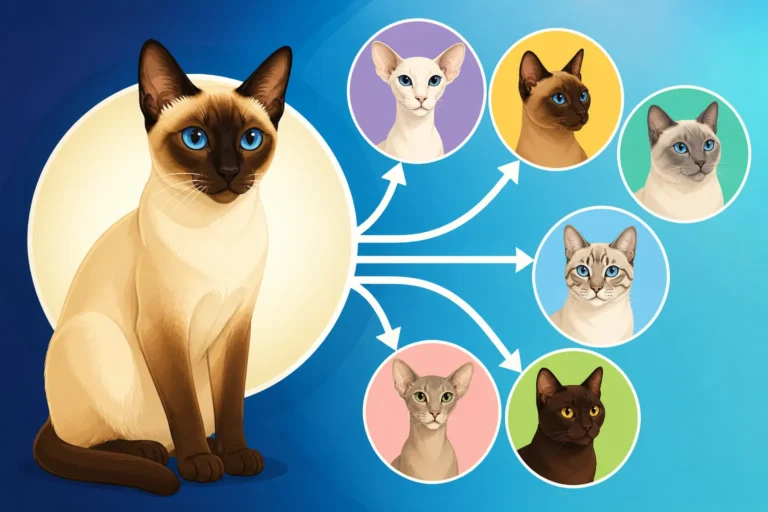
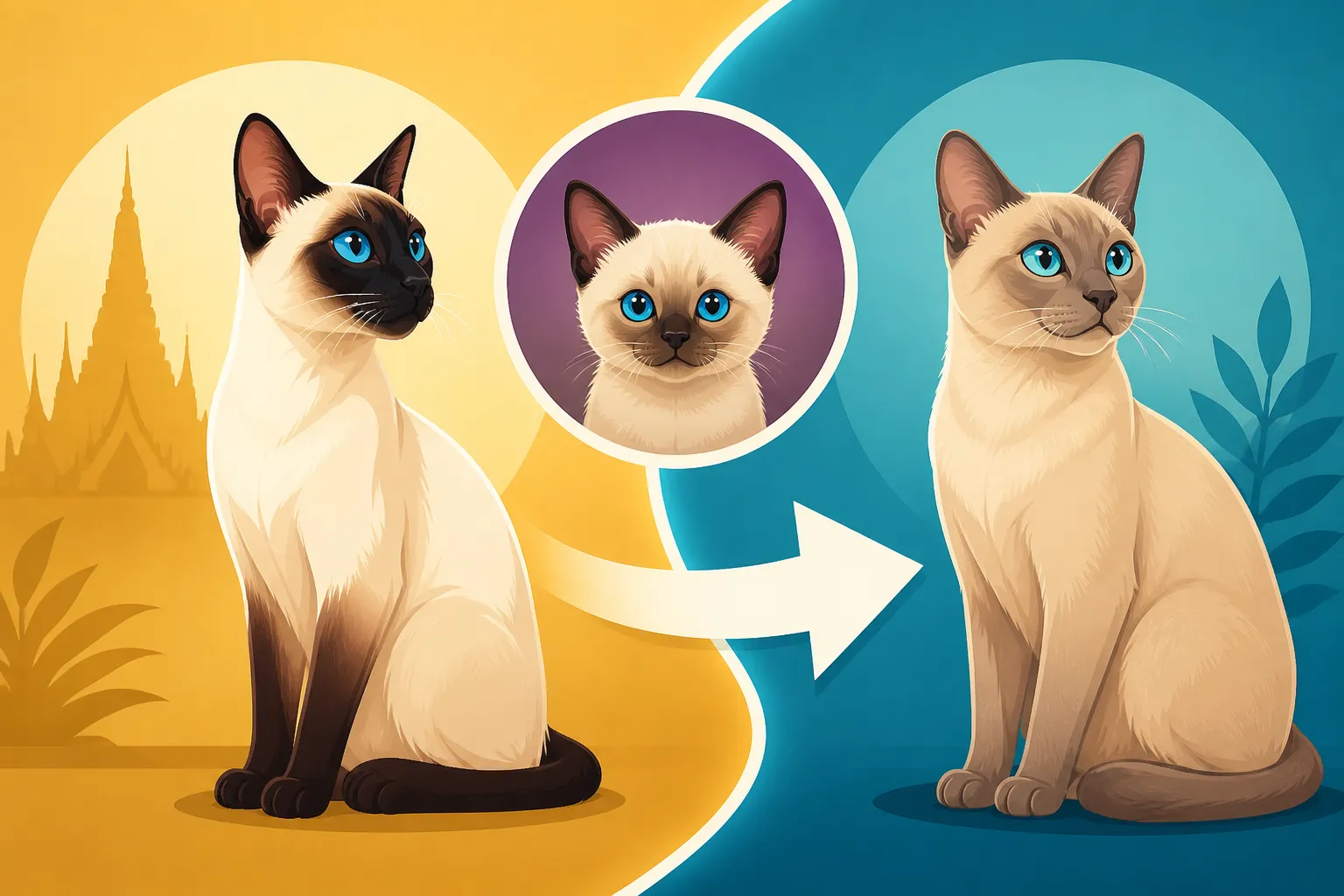
The Tonkinese did not come from the Siamese alone. The breed was developed by crossing Siamese and Burmese cats, then selectively breeding cats with a distinctive blend of traits. That history explains why Tonkinese cats can look familiar to Siamese fans while having their own coat patterns, eye colors, and breed identity.
How Siamese and Burmese Cats Contributed to the Tonkinese
The Siamese influence
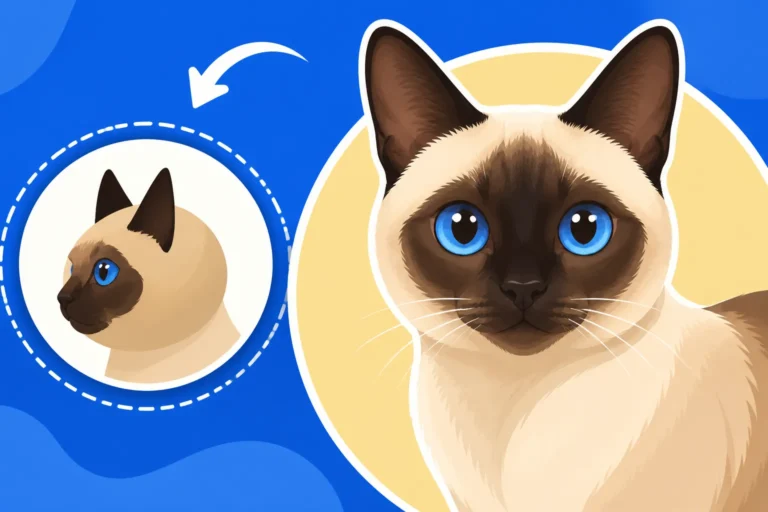
Siamese cats contributed much of the Tonkinese’s elegant, athletic appearance and colorpoint heritage. Their darker points—on the face, ears, legs, and tail—reflect a temperature-sensitive pigment pattern: cooler parts of the body develop darker fur than warmer areas. Siamese cats also helped pass on the vivid, people-focused character often associated with Tonkinese cats, though personality always varies from one individual to another.
The Siamese contribution is especially visible in Tonkinese cats with pointed coats and blue eyes. But the Tonkinese is not simply a Siamese with a different name or a less extreme body type. Its defining appearance comes from a blend of Siamese and Burmese traits, and its breed standards describe a cat in its own right. For a closer look at the Siamese side of that comparison, see How a Siamese Cat Differs From a Tonkinese.
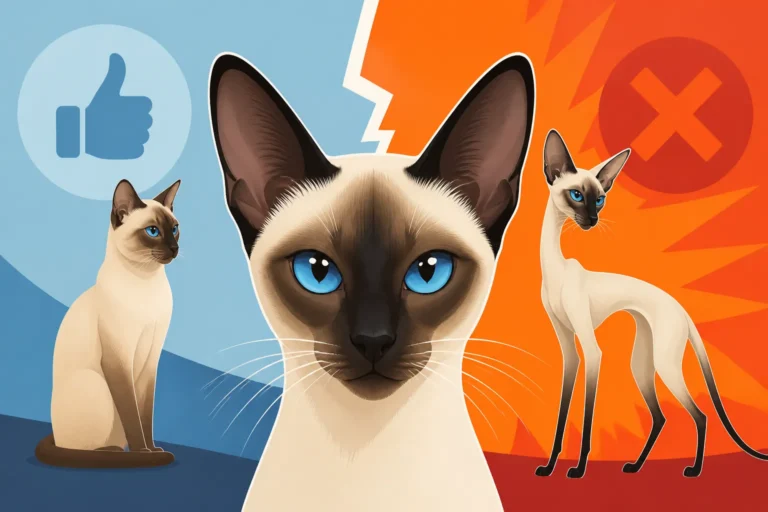
It also helps to remember that “Siamese” can mean different things in everyday conversation. Some people picture the long, angular modern show type; others mean an older, more moderate-looking cat. That variation can make it hard to judge ancestry from appearance alone. A cat that looks like a Siamese mix is not necessarily a Tonkinese, and visual resemblance cannot confirm a cat’s pedigree.
The Burmese influence
The Burmese contributed a more compact, muscular build and a different expression of the colorpoint pattern. Burmese cats are generally associated with rich, even coat colors and gold-toned eyes, while Siamese cats are known for strong contrast between pale bodies and dark points, along with blue eyes. The Tonkinese sits between those visual extremes in a way that makes the two parent breeds recognizable without simply copying either one.
The history of the Burmese breed is part of the wider story. One often-discussed foundation cat, Wong Mau, was brought to the United States from Burma in the early twentieth century and bred with a Siamese cat. The cats in the resulting litters showed different coat and color expressions. That history is connected to the development of Burmese cats, but it is not the whole story of the Tonkinese as a recognized breed. The Tonkinese was developed later through deliberate Siamese–Burmese breeding and selection.
The Siamese and Burmese also contributed different versions of the same pigment-related gene. In Tonkinese cats, the combination can produce the mink pattern, often accompanied by aqua eyes. That combination is a key reason the Tonkinese looks like a true midpoint between the parent breeds. For broader context on the Siamese family tree, Which Breeds Came Out of the Siamese Cat explains how breeders developed several related breeds from Siamese ancestry.
A blend, not a halfway-made Siamese
Calling the Tonkinese “half Siamese and half Burmese” is a convenient shorthand, but it can be misleading. It may describe the breed’s historical roots, but it does not mean every Tonkinese today is a direct first-generation cross. Once breeders began selecting for consistent traits and maintaining breeding lines, the Tonkinese became an established breed rather than a label for any Siamese–Burmese-looking cat.
Nor does “in between” mean unfinished or less pure. The Tonkinese has a recognizable combination of coat pattern, eye color, body type, and temperament. Individual cats may lean more toward one parent breed in certain features, but a registered Tonkinese is bred according to the standards accepted by its registry. That distinction matters when comparing a pedigreed cat with a mixed-breed shelter cat who happens to have aqua eyes and a mink-colored coat.
How Breeders Developed a Distinct Breed
Siamese–Burmese crosses became a breeding program
The Tonkinese took shape through breeding programs that paired Siamese and Burmese cats in the mid-twentieth century. Breeders were interested in a cat that combined the Siamese’s pointed coloring with the Burmese’s richer body color and sturdier appearance. When the two breeds were crossed, kittens could show different combinations of coat color, eye color, and body type. Breeders then selected cats that best matched the emerging Tonkinese look.
The work took place in more than one place, including Canada and the United States. As the breed gained supporters, breeders worked to establish a consistent type rather than relying on occasional crossbred litters. That meant paying attention not only to the kitten’s coat, but also to health, structure, temperament, and the traits likely to be passed to future generations.
This kind of development takes time. A litter may include kittens who resemble Siamese cats, Burmese cats, or something between them. Breeders who are trying to establish a breed need to make careful choices across generations, while avoiding the assumption that the most visually striking kitten is automatically the best breeding candidate. The history is therefore a story of planned selection, not one single pairing that instantly created the modern Tonkinese.
Mink coloring helped define the Tonkinese
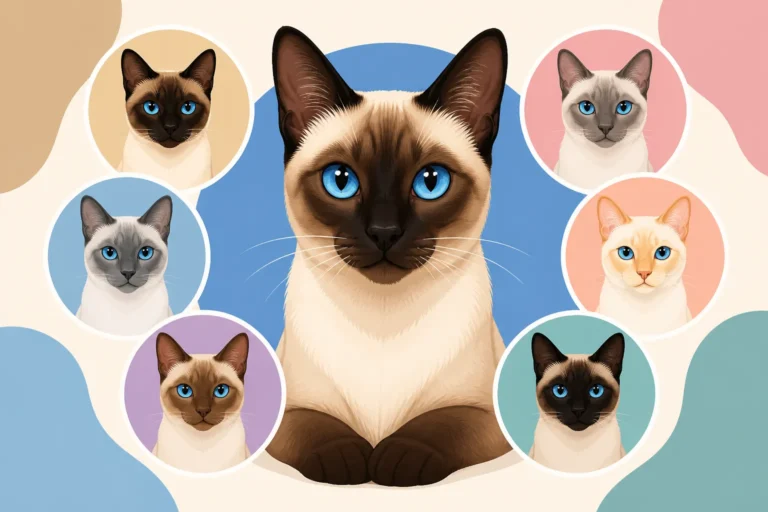
The Tonkinese is commonly described in three coat-pattern categories: pointed, mink, and solid, sometimes called sepia. These categories reflect different expressions of inherited color patterns. Mink is especially associated with the breed because it often combines a noticeable contrast between body and points with aqua eyes. The exact shade can vary, and not every Tonkinese has the same eye color or degree of contrast.
| Coat pattern | General appearance | Eye color often associated with it |
|---|---|---|
| Pointed | Pale body with darker face, ears, legs, and tail | Blue |
| Mink | Moderate contrast between body and points | Aqua |
| Solid or sepia | More even, darker body color | Gold or green tones |
These are broad descriptions, not a reliable way to identify a cat’s breed by sight. Lighting, age, coat color, and individual variation can all affect how a cat appears. A kitten’s coat and eye color may also change as it matures, so a quick look at a young cat is not enough to establish its eventual appearance or pedigree.
The genetics behind the pattern explain why the Tonkinese can look so distinctive, but they do not replace a pedigree or a breeder’s records. If you are exploring how colorpoint patterns work in Siamese cats, Which Gene Makes a Siamese Cat's Points and Why a Siamese Cat's Eyes Are Blue provide useful background on related traits.
Breed recognition came after the cats had a recognizable type
Developing a breed and gaining recognition for it are separate steps. Breeders first need to produce cats with sufficiently consistent traits. Then a cat registry may evaluate the breed and decide whether to accept it, and under what standard. Different registries can use different rules for permitted colors, body type, or registration.
That is why a Tonkinese’s exact classification may depend on the registry involved. If you are considering buying a kitten, ask which registry the breeder uses and what documentation comes with the cat. Registration papers can help establish a pedigree, but they are only one part of evaluating a breeder. You should also ask about the parents’ health, the kittens’ early care, and how the breeder matches kittens with homes.
Breed standards can also clarify why a Tonkinese should not be judged as a Siamese that misses the Siamese ideal. The two breeds are related, but they are assessed as distinct cats. To understand how those standards shape the Siamese side of the comparison, see What the Siamese Cat Standard Asks For and What a Siamese Cat Looks Like by the Standard.
What Makes a Tonkinese Different From a Siamese
Coat and eye color offer clues, not proof
A Tonkinese may have a mink coat and aqua eyes, which can make it look different from the classic Siamese image of a pale body, dark points, and blue eyes. Yet there is no single look that applies to every cat. Tonkinese coats come in several colors and patterns, and the amount of contrast can vary. Siamese cats also vary in appearance, especially when people use the name to refer broadly to cats with Siamese ancestry rather than only to registered cats meeting a particular standard.
This overlap is one reason people often ask whether their cat is a Tonkinese. A cat with a medium-contrast coat, aqua eyes, and a sleek body may resemble one, but resemblance does not prove ancestry. Many mixed-breed cats inherit combinations of coat and eye traits that look similar. If breed identity matters—for example, when buying from a breeder—the most useful evidence is documented lineage, not a photo-based guess.
Color also does not tell you everything about a cat’s health or personality. A coat pattern is an inherited appearance trait, not a guarantee that a cat will be more sociable, more vocal, or easier to care for. When looking at any Siamese-related breed, it is more useful to ask about the individual cat’s health history and observed temperament than to assume those qualities from its color.
Body type and temperament are not exact formulas
Tonkinese cats are often described as medium-sized, muscular, and active, with a body that can look more substantial than a very slender Siamese. But there is variation within both breeds. Nutrition, age, sex, and individual build all affect what a healthy cat looks like, so a broad breed description should not be used as a substitute for veterinary advice about a particular cat.
The same is true of temperament. Tonkinese cats are often social and interactive, traits that many people also associate with Siamese cats. That does not mean every Tonkinese will behave the same way, or that a Siamese cat will necessarily be more talkative or demanding. Early socialization, past experiences, home environment, and individual personality all matter.
If you are choosing between the breeds, consider the day-to-day fit rather than expecting a guaranteed personality. Think about how much company the cat will have, whether there are children or other pets at home, and how you will provide play and interaction. The Tonkinese and Siamese may share a reputation for being people-oriented, but a particular kitten or adult cat still deserves to be assessed as an individual.
A Tonkinese is not simply a “Siamese mix”
In everyday conversation, “Siamese mix” is often used for any cat with a colorpoint coat or Siamese-like appearance. That phrase may be reasonable when a cat’s ancestry is unknown, but it is not equivalent to “Tonkinese.” The Tonkinese is a recognized breed with a history of selective breeding, while “Siamese mix” is a general description of appearance or suspected ancestry.
This difference can matter when adopting. A shelter may describe a cat as a Siamese mix based on its looks, but without known parentage, that label may be an estimate. The cat can still be a wonderful companion; the point is simply that breed labels do not always carry the same degree of certainty. If you are adopting, prioritize the cat’s personality, health needs, and compatibility with your home over a label that may be based on appearance alone.
For a broader look at related cats and their histories, How the Siamese Cat Differs From an Oriental Shorthair and How the Siamese Cat Differs From a Balinese show why shared ancestry does not make these breeds interchangeable. The Tonkinese has its own place in that family tree, with traits shaped by both Siamese and Burmese ancestry.
Choosing and Caring for a Tonkinese
Questions to ask a breeder or rescue
If you are speaking with a breeder, ask how long they have worked with Tonkinese cats and which registry recognizes their breeding cats. Ask to see the kitten’s pedigree and learn about the health and temperament of both parents. A responsible breeder should be willing to explain the breed’s history and the kitten’s care rather than relying on claims such as “rare,” “pure,” or “just like a Siamese” without documentation.
You can also ask how kittens are raised, what veterinary care they have received, and how the breeder handles concerns after a kitten goes home. These questions are useful whether you are choosing a Tonkinese or another breed with Siamese ancestry. Where the Siamese Cat Comes From offers additional historical context if you want to understand the roots behind the Siamese side of the Tonkinese story.
With a rescue cat, ask what is known about the cat’s background and medical history. A rescue organization may have limited information, especially if the cat was found as a stray or surrendered without records. In that situation, a careful veterinary examination and time spent observing the cat’s behavior can tell you more about its practical needs than an uncertain breed guess.
Plan for attention, play, and ordinary cat care
Because Tonkinese cats are often active and sociable, plan for daily interaction, play, and places to climb or explore. Wand toys, puzzle feeders, scratching surfaces, and regular play sessions can help keep an indoor cat engaged. Rotating toys can make familiar items feel more interesting without requiring a constant stream of new purchases. If you are comparing food, toys, or basic supplies, retailers such as Chewy can be one place to review product information; use ingredient labels and your veterinarian’s advice to guide food choices.
A cat who enjoys company may find long stretches alone difficult, but that does not mean every Tonkinese needs another cat. Some do well as only pets when their people provide predictable interaction, while others may benefit from a compatible companion. Introductions should be gradual, and the resident cat’s personality matters more than the idea that two cats of the same breed will automatically get along.
As you prepare your home, focus on practical needs rather than breed stereotypes. Make sure the cat has clean litter, fresh water, scratching options, safe resting places, and routine veterinary care. Chewy and other pet retailers can help you compare carriers, litter supplies, and enrichment items, but the best choices depend on your own home and cat. For a cat who is nervous around change, introduce new items gradually and keep familiar food, bedding, and routines in place.
Keep the breed story in perspective
The Tonkinese is a helpful example of how breeds develop: breeders combine existing traits, select for a consistent look and temperament, and work toward recognition under a defined standard. The Siamese contributed the colorpoint heritage and some of the Tonkinese’s familiar elegance; the Burmese contributed another expression of color and a more substantial build. Together, those influences produced a breed that is related to both, but not identical to either.
Understanding that history can make breed descriptions easier to interpret. A Tonkinese is not simply a Siamese with aqua eyes, and a cat who resembles a Tonkinese is not automatically a pedigreed Tonkinese. Whether you are researching ancestry, choosing a kitten, or adopting an adult cat, the most reliable approach is to combine documented history where available with attention to the individual animal in front of you.
Disclaimer
This article is for general informational purposes only and does not constitute professional advice. Laws, prices and regulations vary by location and change over time. Consult a qualified professional for guidance on your specific situation.