How to Tell a Siamese Cat From a Mixed Breed
A blue-eyed, cream-colored cat with dark paws may look unmistakably Siamese, but pointed coloring appears in several breeds and mixed-breed cats too. A narrow face or chatty personality can add to the impression without proving ancestry. This guide explains what appearance can tell you, what it cannot, and how to assess a cat fairly—whether you adopted a stray, are considering a kitten, or are simply curious.
Start with the difference between Siamese type and Siamese ancestry
A pointed coat is a clue, not proof
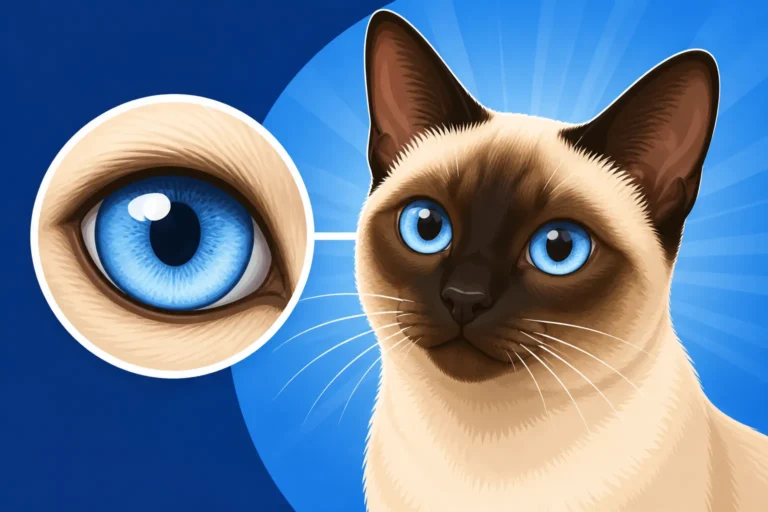
The most recognizable Siamese feature is colorpointing: the cat’s face, ears, legs, and tail are darker than its body. The pattern is linked to a temperature-sensitive pigment gene, so color develops more strongly in the cooler parts of the body. Many Siamese cats also have blue eyes, which are associated with the same colorpoint pattern.
Those traits can make a cat look Siamese, but they do not establish that it is a purebred Siamese. The colorpoint pattern occurs in other pedigreed cats and in mixed-breed cats. A shorthaired cat with blue eyes and dark “points” might be a Siamese, a mix, or a cat with similar coloring whose family history is unknown. For background on the pattern, see Which Colors a Siamese Cat Comes In.
The details of the coat can vary, too. Seal, blue, chocolate, and lilac are familiar point colors, while tabby markings on the points may lead people to use terms such as “lynx point.” Color names can describe what a cat looks like; they do not, by themselves, confirm its breed. Breed standards and accepted color categories can also differ among registries.
Breed identity depends on more than looks
A pedigreed Siamese is a cat whose ancestry is documented through a recognized registry and breeder records. A cat with Siamese-like features but no reliable pedigree is more accurately described as Siamese-type or possibly a Siamese mix. That distinction is not a judgment about the cat’s quality or personality. It simply separates documented ancestry from visual resemblance.
Even a close look at the face and body cannot settle the question with certainty. A pointed coat, blue eyes, and long, slim build may fit the familiar Siamese image, but each feature can occur in cats without known Siamese ancestry. Conversely, a cat with some Siamese ancestry may not strongly resemble the show-standard version of the breed.
If a shelter, rescue, or previous owner calls a cat “Siamese,” ask what that label is based on. It may come from a pedigree, a known parent, or simply the cat’s appearance. That history can be helpful, but it is worth distinguishing what someone knows from what they are guessing.
Compare the features without treating any one of them as decisive
Look at coat, eyes, and body together
A typical Siamese has a short, close-lying coat, a pointed pattern, and blue eyes. Many also have a lean, long-bodied outline, long legs, a fine tail, and a wedge-shaped head with large ears. The exact look varies: breed standards have shaped the modern Siamese silhouette, while cats described as traditional or applehead Siamese may have a rounder head and sturdier appearance. See What a Siamese Cat Looks Like by the Standard, What an Applehead Siamese Cat Is, and What a Wedge Headed Siamese Cat Is for more on those differences.
When you assess a cat, take in the whole picture rather than checking off traits one by one. For example, a blue-eyed, cream-colored cat with dark paws has an obvious point pattern, but that does not tell you whether its head shape, coat, or body reflects Siamese ancestry. A lean frame or large ears may add to the resemblance, yet neither feature is exclusive to the breed.
Age and condition can also change how a cat looks. A kitten’s points may become more visible as it matures, and a cat’s coat shade can shift with age and temperature. Body shape can be affected by growth, health, and weight. A photograph—especially one taken in unusual lighting—may not show color or proportions accurately, so look at the cat in person when possible.
| Feature | Common in Siamese cats | Why it is not conclusive |
|---|---|---|
| Colorpoint coat | Yes | The pattern appears in other breeds and mixed-breed cats |
| Blue eyes | Yes | Blue eyes can occur in cats without Siamese ancestry |
| Lean, long-bodied build | Often | Body shape varies naturally and is not unique to Siamese cats |
| Wedge-shaped head and large ears | Common in modern show types | Traditional types and individual cats may look different |
| Vocal, social behavior | Often associated with the breed | Temperament varies by individual and is not a breed test |
| Pedigree records | Expected for a documented purebred | Records, rather than appearance, establish registered lineage |
Treat personality as background, not a breed test
Siamese cats are often described as social, active, people-oriented, and vocal. Some follow their people from room to room or announce their opinions at dinner time. But cats are individuals, and those behaviors are not exclusive to Siamese cats. A mixed-breed cat may be very talkative, while a pedigreed Siamese may be comparatively quiet.
A cat’s behavior can also reflect its life experience. A shy rescue may need time to feel safe, and a confident, demanding cat may simply have learned that persistent meowing gets attention. Neither response reliably identifies ancestry. If you are trying to understand a cat’s habits, What a Siamese Cat's Temperament Is Really Like and Why a Siamese Cat Meows So Much can help put breed-associated behavior in context.
Use temperament as one part of a broader description, not as evidence that confirms a breed. It can help you understand what kind of home a cat may enjoy, but it cannot replace pedigree records or establish a cat’s family tree.
Check the cat’s history and consider what a DNA test can tell you
Ask for documentation when ancestry matters
If you are buying a kitten and want a pedigreed Siamese, ask the breeder which registry the litter is registered with and what paperwork will accompany the kitten. Ask to see records that connect the kitten to its parents, rather than relying on a verbal description or a photo of a similar-looking cat. You can also read Whether a DNA Test Confirms a Siamese Cat to understand why genetic results and pedigree records answer different questions.
For an adopted adult cat, complete records may not exist. A rescue may know where the cat was found or have information from a previous home, but a breed label in an intake description may be based on appearance. Ask what is known, what is documented, and what is an estimate. It is perfectly reasonable for the answer to be “we don’t know.”
If your main concern is choosing a cat with a particular personality or care needs, focus on the individual animal. Ask about its behavior, medical history, and daily routine. Breed identification may be interesting, but a reliable picture of the cat in front of you is often more useful than a confident-sounding guess about its distant ancestry.
Understand the limits of consumer DNA results
Cat DNA tests may compare a sample with reference populations or look for selected genetic markers. The results can offer clues, but they are not the same thing as a pedigree. A test’s usefulness depends on which breeds and populations its reference database includes, what the test examines, and how the provider interprets the results. An estimate that suggests a relationship to a breed should not automatically be treated as proof of purebred status.
If you are considering a kit sold through a retailer such as Chewy, read the test description carefully and check that it is intended for cats. Before ordering, look for a clear explanation of what the report measures and what its results mean. Chewy or any other retailer can be a place to compare product information, but the retailer’s listing does not make a genetic result equivalent to registered ancestry.
When reviewing a kit listing on Chewy, pay attention to whether it describes breed ancestry, health markers, or both; those are different kinds of results. If you decide to order through Chewy, keep your expectations modest: a DNA report may add context, but it may not deliver a definitive answer about whether a cat is a Siamese. If you have questions about a result that could affect health decisions, discuss it with your veterinarian.
Use a practical identification checklist
Work through the evidence in a sensible order
Start with what you can observe, then separate it from what you can verify. This keeps a familiar-looking cat from being labeled purebred on appearance alone.
- Describe the coat. Note whether the body is lighter than the face, ears, legs, and tail, and whether the darker areas are solid or striped.
- Look at the eyes. Record their color, but remember that blue eyes are not exclusive to Siamese cats.
- Consider the overall build. Note the body length, leg shape, tail, head profile, and ear size without treating any one feature as decisive.
- Ask about behavior and history. These details help you understand the individual cat, but they do not confirm its breed.
- Look for records. A documented pedigree is the strongest evidence of registered Siamese ancestry.
- Use DNA testing cautiously. Treat a consumer result as an estimate or additional clue, not a substitute for records.
As you go, keep separate notes for observations and evidence. “Blue eyes and dark paws” is an observation. “The breeder provided registry paperwork showing this cat’s lineage” is documentation. That simple distinction makes it easier to speak accurately about the cat, especially when sharing information with a vet, rescue, or prospective adopter.
If the cat has a striped pattern on its points, it may be described as a lynx point. That phrase refers to the coat’s appearance, not necessarily to a Siamese pedigree. The relationship between point patterns and breed labels can be confusing, so Whether a Lynx Point Is a Siamese Cat or a Colorpoint Shorthair is a useful next read.
Avoid common identification mistakes
One common mistake is assuming that a pointed cat must be Siamese. Another is assuming that a cat with a rounder face cannot have Siamese ancestry. Breed types and individual appearances vary, and mixed ancestry can produce a wide range of looks. A cat does not need to match a show-ring silhouette to be a wonderful companion—or to have some Siamese ancestry.
It is also easy to confuse a breed name with a color description. “Siamese” refers to a breed, while “colorpoint” describes a coat pattern. Cats from different backgrounds can share that pattern. The same caution applies to labels used casually in advertisements or shelter listings: a description may be intended to help people picture the cat rather than certify its ancestry.
Finally, do not use breed guesses to make medical decisions. If a cat has a symptom or a health concern, base the next step on the cat’s condition and veterinary advice, not on whether it seems Siamese. For a broader look at the breed’s history and variations, see How the Thai Split From the Siamese Cat.
A cat can look strikingly Siamese without having documented Siamese ancestry, and a cat with Siamese ancestry may not match the familiar image perfectly. The most accurate description depends on the evidence: call observed traits what they are, treat behavior as individual, and reserve “pedigreed Siamese” for cats with reliable lineage records.
Disclaimer
This article is for general informational purposes only and does not constitute professional advice. Laws, prices and regulations vary by location and change over time. Consult a qualified professional for guidance on your specific situation.