Whether the Applehead Siamese Cat Lives Longer
An Applehead Siamese may look sturdier than the slim, angular Siamese often seen in show rings, but that appearance does not prove it will live longer. There is no reliable lifespan rule showing that Applehead cats outlive other Siamese. This guide explains what the label means, what can influence longevity, and how to support a Siamese cat through every life stage.
Does an Applehead Siamese Cat Live Longer
There is no confirmed lifespan advantage
“Applehead Siamese” is commonly used for a Siamese with a rounder head and a more substantial build than the modern, wedge-headed show type. It describes an appearance, not a guaranteed health profile or a separate measure of longevity. A round face alone cannot tell you how long a cat will live.
There is no strong evidence that Applehead Siamese cats, as a group, live longer than wedge-headed Siamese cats. Individual cats can reach old age in either type, and some become ill relatively young. Genetics, early care, access to veterinary treatment, indoor safety, and ordinary luck all affect an individual cat’s life.
A breeder or seller may describe an Applehead as “healthier” or “longer-lived.” Treat those claims as a reason to ask more questions, not as proof. Ask about the cat’s parents and relatives, the health issues seen in the family, and what veterinary care the kitten has received. The broader context in How Healthy the Siamese Cat Actually Is can help separate breed reputation from an individual cat’s health needs.
“Traditional” and “Applehead” do not guarantee the same background
The words Applehead, traditional, and old-style are often used informally, and people do not always use them in exactly the same way. Registry definitions and breeder terminology can differ. So two cats both described as Applehead Siamese may not share the same pedigree, body type, or breeding history.
Some families use “Applehead” to mean a less extreme-looking Siamese. Others use it for cats with particular ancestry or for cats that resemble older photographs of the breed. The label by itself does not confirm registration status or tell you whether a cat belongs to a separately recognized breed. For more background, see Whether the Traditional Siamese Cat Still Exists and How the Thai Split From the Siamese Cat.
That distinction matters when someone makes a lifespan comparison. If “Applehead Siamese” refers to a loose mix of appearances and lineages, comparing its lifespan with a more narrowly defined show population is difficult. Without consistent definitions and good long-term health records, a confident claim that one type lives longer than another is not well supported.
A sturdy look is not a health assessment
A broader head or heavier frame is not the same thing as good health. A cat can look robust while carrying an inherited condition, dental disease, or an illness that has not yet caused visible symptoms. Conversely, a fine-boned Siamese can be perfectly healthy at an appropriate weight.
When you assess a cat, look beyond its outline. Notice whether it moves comfortably, breathes quietly, eats and drinks normally, and keeps a clean coat. Ask for veterinary records and a clear account of any known diagnoses. A kitten’s appearance cannot predict its entire adult health, and a healthy-looking adult still needs regular checkups.
For prospective owners, the most useful discussion is often about the family rather than the head shape. Ask what health problems have appeared in close relatives, whether older relatives are still living, and what they died from if they are not. Those details are not a guarantee either, but they can offer more meaningful context than a general claim that a particular type lives longer.
What Shapes a Siamese Cat’s Lifespan
Genetics and family history
Inherited traits can influence health, but no single appearance label captures a cat’s genetic risks. A responsible breeder should be willing to discuss health in the family honestly, including conditions for which there may not be a simple screening test. The questions in What a Siamese Cat Breeder Should Have Screened and Which Health Tests a Siamese Cat Breeder Runs can help you prepare for that conversation.
Family history is useful, but it is not a crystal ball. A cat may develop a condition that has not been reported in its close relatives, and relatives who lived to an advanced age do not guarantee the same outcome for a kitten. The goal is to understand what is known and make sensible plans, not to demand certainty that no breeder can provide.
If you already have an Applehead Siamese, keep a record of veterinary visits, test results, weight changes, and any recurring symptoms. This information can help your veterinarian spot changes over time. It is particularly useful when a problem develops gradually, since small shifts in appetite, drinking, or activity can be easy to miss in a busy household.
Preventive care and early attention
Routine veterinary care gives you a chance to discuss changes before they become urgent. Regular checkups allow a veterinarian to assess weight, teeth, heart and lung sounds, mobility, and other signs that may not be obvious at home. The right visit schedule depends on the cat’s age and health, so ask your veterinarian what makes sense for your cat.
Pay attention to changes in normal behavior. A cat that stops jumping onto a favorite chair, hides more often, loses weight, or begins drinking noticeably more may need an examination. Those signs do not identify a specific disease by themselves, but they are worth discussing rather than waiting for a dramatic decline. Signs a Siamese Cat Is Unwell offers a useful overview of changes owners may notice.
Dental care is another part of the longevity conversation. Cats can be very good at hiding mouth pain, and discomfort may show up as reluctance to eat, dropping food, or avoiding touch around the face. Ask your veterinarian how to care for your cat’s teeth and how often the mouth should be examined. A plan that fits the cat’s temperament is more realistic than expecting every cat to accept brushing immediately.
Indoor safety, nutrition, and a healthy weight
A safe home reduces exposure to hazards such as traffic, fights with other animals, and some infectious diseases. Indoor living does not make a cat immune to illness, but it can reduce certain preventable risks. If your cat enjoys fresh air, secure outdoor access, such as a well-designed enclosure or supervised harness time, can offer stimulation without leaving the cat to roam.
A suitable diet and a stable, healthy weight matter throughout life. Siamese cats can be naturally slender, so don’t judge their condition by comparison with a rounder-bodied cat. Your veterinarian can help you assess body condition and decide whether a weight change is appropriate. If you are buying food or routine supplies, retailers such as Chewy may be one place to compare available options; the important part is choosing a diet that fits your cat’s needs, not a product marketed to a particular head type.
Keep fresh water available and monitor eating habits. A sudden appetite change, unexplained weight loss, or persistent vomiting deserves attention. For practical background on the breed’s build, Why a Siamese Cat Feels Bony explains why a naturally lean outline can be mistaken for underweight—and why a change from that cat’s usual condition matters.
Applehead and Wedge-Headed Siamese Compared
Appearance can vary without predicting lifespan
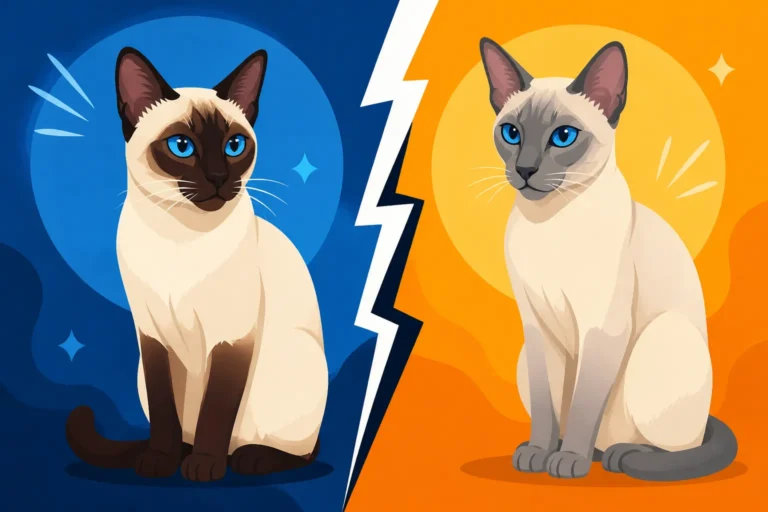
The contrast people often describe is visual: Applehead cats tend to have a rounder head and a fuller-looking body, while modern show Siamese are commonly described as longer, finer-boned, and more angular. These are broad descriptions. Individual cats vary, and labels can be applied inconsistently.
| Feature | Applehead type as commonly described | Wedge-headed type as commonly described | What it tells you about lifespan |
|---|---|---|---|
| Head shape | Rounder or broader | Longer and more angular | No dependable lifespan prediction |
| Overall build | Often described as sturdier | Often described as more slender | Build alone does not establish health |
| Naming | Informal usage varies | Often associated with modern show type | Labels may not correspond to identical populations |
| Health assessment | Requires individual history and examination | Requires individual history and examination | Veterinary care and health history matter more than the label |
The table is a description of common usage, not a diagnostic checklist. A rounder-headed cat can be underweight or unwell, and a slim cat can be in excellent condition. Compare a cat with its own healthy baseline rather than with a stereotype of the “right” Siamese shape.
If you are choosing between cats, temperament and practical fit matter too. A cat’s social needs, activity level, and comfort with household routines will shape daily life far more directly than whether its head looks round or wedge-shaped. Ask to meet the cat when possible and learn how it behaves in familiar surroundings.
How to evaluate a breeder’s lifespan claims
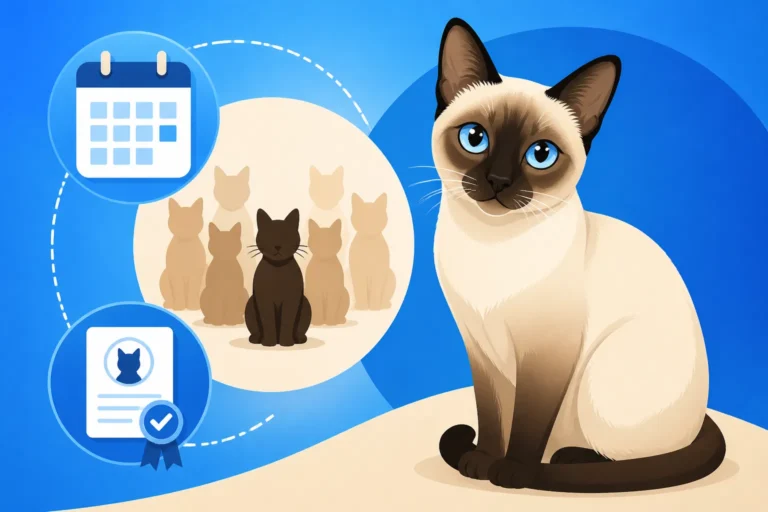
If a breeder says Appleheads live longer, ask what the claim is based on. Is it personal experience with a few cats, records from a wider group, or a documented history across multiple generations? Anecdotes can be meaningful and worth hearing, but they do not establish that a type reliably outlives another.
Ask for ages and causes of death among close relatives when that information is available. Ask whether the breeder knows of recurring health concerns in the family and what steps are taken to reduce known risks. A thoughtful answer may include uncertainty; a guarantee that every kitten will live to a particular age should make you cautious.
Also ask what the breeder’s terminology means. Do they mean a particular registered breed, a certain pedigree, or simply a rounder-looking Siamese? A clear explanation makes it easier to understand what you are being offered. For a wider set of questions about breeder health information, read Which Health Results a Siamese Cat Breeder Can Show.
Helping an Applehead Siamese Reach a Healthy Old Age
Build a routine you can maintain
The best care plan is one that fits your real household. Keep veterinary appointments on the calendar, know where your cat’s records are, and make a note when something changes. If your cat is uneasy in a carrier or at the clinic, ask the veterinary team about ways to make visits less stressful rather than postponing care indefinitely.
At home, make daily needs easy to meet. Keep food and water in accessible places, provide clean litter boxes, and offer comfortable resting spots. For a senior cat, small changes such as a step to a favorite perch or a litter box with an easier entry may help preserve familiar routines as mobility changes.
Food, litter, grooming tools, and other recurring supplies can be organized through a retailer such as Chewy if that suits your household. Shopping convenience is secondary to monitoring whether your cat is actually eating, drinking, and using the litter box normally. A delivery routine should not replace noticing a change in the cat’s behavior or contacting a veterinarian when something seems wrong.
Adjust care as your cat ages
A cat’s needs can shift with age. Some become less active, sleep more, or need help reaching favorite places. Others remain playful but develop changes in hearing, vision, appetite, or grooming. An age-related change is not automatically harmless, though; a veterinarian can help distinguish an expected adjustment from a treatable problem.
Older cats may benefit from more frequent conversations with their veterinary team, especially if they have a chronic condition or a noticeable change in weight, thirst, mobility, or behavior. Keep track of what is normal for your cat. A short note on a phone or calendar can make it easier to explain when a symptom began and whether it is getting worse.
If you are caring for a senior Applehead Siamese, remember that “living longer” is not only about a number of years. Comfort, mobility, appetite, social engagement, and the ability to enjoy familiar activities all matter. Caring for a Siamese Cat Past Twelve offers additional guidance for adapting care as a cat grows older.
Focus on the individual cat, not the label
The honest answer is that Applehead Siamese cats are not known to live longer simply because they have a rounder head or sturdier appearance. A specific cat’s health, background, home environment, and care are more useful guides than the name applied to its type.
That can feel frustrating if you are trying to make a confident choice or hoping a certain look offers reassurance. It is reasonable to ask about longevity, but no appearance label can promise a long life. A careful family-history discussion, routine veterinary care, attention to changes, and a safe, supportive home give you more practical ways to help your cat thrive.
Disclaimer
This article is for general informational purposes only and does not constitute professional advice. Laws, prices and regulations vary by location and change over time. Consult a qualified professional for guidance on your specific situation.