How the Oriental Shorthair Came From the Siamese Cat
A cat with the long, elegant shape of a Siamese but a solid, tabby, or tortoiseshell coat may be an Oriental Shorthair. The breed grew from Siamese lines, but it wasn’t created by simply changing a coat color. This guide explains the history behind the Oriental Shorthair, how breeders developed its wide range of colors, and what sets it apart from its Siamese relatives.
How the Oriental Shorthair developed from Siamese cats
Postwar breeding reshaped the Siamese type
The Oriental Shorthair took shape in Britain after the Second World War. The war had reduced the number of available breeding cats, making it difficult for breeders to continue some established lines. To rebuild their programs, breeders crossed Siamese cats with other shorthaired breeds and domestic cats.
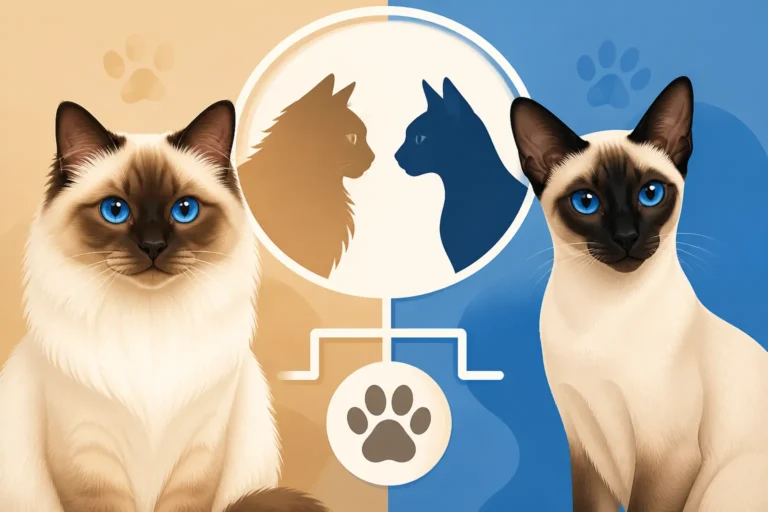
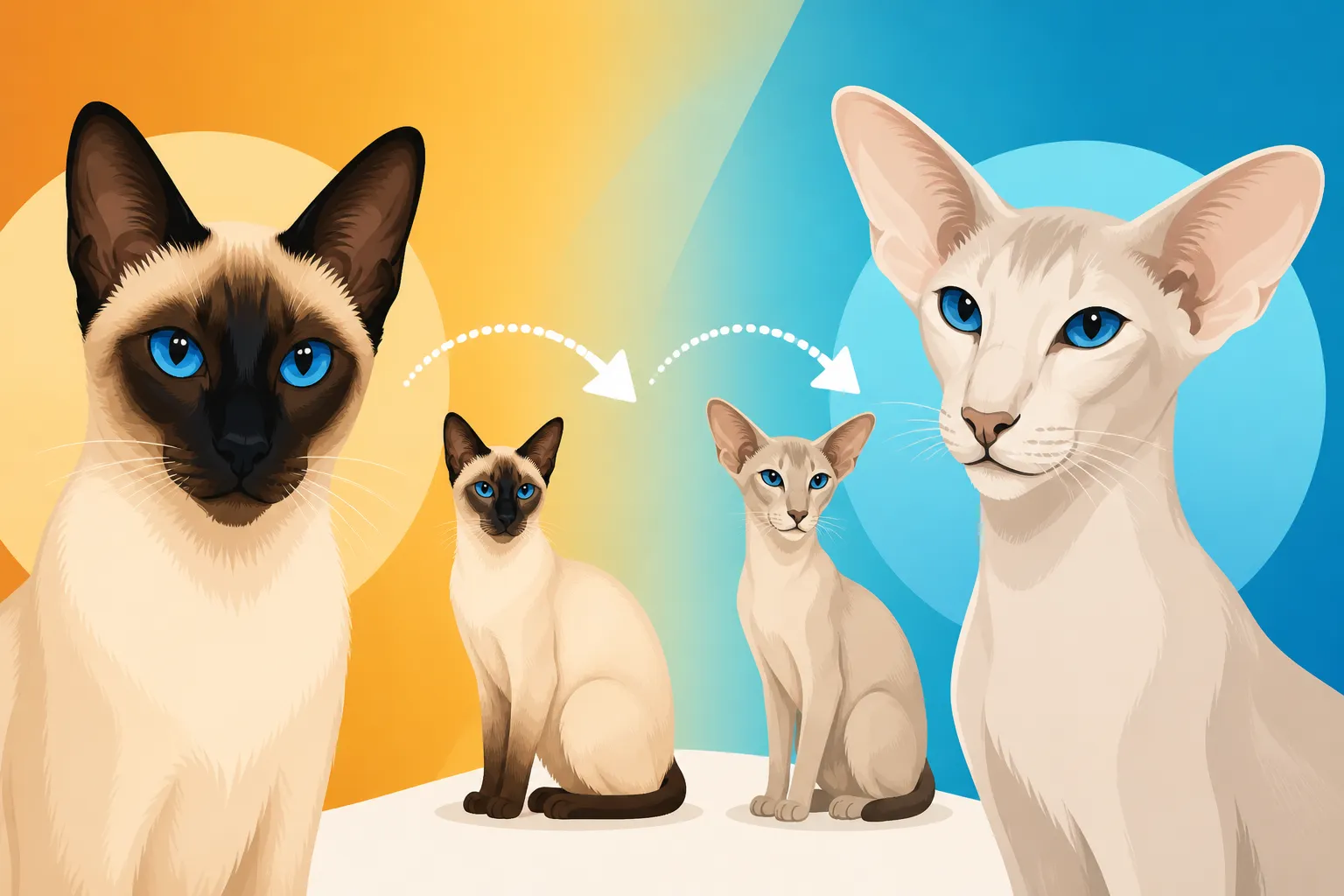
Those crosses introduced a wider range of coat colors and patterns. Breeders then selected cats with the body shape and general appearance they wanted, often breeding descendants back to Siamese cats. Over generations, this produced cats that looked recognizably Siamese in build but came in colors and patterns beyond the traditional pointed coat.
It’s helpful to think of the Oriental Shorthair as a carefully developed relative of the Siamese, rather than a Siamese cat with an unusual color. Siamese cats contributed heavily to the breed’s foundation and type, while other cats contributed variety in coat color and pattern.
Breeders used several kinds of cats
Siamese cats were central to the development of the Oriental Shorthair, but they were not the only cats involved. Breeders used cats with different coats and backgrounds to widen the available gene pool and introduce traits not typically seen in traditional Siamese lines. British Shorthairs, Russian Blues, Abyssinians, and domestic shorthairs are among the breeds and cats associated with this broader development.
The exact ancestry can vary among individual lines and breeding programs. It is more accurate to say the Oriental Shorthair developed through planned crossings involving Siamese cats than to imagine one single, uniform cross that created every Oriental.
This kind of careful selection is common in the history of cat breeds. A useful comparison is how Siamese-derived breeds developed along different paths, as explored in The Breeds a Siamese Cat Founded and Which Breeds Came Out of the Siamese Cat. The Oriental Shorthair is one of the clearest examples of breeders preserving a Siamese-like outline while deliberately expanding coat variety.
What the Oriental Shorthair inherited from the Siamese
The body and expression remain familiar
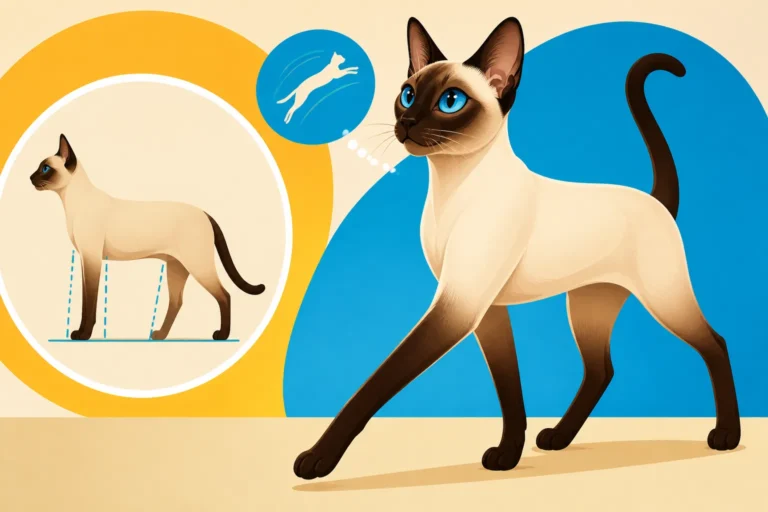
Oriental Shorthairs typically share the Siamese’s fine-boned, athletic appearance. They are long-bodied, slender, and graceful, with a wedge-shaped head, large ears, and almond-shaped eyes. Their silhouette can look so similar to a Siamese that the coat may be the first obvious difference.
That shared look reflects deliberate breeding. Breeders wanted to maintain the distinctive Siamese type while allowing additional colors and patterns. If you’re trying to understand how the breed’s outline relates to Siamese standards, What a Siamese Cat Looks Like by the Standard offers helpful context. The history of changing preferences in that outline is also covered in How the Siamese Cat's Head Changed Shape in Fifty Years.
Their resemblance does not mean every Oriental Shorthair is identical to a Siamese in temperament or appearance. Individual cats vary, and breed descriptions are general patterns rather than guarantees. A particular cat may be more reserved, more outgoing, or simply less vocal than the breed stereotype suggests.
Coat color is the most visible difference
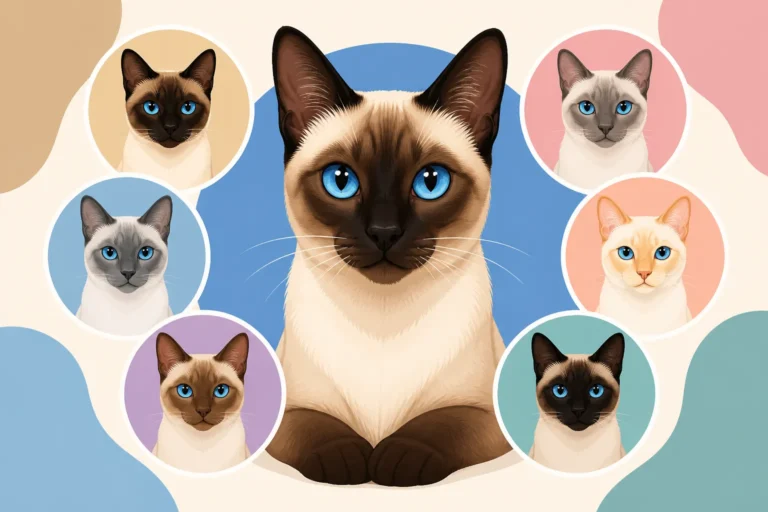
Traditional Siamese coloring is pointed: the body is lighter, while the face, ears, legs, and tail are darker. This pattern is associated with a temperature-sensitive form of pigmentation. The Oriental Shorthair’s development opened the door to a much broader range of coat colors and patterns, including solid colors, tabby patterns, tortoiseshell coloring, and other variations.
Recognized colors and patterns can depend on the cat registry. A cat that looks “Oriental” to a casual observer might be classified differently under a particular registry’s rules, and some pointed cats may be grouped separately from non-pointed Oriental Shorthairs. For background on how point-color rules differ, see Which Point Colors Other Registries Accept in a Siamese Cat.
The most useful distinction is this: “Siamese” usually refers to a specific breed with a pointed coat pattern, while “Oriental Shorthair” refers to a related breed with a much wider range of accepted coat colors and patterns. The two share ancestry and type, but coat pattern and registry classification help distinguish them.
| Feature | Siamese | Oriental Shorthair |
|---|---|---|
| Historical relationship | A foundation breed for Oriental lines | Developed using Siamese cats and other cats |
| Coat appearance | Traditionally pointed | Broad variety of colors and patterns |
| General build | Slender, long, and elegant | Often similarly slender, long, and elegant |
| Breed identity | Defined by its own breed standards | A distinct related breed with its own standards |
| Registry details | Point colors and standards vary by registry | Accepted colors and classifications vary by registry |
How the Oriental Shorthair became a distinct breed
A shared ancestry does not make two breeds interchangeable
Because Oriental Shorthairs and Siamese cats share important ancestry and a similar shape, people sometimes use the names loosely. That can create confusion, especially in online listings where a seller may use “Siamese” as a broad description for any slender cat with large ears or a pointed pattern.
In a registered breed, the name is more specific. A breeder’s records and the relevant registry’s standards help establish whether a cat is recognized as an Oriental Shorthair, a Siamese, or another breed. Appearance alone is not enough to confirm pedigree, particularly for mixed-breed cats with a Siamese-like look.
The relationship also differs from the history of the Thai cat, which represents a separate breed path connected to older Siamese type. How the Thai Split From the Siamese Cat explains that distinction. Looking at these histories together makes it easier to see that “Siamese-related” can describe several different breed stories, not one interchangeable category.
Breed recognition followed its own path
As breeding programs developed, Oriental Shorthairs became established as a breed in their own right. In the United States, the breed gained formal recognition through cat registries, and its standards set out how its body, head, coat, and color varieties are evaluated. Recognition details and accepted varieties differ among organizations, so a breeder or owner should check the specific registry involved.
This matters when someone is choosing a kitten or trying to identify an adult cat. A listing that says “Oriental Siamese” may be informal shorthand, not a registry-recognized breed name. Ask what registration papers, if any, accompany the cat, and whether the breeder can explain the parents’ registered breeds.
The broader story fits into the history of Siamese influence on modern cat breeds. For a wider view of that ancestry, see Where the Siamese Cat Comes From and How a Siamese Cat Differs From an Oriental Shorthair. The shared family resemblance is real, but each breed has its own identity and breeding history.
Identifying and choosing an Oriental Shorthair
Look beyond the coat and face
A pointed coat or a long, wedge-shaped face can suggest Siamese ancestry, but neither feature proves that a cat is an Oriental Shorthair. Many mixed-breed cats have similar traits, and some Oriental Shorthairs may have colors that are unfamiliar to people who only know the traditional Siamese pattern.
If you are considering a kitten from a breeder, ask which registry recognizes the litter and what documentation is available. Ask to see the parents’ registered names or records where appropriate, and learn how the breeder describes the kittens’ expected adult coat and pattern. Responsible answers should be clear without relying on vague claims such as “rare Siamese” when the cat is being presented as a different breed.
If you are adopting an adult cat, breed identity may be uncertain, and that is perfectly fine. A shelter or rescue may describe a cat as an Oriental Shorthair mix based on appearance, but without pedigree records, it is safer to treat that as an informed guess rather than a confirmed lineage.
Prepare for the individual cat, not just the breed label
People drawn to Oriental Shorthairs often love the sleek appearance and the breed’s connection to Siamese cats. But the day-to-day fit depends on the individual cat’s personality, activity level, and needs. Spend time with the cat if possible, ask about its history, and consider whether your home can offer routine interaction, play, and places to climb and rest.
For practical supplies, make a simple checklist before bringing a cat home: a secure carrier, litter box, litter, food and water dishes, scratching surfaces, and toys. If you already use Chewy, its catalog can be one place to compare basics such as litter and carriers, but a product listing cannot verify a cat’s breed. Prioritize the cat’s established diet at first, and ask the rescue or breeder what the cat is already eating before making a change.
Chewy may also be useful for comparing different styles of scratching posts or interactive toys once you know what your cat enjoys. You do not need to buy everything at once: start with essentials, observe whether the cat prefers a tall scratching post or a horizontal pad, and add enrichment based on its behavior. The aim is not to shop for a breed stereotype but to make the home comfortable for the particular cat you bring into it.
Disclaimer
This article is for general informational purposes only and does not constitute professional advice. Laws, prices and regulations vary by location and change over time. Consult a qualified professional for guidance on your specific situation.