Whether a Birman Is Related to the Siamese Cat
A Birman and a Siamese can look like close relatives: both have blue eyes, darker points, and a strong presence in the room. But the resemblance does not make them the same breed, and the Birman’s exact ancestry is not fully documented. This guide explains what they share, where their histories diverge, and how to tell the breeds apart.
Are Birman Cats Related to Siamese Cats
They are separate breeds with some traits in common
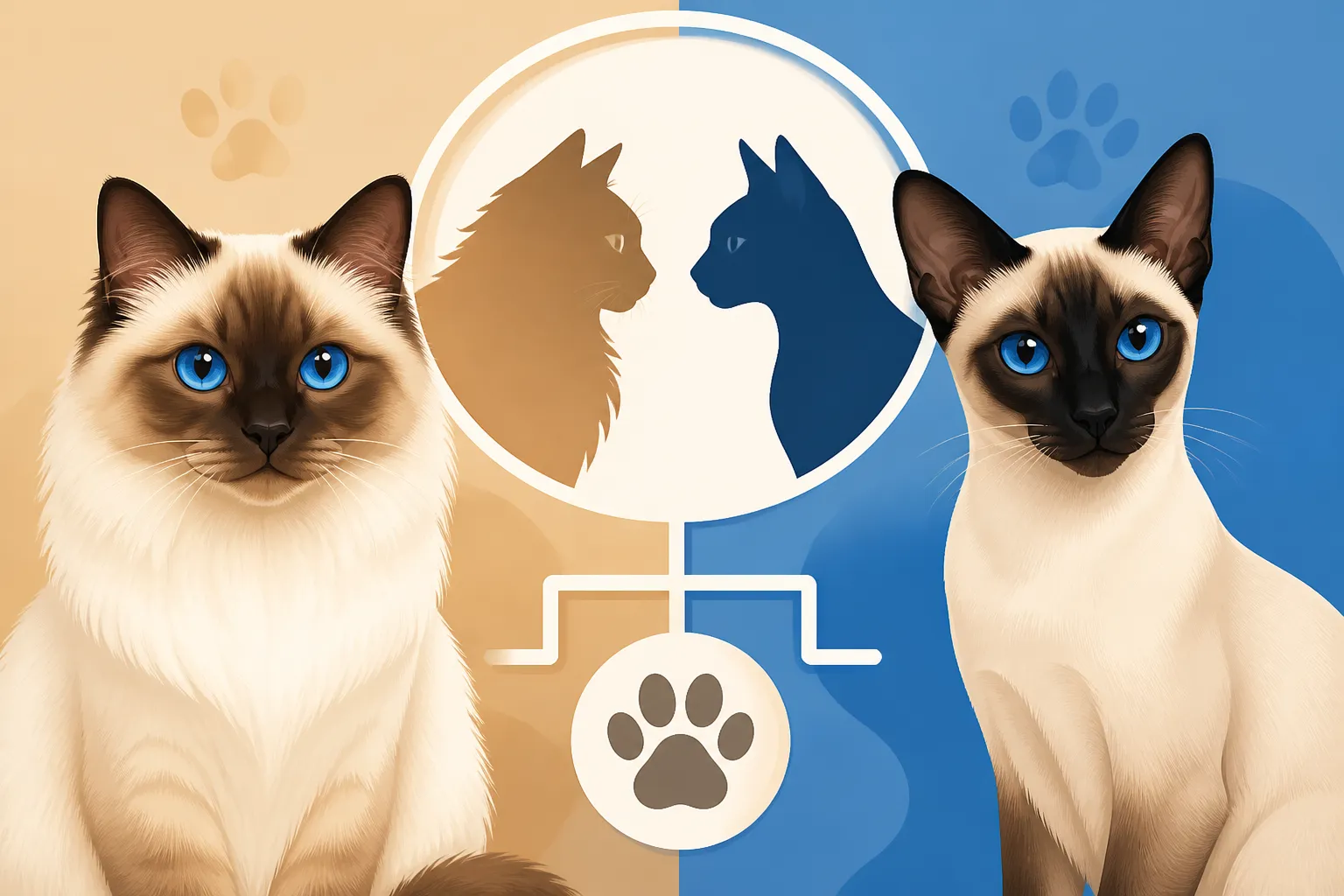
Birmans and Siamese cats are recognized as distinct breeds. A Birman is not simply a long-haired Siamese, and a Siamese is not a short-haired Birman. Their standards describe different overall looks: the Birman has a medium-to-long silky coat, a sturdy build, and distinctive white “gloves” on its paws. The Siamese has a short, close-lying coat and a long, slender outline.
The resemblance comes partly from their shared colorpoint pattern. In both breeds, the body is generally lighter than the cooler areas—the face, ears, legs, and tail. Both also have blue eyes. These features make it easy to assume there must be a simple, direct family connection, especially when a pale Birman kitten’s points begin to darken as it grows.
That shared appearance does not, by itself, tell us how recently two breeds shared ancestors. The colorpoint pattern is a trait found in more than one cat breed. It is useful to understand the biology behind that look, but it is not a reliable family tree. For more on the Siamese side of the pattern, see Why a Siamese Cat's Eyes Are Blue and How Temperature Controls a Siamese Cat's Color.
A Siamese contribution to Birman ancestry is possible but not the whole story
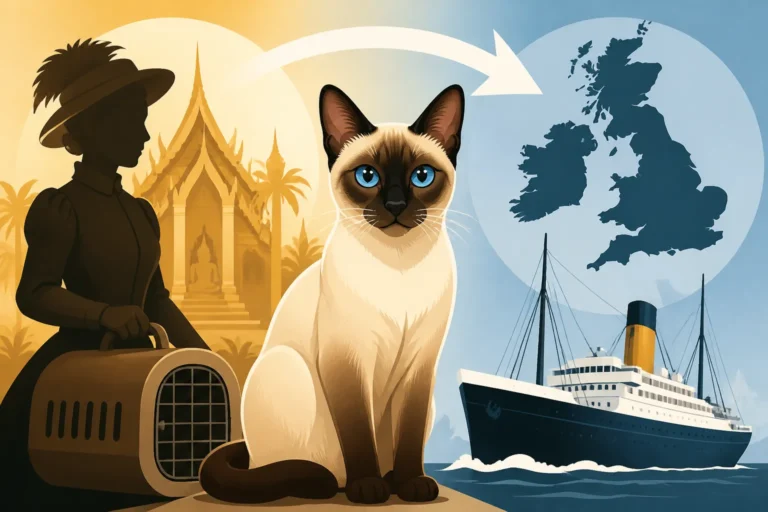
The Birman’s origins are surrounded by stories, incomplete records, and later breeding. The breed is often associated with Burma and sometimes called the Sacred Cat of Burma. That traditional story is part of the breed’s cultural identity, but it should not be treated as a fully documented account of how the modern Birman was developed. The historical question of whether Siamese cats were among the ancestors is more complicated than a simple yes or no.
Siamese cats may have contributed to Birman lines, particularly in the breed’s development and rebuilding in Europe. Like many pedigreed breeds, Birmans were shaped by deliberate breeding, and historical accounts of early crosses are not always consistent or complete. Some discussions of the breed’s past also refer to other long-haired cats. It is safest to say that Siamese influence is possible and often discussed, but the Birman cannot be reduced to a Siamese cross.
That distinction matters because breed history is not the same as a modern cat’s individual pedigree. Even if a breed’s development involved another breed, it does not mean every Birman has a recent Siamese parent or grandparent. If you are considering a kitten and want to know about its specific ancestry, ask the breeder for the pedigree and supporting records rather than relying on appearance or a general breed-history claim.
What Birmans and Siamese Cats Share
Both have the colorpoint pattern and blue eyes
The most visible overlap is colorpointing. The pigment-producing process behind a cat’s coat is affected by temperature: cooler parts of the body tend to develop darker color, while warmer areas remain lighter. That is why points are commonly most noticeable on the ears, face, paws, and tail. Kittens may be born very pale, with their pattern becoming clearer as they mature.
This pattern appears in both Birman and Siamese cats, but it does not make their coats identical. Siamese cats have a short coat that lies close to the body. Birman coats are longer and silky, with a noticeable ruff around the neck in many adults. A Birman’s coat can also be less prone to matting than some dense long-haired coats, but it still needs regular attention, especially around the chest, underarms, and hindquarters.
Both breeds are associated with blue eyes, another striking feature that can make a casual comparison feel persuasive. But coat color and eye color are only part of a cat’s identity. The broader physical standard, ancestry, and pedigree matter too. For the Siamese breed’s overall appearance, What a Siamese Cat Looks Like by the Standard gives useful context.
Their temperaments can overlap without being interchangeable
People often describe Siamese cats as social, vocal, and highly involved in household life. Birmans are commonly described as affectionate and people-oriented as well, though individual cats vary. A friendly Birman may follow someone from room to room, while a quieter Siamese may prefer to communicate with a look rather than a long conversation.
Breed descriptions are tendencies, not promises. A cat’s personality is influenced by its own temperament, early experiences, health, and home environment. Two kittens from the same litter can behave differently: one may greet visitors at the door, while another retreats to a favorite perch until the house settles down. It is more helpful to meet the individual cat and ask how it behaves than to assume every Birman or Siamese will fit a stereotype.
The same caution applies to energy and sociability. A prospective owner who hopes for a calm, silent cat may be surprised by a chatty Siamese, but a Birman is not guaranteed to be quiet or low-maintenance. If vocal behavior is a key consideration, How Loud a Siamese Cat Is offers a closer look at one side of the comparison.
How to Tell a Birman From a Siamese Cat
Compare coat, body shape, and paws
A Birman’s coat is one of the easiest clues. It is longer than a Siamese coat and usually has a soft, silky feel. Birmans are colorpoint cats, but their white paws are especially distinctive: the breed is known for white gloves on the front feet and white “laces” extending up the backs of the hind feet. The markings should be assessed as part of the whole cat, not just from a quick glance at one paw.
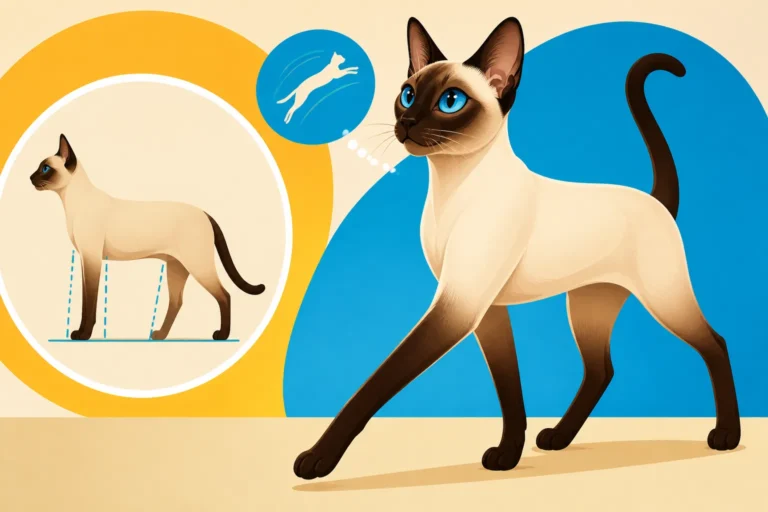
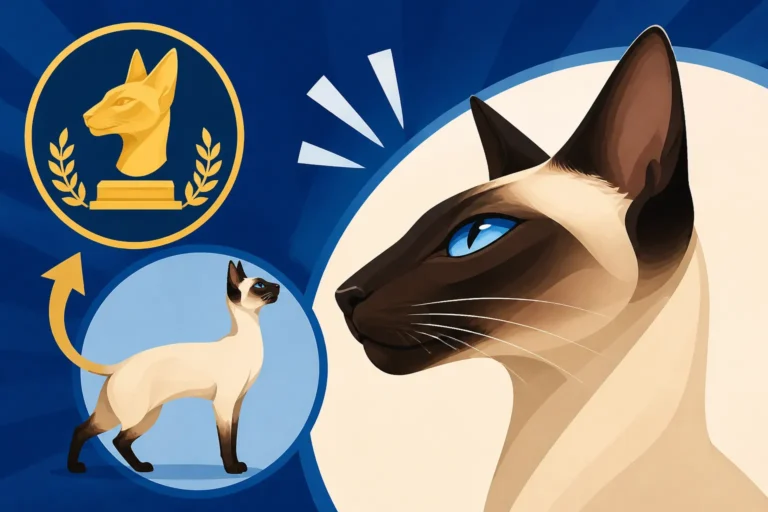
Siamese cats have short coats and a more elongated, fine-boned appearance. Their bodies, legs, and tails are typically long and slender, and their large ears and wedge-shaped head are prominent in the modern show type. There is variation between individual cats and between lines, so not every Siamese will look identical. For background on how the breed’s appearance changed over time, see How the Siamese Cat's Head Changed Shape in Fifty Years.
| Feature | Birman | Siamese |
|---|---|---|
| Coat length | Medium to long, silky | Short and close-lying |
| Common pattern | Colorpoint with characteristic white gloves | Colorpoint, generally without Birman-style white gloves |
| Eyes | Blue | Blue |
| General build | Sturdy, medium-bodied | Long, slender, fine-boned |
| Grooming focus | Regular combing, especially in longer areas | Occasional brushing to remove loose hair |
| Breed identity | Separate pedigreed breed | Separate pedigreed breed |
If you are comparing grooming tools at Chewy or another retailer, think about the coat in front of you rather than choosing based only on a breed label. A Birman may benefit from a comb that can reach through longer fur without pulling, while a short-haired Siamese generally needs less intensive coat work. Go slowly around sensitive spots such as the belly and behind the legs, where tangles can be easy to miss.
Consider grooming and home care, not just appearance
A Birman’s longer coat means brushing is a regular part of care, even if the coat feels smoother and less dense than that of some other long-haired breeds. A few calm minutes at a time can be easier than waiting until a tangle becomes a knot. If a cat dislikes being brushed, start with brief sessions and reward calm behavior; forcing a long grooming session can make the next one harder.
A Siamese’s short coat is usually simpler to maintain, but “low grooming” does not mean “no grooming.” Brushing can help remove loose hair, and all cats need routine care such as nail checks, dental attention, and wellness visits. Coat length also does not tell you whether a cat will tolerate handling. Some Birmans happily settle for a comb, while some short-haired cats object to a few strokes.
For a practical supplies comparison, Chewy can be one place to look at different comb styles, but the best tool is the one that suits your cat’s coat and can be used gently. Pay attention to whether the teeth glide through the fur without snagging. If your cat resists, stop and try again later rather than turning brushing into a wrestling match. Breed-specific routines are helpful starting points, not a substitute for noticing your own cat’s comfort.
What Breed History Can and Cannot Tell You
Breed origin stories are not the same as verified ancestry
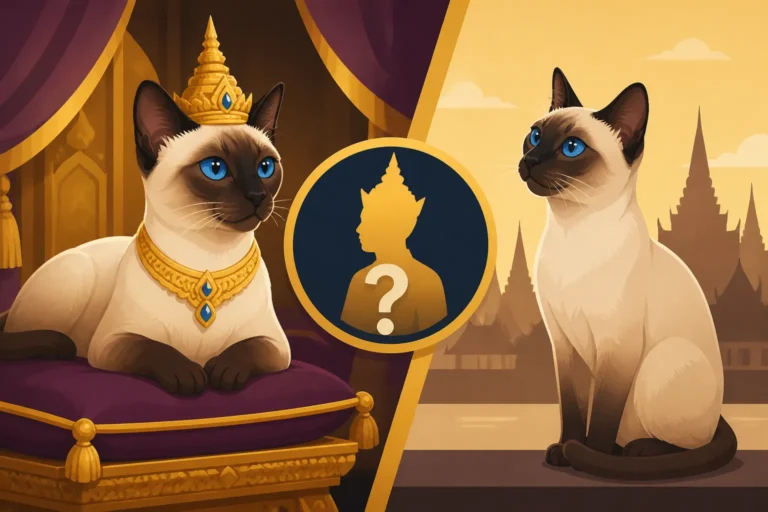
The Birman’s origin story is often told with a temple setting and a dramatic legend. Such stories help explain why the breed is sometimes called the Sacred Cat of Burma, but folklore is different from documented breeding history. The modern breed’s development in Europe is better understood through records, breeder accounts, and the history of pedigreed cat breeding than through a single legend.
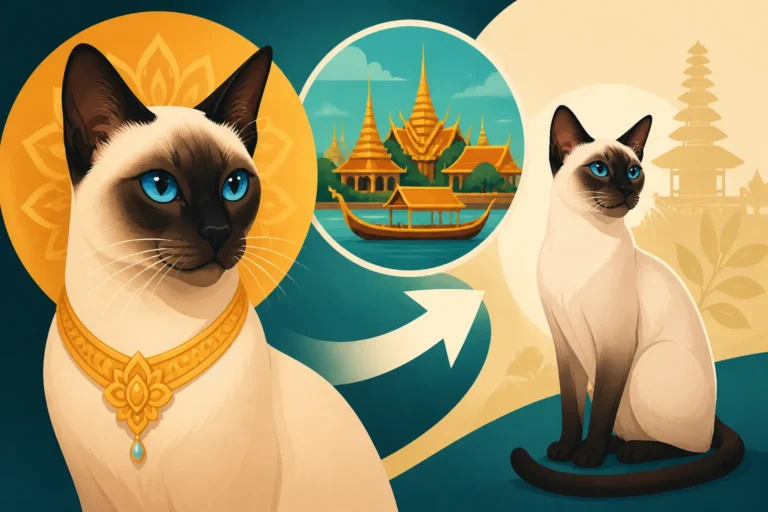
The Siamese also has a distinct history and is associated with Siam, now Thailand. The two breeds therefore have different identities and histories, even though their modern appearances share features. If you want to explore that difference further, The Siamese Cat Came From Siam, Not Thailand and Whether the Siamese Cat Was a Temple Cat provide context on the Siamese’s own history and the stories attached to it.
A broad history can help explain why a breed looks the way it does, but it cannot establish the ancestry of one particular cat. A Birman-looking cat without pedigree papers may be a Birman, a mix, or another cat with similar coloring. Likewise, a blue-eyed colorpoint cat is not automatically a Siamese. Appearance can suggest possibilities; it cannot confirm a breed on its own.
Pedigree and records matter more than a visual guess
If a breeder describes a kitten as a Birman-Siamese cross, ask what that means in practical terms. Is there a documented Siamese parent? Are both parents identified in a pedigree? Is the kitten being sold as a registered Birman, a crossbreed, or a companion cat with no formal breed claim? Clear answers help you understand what you are adopting and what kind of records you should expect.
A seller’s use of words such as “Siamese-type” or “Birman-looking” can describe appearance without proving ancestry. That is not necessarily a problem if the cat is being honestly represented, but it is different from a documented pedigree. If registration matters to you, ask which registry is involved and what paperwork will accompany the cat. You can also read Which Breeds Came Out of the Siamese Cat for a broader view of how Siamese ancestry and influence are discussed across related breeds.
DNA tests may provide information about certain genetic traits or ancestry estimates, depending on the test, but they should not be treated as a simple substitute for pedigree documentation. A test result does not necessarily settle every breed-history question or confirm that a cat meets a breed standard. If the question is whether a specific kitten is a registered Birman or Siamese, ask for records tied to that kitten and its parents.
Choose the cat in front of you
For a future owner, the practical question may be less “Are these breeds related?” and more “Which cat fits my home?” A Birman’s longer coat brings regular grooming into the routine. A Siamese’s short coat is easier to maintain, but its social needs and vocal tendencies may be a bigger consideration for some households. Neither breed is automatically the better choice; the match depends on your time, preferences, and the individual cat.
If you are visiting a breeder or rescue, notice how the cats respond to handling and ordinary household sounds. Ask what they eat, how they have been socialized, whether they are comfortable being groomed, and what health information is available. With a rescue cat, the history may be incomplete, so focus on the cat’s current behavior and arrange a veterinary check when appropriate.
For someone comparing brushes or other everyday supplies at Chewy, the useful question is not whether a product is marketed specifically for Birmans or Siamese cats. It is whether it suits the animal’s coat, size, and tolerance for handling. Choosing based on the real cat—rather than assuming a shared appearance means identical needs—is the most reliable way to make the relationship between the breeds useful rather than confusing.
Disclaimer
This article is for general informational purposes only and does not constitute professional advice. Laws, prices and regulations vary by location and change over time. Consult a qualified professional for guidance on your specific situation.