Whether a Long Haired Siamese Cat Exists
A fluffy, blue-eyed colorpoint cat may look like a Siamese with a longer coat, but the name on its pedigree can be different. That distinction matters when you’re comparing breed standards, talking with a breeder, or trying to identify a cat you’ve adopted. Here’s how the Balinese fits into the picture, what “long-haired Siamese” usually means, and what coat care to expect.
Is there such a thing as a long-haired Siamese cat
The short answer depends on what you mean by Siamese
People do use the phrase “long-haired Siamese cat,” and it’s an understandable description: the cat may have the familiar colorpoint pattern, blue eyes, and fine-boned outline associated with Siamese cats, but with a flowing coat. The complication is that everyday descriptions and formal breed names don’t always match.
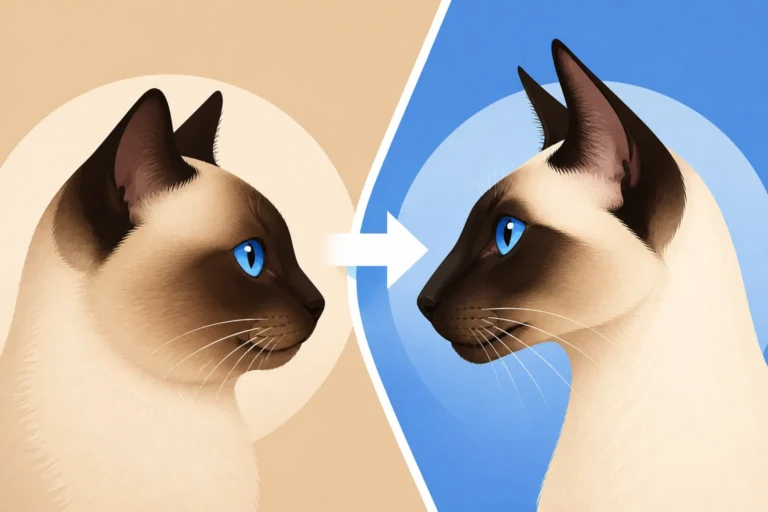
The breed most often associated with a long-haired Siamese is the Balinese. It shares much of the Siamese’s appearance and personality, but its semi-long coat gives it a noticeably softer, more feathered look. Many people casually call a Balinese a long-haired Siamese, while breeders and cat registries may identify it as a distinct breed.
So, if you’re asking whether a Siamese-looking cat can have long fur, absolutely. If you’re asking whether “long-haired Siamese” is the official breed name on every pedigree, generally no. The label depends on the cat’s documented ancestry and the naming rules used by the breeder or registry.
How the Balinese is connected to the Siamese
Long-haired kittens occasionally appeared in Siamese breeding lines. The coat difference is associated with a recessive longhair gene: a kitten needs to inherit the relevant genetic variant from both parents to have long hair. Breeders developed the Balinese from these long-haired cats, selecting for a consistent type and the Siamese-style pointed pattern.
The Balinese is not simply a Siamese that has been groomed differently, nor does every long-haired cat with dark ears and blue eyes qualify as one. Breed identity involves ancestry and a breed standard, not appearance alone. If you’re curious about the breed’s development, How the Balinese Came From the Siamese Cat explores its relationship to Siamese breeding.
The two breeds are often compared because they can share a slender body, wedge-shaped head, large ears, blue eyes, and lively, people-focused temperaments. The coat is the most obvious difference, but it isn’t the only detail that may vary. For a closer look at those similarities and differences, see How a Siamese Cat Differs From a Balinese.
Why the names can get confusing
Breed names aren’t always used consistently in casual conversation, online listings, or even among breeders. One person may say “long-haired Siamese” to describe any long-coated colorpoint cat, while another uses that phrase specifically for a Balinese. Some registries recognize Balinese as a separate breed, and terminology for related long-haired colorpoint cats can vary between registry systems.
That’s why a photo alone can’t settle the question. A long, silky coat and Siamese-like points can suggest a Balinese or a related type, but they don’t establish pedigree. If a seller uses “long-haired Siamese” as a breed claim, ask what the cat’s registration papers say and which registry issued them. You can also ask what the parents are registered as and whether the breeder can explain how the kitten’s lineage fits the name being used.
| What you’re looking at | What it usually means | What to check |
|---|---|---|
| A Balinese | A Siamese-related breed with a semi-long coat | Pedigree and registry breed designation |
| A long-haired colorpoint cat | A visual description, not proof of a particular breed | Ancestry, parent information, and documentation |
| A cat advertised as a “long-haired Siamese” | Often a casual label for a Balinese or a Siamese-type mix | What the seller means by the term and what the records show |
| A short-haired, pointed cat with Siamese-like features | It may be a Siamese, a related breed, or a mixed-ancestry cat | Breed papers if pedigree matters to you |
What a long-haired Siamese or Balinese looks like
Coat, points, and eye color
The Balinese’s coat is typically medium-length and fine, with longer hair around areas such as the tail. It tends to lie close to the body rather than forming the dense, rounded outline of a thick-coated cat. Its pointed pattern is familiar from Siamese cats: the ears, face, legs, and tail are darker than the warmer or paler body.
The color of those points can vary according to the cat’s lineage and the breed standards used by different organizations. The classic Siamese point colors are seal, blue, chocolate, and lilac, while some registries recognize additional colors or patterns in related breeds. If point-color terminology is part of your search, Which Point Colors Other Registries Accept in a Siamese Cat offers useful context.
Blue eyes are another common feature of Siamese-related colorpoint cats. Still, a blue-eyed cat with a pointed coat isn’t automatically a Balinese or Siamese. Several breeds and mixed-breed cats can have similar coloring, so appearance is a clue rather than a certificate of ancestry.
Body shape and expression
Balinese cats are generally described as lithe and athletic, with a long body, long legs, and a fine-boned appearance. Their coat can make them look fuller than a short-haired Siamese, especially around the tail, but the silhouette underneath is often still elegant rather than bulky.
Their expression may also look familiar to people who know Siamese cats: large ears, a defined face, and bright blue eyes. However, there’s variation among individual cats and breeding lines. Not every Balinese has the same head shape, coat length, or degree of fluff, and a cat’s appearance can change as it matures.
If you’re trying to distinguish a Balinese from a Siamese, focus on the full picture: coat length, body type, pedigree, and the breed name used in the cat’s records. A single feature—such as a fluffy tail or blue eyes—isn’t enough. For broader context on Siamese appearance and standards, see What a Siamese Cat Looks Like by the Standard.
Temperament and everyday behavior
Balinese cats are often described as social, active, and communicative, much like Siamese cats. A cat may follow a favorite person from room to room, request play, or make its opinions known when dinner is late. That said, no breed description predicts every individual’s personality. Early experiences, health, age, and the cat’s own temperament all matter.
If you’re drawn to a Balinese because you enjoy the Siamese’s lively, people-oriented reputation, remember that the same closeness can mean a cat wants regular company and interaction. A busy household can still work well, but it helps to plan for play, predictable routines, and companionship rather than expecting the cat to entertain itself all day.
The names and histories behind these related breeds can get tangled. For example, the Oriental Shorthair is another breed with a connection to Siamese breeding, but it is not simply a long-haired Siamese. How a Siamese Cat Differs From an Oriental Shorthair can help clarify that distinction.
Grooming and coat care for a long-haired Siamese-type cat
Does the longer coat need daily brushing
A Balinese’s fine, single coat is often less prone to heavy matting than a dense double coat, but that doesn’t mean it can be ignored. Regular gentle combing helps remove loose hair and catch small tangles before they tighten. Pay particular attention to the tail, behind the ears, and anywhere the fur rubs against a collar or harness.
Start slowly if your cat is new to grooming. Let them sniff the comb, brush for a short time, and reward calm cooperation with a treat or a favorite activity. If you try to work through a stubborn knot by pulling, the experience can make future grooming harder. Forcing a comb through a painful tangle may also irritate the skin; if a mat is tight or close to the skin, ask a veterinary professional or experienced groomer for help.
A metal comb with rounded tips can be useful for checking through the coat, while a soft brush can help with loose hair. Chewy is one place owners may look for basic grooming supplies, but choose tools based on your individual cat’s coat and comfort, not just a breed label. How Often a Siamese Cat Needs Brushing explains why even short-haired cats benefit from occasional coat care.
Will a long-haired cat shed a lot
Yes, a Balinese can shed. “Long-haired” doesn’t mean the coat is maintenance-free, and it doesn’t mean every loose hair will stay neatly attached until brushing time. Some owners notice more shedding during seasonal changes, while others mainly notice hair on dark clothes, blankets, or favorite sleeping spots.
A routine can make loose hair easier to manage. Comb your cat regularly, wash bedding as needed, and keep a lint roller handy if fur on clothing is a frustration. Chewy may also carry lint rollers and grooming tools, though the best approach is simply the one you’ll use consistently without making your cat dread handling.
No cat breed is truly hypoallergenic. Allergens are associated with proteins produced by cats, not just the length of their fur, so a longer coat does not make a cat automatically more allergenic—or less allergenic. If allergies are a concern, spend time around the individual cat before committing when possible, and review Whether a Siamese Cat Is Hypoallergenic for more background.
Do long-haired Siamese cats need baths or professional grooming
Most healthy cats groom themselves and don’t need frequent baths. A Balinese may need help if the coat becomes soiled, greasy, or tangled, but routine bathing can create unnecessary stress and dry the skin. If a bath is needed, use a cat-safe product and make the experience calm and brief; avoid using human shampoo.
Professional grooming is not automatically necessary for every Balinese. Some cats do well with regular combing at home, while others need occasional help, particularly if they dislike grooming or develop tangles. The right choice depends on the cat’s coat condition, tolerance for handling, and any medical or mobility issues that make self-grooming difficult.
If coat care suddenly becomes harder—for example, your cat stops grooming, develops mats, or has greasy patches—it may be more than a grooming problem. Pain, dental trouble, obesity, or other health issues can make normal grooming uncomfortable. Ask a veterinarian about a change that persists rather than assuming the cat is simply being fussy.
How to tell what kind of cat you’re considering
Ask for pedigree details, not just a breed label
If you’re buying from a breeder and want a Balinese, ask to see the kitten’s registration information and clarify which breed name appears on the paperwork. Ask about the parents, too. A responsible breeder should be able to explain the kitten’s background and the terminology they use without relying on a vague sales description.
If the cat is being rehomed or adopted, formal records may not be available. In that case, it’s reasonable to describe the cat as a long-haired colorpoint or a Siamese-type cat if that matches its appearance, while acknowledging that appearance alone can’t confirm breed. A shelter or previous owner may know some history, but missing records are common and don’t make the cat any less lovable.
DNA testing can provide ancestry clues, but it should not be treated as a replacement for a documented pedigree. A test result may not establish a cat’s official registry breed, and the meaning of ancestry reports can vary. Whether a DNA Test Confirms a Siamese Cat explains why genetic ancestry and formal breed identification aren’t quite the same thing.
Questions worth asking before bringing one home
Whether you’re speaking with a breeder, rescue volunteer, or previous owner, a few practical questions can help you understand the cat in front of you:
- What breed name appears on the cat’s records? This helps separate a formal designation from a casual description.
- What do you know about the parents? Their breed records or coat types may explain how the kitten’s appearance developed.
- How does the cat respond to brushing? A calm grooming routine can make coat care easier at home.
- Has the cat had any skin or coat problems? This may reveal a need for extra care or a veterinary check.
- What is the cat like around people and other animals? Temperament matters more to daily life than a label alone.
- What grooming tools or routine has the cat already accepted? Keeping familiar habits can make the transition gentler.
You can also use Chewy to browse basic supplies once you know what your cat tolerates, but there’s no need to buy an elaborate grooming kit before meeting the cat. A simple comb, patient handling, and a gradual routine are often a better starting point than a drawer full of tools.
Is a long-haired Siamese right for your home
If you love the Siamese look but prefer a soft, flowing coat, a Balinese may be exactly the kind of cat you have in mind. Just be prepared for an individual personality rather than a guaranteed breed stereotype, and plan for regular companionship and grooming.
If you’re adopting a cat described as a long-haired Siamese, take the phrase as a helpful visual description unless reliable records confirm a specific breed. You can still make a thoughtful choice by learning about the cat’s health, behavior, care needs, and history. Whether the paperwork says Balinese, Siamese-type, or mixed breed, the most important question is whether you can offer that particular cat a safe, engaging home.
Disclaimer
This article is for general informational purposes only and does not constitute professional advice. Laws, prices and regulations vary by location and change over time. Consult a qualified professional for guidance on your specific situation.