Whether a Solid Colored Siamese Cat Exists
A cat with a cream body and dark ears may look “solid” at first glance, while a charcoal-colored cat with blue eyes may be advertised as a Siamese. Breed labels can be confusing because coat color, pattern, ancestry, and registry rules are different things. This guide explains what “solid-colored Siamese” usually means and how to identify the cat you’re looking at.
Why a Solid-Colored Siamese Is Usually a Contradiction
The Siamese is a colorpoint breed
In the conventional breed definition, a Siamese is a colorpoint cat: its body is lighter than its “points,” the darker areas on the face, ears, legs, feet, and tail. The contrast may be subtle in an adult cat, but the coat is still patterned rather than one uniform color from nose to tail.
This distinctive pattern comes from a temperature-sensitive pigment process. Cooler areas of the body develop more pigment, which is why the points are darker than the warmer central body. A Siamese kitten is often born very pale, then develops visible points as it grows. If you want to explore that process in more detail, see A Siamese Cat's Points Are Made by Temperature and Why a Siamese Cat Kitten Is Born White.
A true solid-colored coat, by contrast, is generally the same basic color across the cat’s body, without the classic pale-body-and-dark-points pattern. So when someone asks whether a solid-colored Siamese exists, the clearest answer is: not as a typical Siamese under the breed’s defining color pattern. A cat may have Siamese ancestry, look somewhat Siamese, or be casually described as Siamese without being a solid-colored Siamese in the strict breed sense.
That distinction can feel frustrating if a shelter listing, online ad, or family story uses “Siamese” as a catch-all for any sleek cat with a distinctive face. The label may describe resemblance or suspected ancestry rather than a registered breed. To understand the appearance associated with the breed standard, compare What a Siamese Cat Looks Like by the Standard and Which Colors a Siamese Cat Comes In.
“Solid” can describe a point color, not the whole coat
People sometimes use “solid” to describe a point color, such as seal or blue, rather than the cat’s entire coat. A seal point Siamese, for instance, has dark brown points and a lighter body. The points may be broad or dark enough that the cat looks much darker overall, but that does not make it a solid-colored cat.
Age, temperature, and lighting can make the contrast harder to read. An older Siamese may darken across the body, and a photograph taken in dim light can make its coat appear almost uniform. Even then, look closely at the chest, belly, and inner legs: the body often remains lighter than the points, even if the difference is less dramatic than it was when the cat was young.
There is also a difference between “solid” and “self-colored.” In cat terminology, a solid or self-colored coat has an even color without the Siamese-style restriction of pigment to cooler body areas. Calling a Siamese “solid seal” may therefore mean “seal-colored points,” or it may simply be an informal description. Asking what the person means by “solid” can clear up a lot of confusion.
Cats Commonly Mistaken for Solid Siamese
Oriental Shorthairs can have solid coats
The Oriental Shorthair is one of the most common sources of confusion. It is closely related to the Siamese and shares a similar sleek build and prominent ears, but it comes in a much wider range of coat colors and patterns, including solid colors. A solid black or solid blue Oriental Shorthair may look Siamese-like in shape, yet its coat does not have the Siamese colorpoint pattern.
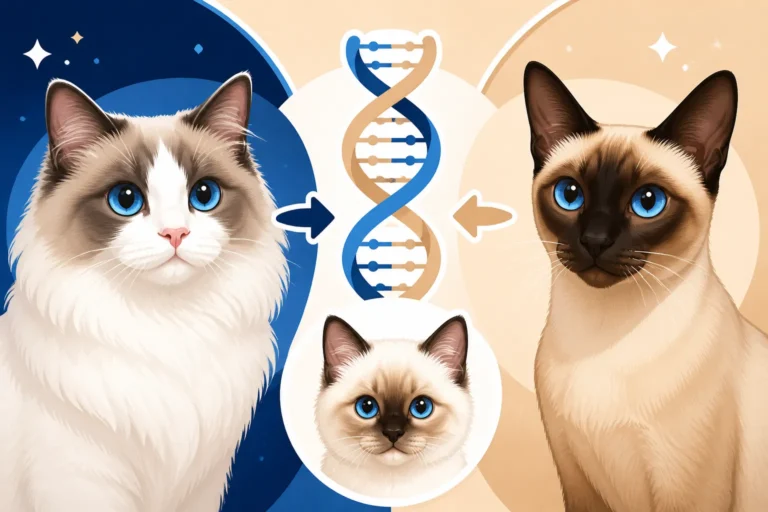
The two breeds are closely connected historically and share ancestry, but related does not mean interchangeable. The Siamese is associated with colorpoint markings, while the Oriental Shorthair includes many non-pointed colors. Breed names and accepted colors can also vary by registry, so a cat’s formal classification depends on the organization and its rules. For a closer comparison, see How a Siamese Cat Differs From an Oriental Shorthair and The Breeds a Siamese Cat Founded.
A solid-colored cat with a Siamese-like profile might also be a mixed-breed cat. Without reliable pedigree documentation, appearance alone generally cannot establish that a cat is a purebred Siamese. Blue eyes, a long body, or large ears may contribute to a Siamese-like impression, but no single feature proves breed identity.
Colorpoint Shorthairs and mixed-breed cats add to the confusion
Colorpoint Shorthairs resemble Siamese cats and also have pointed coats. Depending on the registry, the names and recognized color categories can differ. Some cats described casually as “Siamese” may be classified as Colorpoint Shorthairs under a particular system, especially when their point color falls outside that registry’s Siamese standard. See What a Colorpoint Shorthair Is Next to a Siamese Cat for more on that distinction.
Mixed-breed cats can also inherit some Siamese-like traits without being purebred Siamese. A shelter cat may have blue eyes, a pale body, and darker ears, or may simply have a face and build that remind people of the breed. Those observations can help describe the cat’s appearance, but they do not confirm its ancestry.
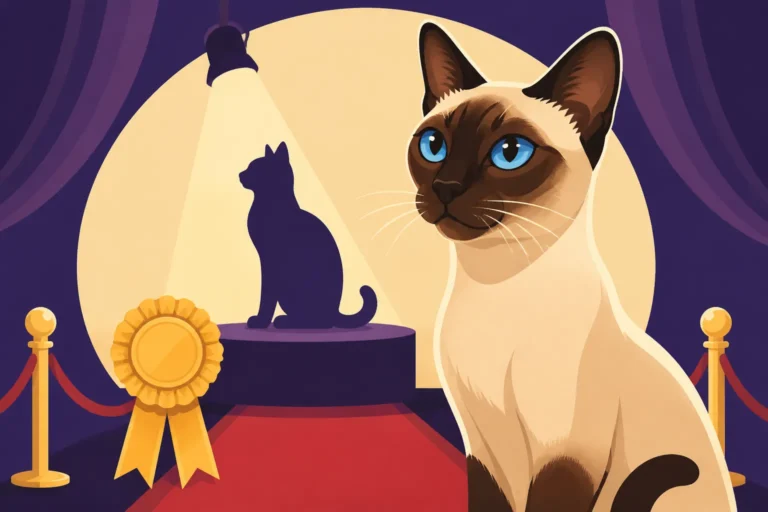
If a seller or listing uses a breed label that seems inconsistent with the cat’s coat, ask what the label is based on. A pedigree is different from a visual guess, and an informal description is different from registry classification. When considering a kitten, What the Siamese Cat Standard Asks For can help you understand why appearance and official breed identity are not always the same thing.
How to Tell Whether a Cat Is Solid or Colorpoint
Check the coat pattern, not just the overall darkness
Start by looking at the cat in natural light, because indoor lighting and phone cameras can flatten color differences. Compare the face, ears, legs, feet, and tail with the torso. If the points are noticeably darker and the body is lighter, the cat has a colorpoint pattern—even if the body has darkened with age.
| What you notice | What it may suggest |
|---|---|
| Lighter torso with darker face, ears, legs, feet, and tail | Colorpoint pattern, as seen in Siamese cats |
| Similar color across the torso and points | Solid coat, or a pattern that is difficult to assess in the lighting |
| Blue eyes with a pale body and darker points | Consistent with a colorpoint appearance, but not proof of breed |
| Dark overall coat with faintly lighter body areas | Could be an older or darkened colorpoint cat; examine it in good light |
| Siamese-like shape but an even coat color | Could be an Oriental Shorthair, mixed-breed cat, or another cat with a similar appearance |
The table is a starting point, not a breed-identification test. Coat patterns can be subtle, and age or coat condition can affect how clearly they show. If the cat’s exact breed matters—for example, because you are choosing a registered kitten—ask for documentation from the breeder or registry rather than relying only on photographs.
It can help to take pictures from several angles in daylight and compare the torso with the paws and tail. A close-up of the face alone can be misleading because a pointed face may look dark enough to dominate the whole image. A full-body view is more useful for seeing whether the body and points differ.
Understand what a registry or pedigree can confirm
A pedigree records a cat’s documented lineage, while a registry applies its own breed definitions and standards. Neither a color description in a casual advertisement nor a cat’s resemblance to a breed is the same as documented registration. If a cat is represented as a registered Siamese, ask which registry it is registered with and what paperwork will accompany it.
Registries may differ in which point colors or related categories they accept. That is one reason a cat can be called Siamese in everyday conversation while receiving a different formal classification in a particular system. For a broader look at those differences, see Which Point Colors Other Registries Accept in a Siamese Cat.
A DNA test may offer information about genetic ancestry, depending on the test and its reference data, but it should not be treated as a substitute for pedigree documents or registry rules. A result that suggests ancestry from a related population does not automatically establish that a cat qualifies as a registered Siamese. If you are adopting a cat rather than buying a pedigree kitten, it is perfectly reasonable to describe what you can see—such as “short-haired, blue-eyed, colorpoint”—without making a definite breed claim.
What About White or Nearly Solid Siamese Cats
A pale body does not make the cat solid white
Siamese cats often have a very light body, especially when they are young or when the contrast between body and points is subtle. From across the room, a pale cat may appear nearly white. But a colorpoint Siamese still has darker points, so “mostly pale” is not the same as a solid white coat.
A genuinely solid white cat lacks the characteristic dark points of the Siamese pattern. White cats can have many different ancestries, and white fur by itself does not show that a cat is Siamese. For a focused discussion of that distinction, see Whether a Solid White Siamese Cat Exists.
Photographs can make this especially confusing. A bright background may wash out the body color, while shadows can exaggerate the darkness of the face and ears. If you are trying to describe a cat accurately, check the coat in ordinary daylight and look for the pattern across the body rather than relying on a single close-up.
A darker Siamese is still not a solid-colored cat
Some Siamese cats darken as they age, and a cool environment can contribute to a darker-looking coat. In an older cat, the torso may become much less pale than it was in kittenhood. That change can make the cat look more uniform, but it does not automatically turn a colorpoint pattern into a solid coat.
This is one reason people sometimes disagree about what they are seeing. One person may focus on the cat’s overall dark appearance; another may notice that the paws, face, and tail are still darker than the torso. Both may be describing the same cat from different perspectives. The key question is whether there is a colorpoint pattern, not whether the cat looks pale or dark overall.
For a buyer, adopter, or curious owner, the practical takeaway is simple: use “solid-colored Siamese” cautiously. It may be an informal label, a misunderstanding of point color, or a reference to a Siamese-like cat with a different breed or mixed ancestry. A cat can be lovely, affectionate, and deeply Siamese-like without fitting the strict breed definition. If you are choosing a cat, focus on its health, temperament, care needs, and any documentation that matters to you—rather than assuming that a color description settles its breed.
Disclaimer
This article is for general informational purposes only and does not constitute professional advice. Laws, prices and regulations vary by location and change over time. Consult a qualified professional for guidance on your specific situation.