Which Films Feature a Siamese Cat
A familiar movie cat can look unmistakably Siamese on screen, yet breed labels are often repeated loosely in cast lists and fan discussions. This guide separates well-known Siamese characters from cats that are commonly mistaken for them, explains what makes each appearance notable, and offers a practical way to judge claims about a film’s feline star.
Films with clearly identified Siamese cats
Some films name a cat as Siamese in the story or its associated descriptions, making the breed connection relatively straightforward. These appearances range from comic side characters to a cat who is central to the plot.
Lady and the Tramp
The best-known Siamese cats in an animated film are Si and Am from Disney’s Lady and the Tramp. They belong to Aunt Sarah and cause trouble during the sequence in which they are left in Lady’s care. Their distinctive pointed coats and blue eyes make their breed easy to recognize, but the movie’s influence goes beyond their appearance.
The original film includes “The Siamese Cat Song,” a scene that has drawn criticism for its portrayal of Asian-coded characters and its use of stereotypes. That criticism is about the film’s creative choices, not about Siamese cats or their real-life behavior. Si and Am are fictional troublemakers, not a guide to what the breed is like at home.
The 2019 live-action adaptation also features the characters. When comparing versions, it helps to remember that adaptations can alter scenes, character details, and tone. A movie character’s actions are written for a story; they should not be treated as evidence that real Siamese cats are sneaky, destructive, or naturally difficult.
For a broader look at misconceptions attached to the breed, see What People Get Wrong About the Siamese Cat. And if you’re curious about the cats’ striking blue eyes, Why a Siamese Cat's Eyes Are Blue explains the connection between the breed’s coloring and eye color.
That Darn Cat!
In Disney’s That Darn Cat! a Siamese cat called D.C. becomes involved in a mystery after a message connected to a kidnapping is discovered on his collar. The original film was released in 1965, and a remake followed in 1997. In both, the cat is central to the story: people try to follow his movements and work out what he knows.
D.C. is a good example of a movie using a cat’s independent roaming as a plot device. In real life, a cat wandering through a neighborhood does not reliably return with clues, and outdoor access carries risks that a family adventure movie can gloss over. The character is charming partly because he moves through the story on his own terms; that does not mean every cat is comfortable or safe doing the same.
If a Siamese cat’s voice is what you remember most from the film, it’s worth separating screen performance from ordinary behavior. Some Siamese cats are quite vocal, while others are quieter. Whether Every Siamese Cat Is Vocal looks at that variation, and What the Siamese Cat's Temperament Is Really Like covers the breed’s personality without relying on a movie character as a template.
Bell, Book and Candle
In the 1958 romantic fantasy Bell, Book and Candle, a Siamese cat named Pyewacket belongs to the story’s witch, Gillian Holroyd. Pyewacket is a memorable companion and a familiar in the film’s magical world, rather than the source of a mystery or comic disaster.
The cat’s role has helped keep Pyewacket in lists of notable Siamese movie characters. It also shows how a film can use a cat’s quiet presence to make a character’s home feel personal and slightly mysterious. That is a storytelling choice, not a special trait of the Siamese breed.
The Incredible Journey
The 1963 film The Incredible Journey includes Tao, a Siamese cat traveling with two dogs across the Canadian wilderness. The journey is the heart of the story, so Tao is more than a brief visual gag: the cat is one of the animals the audience follows through a difficult trek.
It’s still a fictional adventure. A domestic cat’s ability to cope with travel, unfamiliar terrain, weather, and separation varies enormously, and a movie’s dramatic journey is not a safe model for taking a pet outdoors. The film can make the animals’ endurance feel inspiring while leaving out the careful planning, supervision, and welfare considerations a real trip would require.
| Film | Siamese cat | What the cat does in the story |
|---|---|---|
| Lady and the Tramp | Si and Am | Cause trouble while in Lady’s care |
| That Darn Cat! | D.C. | Becomes involved in a kidnapping mystery |
| Bell, Book and Candle | Pyewacket | Acts as Gillian Holroyd’s feline familiar |
| The Incredible Journey | Tao | Travels with two dogs across the wilderness |
Cats often mistaken for Siamese
A pointed coat and blue eyes can make a cat look Siamese at a glance, but those features alone don’t prove that a character—or a real cat—is a Siamese. Similar coloring appears in other cats, and film summaries sometimes use familiar breed names as shorthand.
Homeward Bound and Sassy
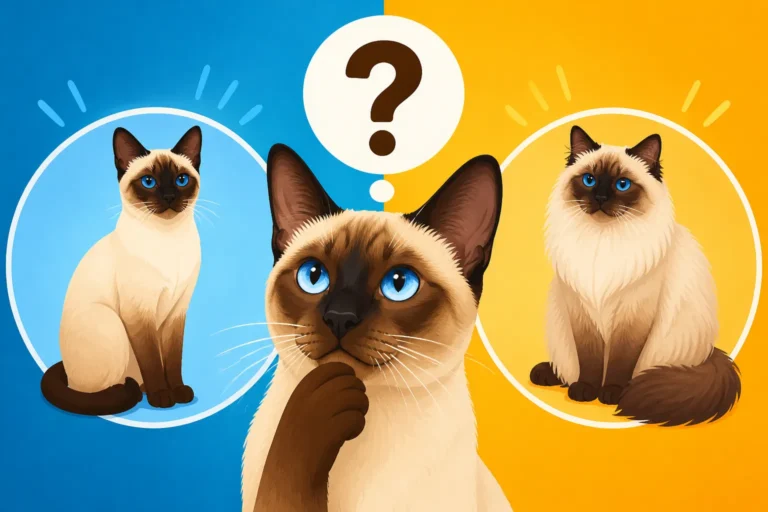
Sassy, the cat in Homeward Bound: The Incredible Journey, is often mistaken for a Siamese because she has a pointed coat and blue eyes. She is generally identified as a Himalayan, a longhaired breed with color-point markings. That visual similarity can lead people to remember her as Siamese, especially if they are recalling the film years later.
This is a useful reminder that “looks Siamese” and “is described as Siamese” are different claims. A movie’s character design may borrow familiar features without presenting the cat as a member of the breed. Sassy’s personality and role in the story also shouldn’t be assumed to describe Siamese cats generally.
The Aristocats and Shun Gon
The Aristocats has a cat named Shun Gon, but he is not one of the film’s Siamese characters. He is presented as a Chinese cat, and the movie’s musical sequence uses cultural caricature that many viewers find objectionable. It is easy to mix him up with other Disney cats when remembering a film’s feline cast, but that doesn’t make him Siamese.
When a movie uses a cat’s appearance and identity as part of a joke or caricature, it helps to distinguish the character’s design from real breed traits and real cultures. For a grounded description of the breed’s appearance, What a Siamese Cat Looks Like by the Standard is more useful than relying on a cartoon’s visual shorthand.
Why pointed coats cause confusion
Siamese cats have color-point coats: the body is typically lighter, while the cooler parts of the body—such as the ears, face, paws, and tail—are darker. But color-point patterns occur in other breeds and mixed-breed cats too. A fictional cat can share the look without being explicitly written or described as Siamese.
There is also variation in how registries recognize point colors and related types. That can make casual movie descriptions seem inconsistent, especially when a character has markings that resemble a Siamese but does not match a viewer’s idea of one. Which Point Colors Other Registries Accept in a Siamese Cat gives more context on why breed descriptions may not always line up neatly.
How to check whether a movie cat is really Siamese
If you’re trying to identify a cat from a film, use more than a quick visual comparison. A character may be labeled in the dialogue, official film materials, or reliable reference descriptions—or may simply have a design that resembles the breed.
Look for a direct identification
Start with what the film itself says. Does a character call the cat Siamese? Is the breed stated in a synopsis or production description? If a source only says the cat has a pointed coat or blue eyes, that supports a visual comparison, not a definite breed identification.
Be cautious with fan pages and short online lists that copy one another. A mistaken label can travel widely because it sounds plausible. If one page calls a character Siamese but doesn’t explain why, look for a clearer description before repeating the claim.
Remember that breed appearance changes
The modern show Siamese is often associated with a long, fine-boned body and a wedge-shaped head, while older images and different breeding traditions may show a less extreme head shape. That means a cat in an older film may not look like the Siamese people most often see in recent breed photographs. How the Siamese Cat's Head Changed Shape in Fifty Years helps explain why familiar images of the breed have shifted.
Even with a good visual reference, looks can only take you so far. A stylized animated cat is designed to communicate quickly, not to meet a breed standard. In live-action films, the cat used on set may also be selected for temperament, training, or availability rather than for a documented pedigree.
Separate the character from the breed
A movie may give a Siamese cat a loud voice, a mischievous streak, or a strong attachment to one person because those traits serve the plot. Real cats vary as individuals. Breed tendencies can be part of the conversation, but they cannot predict exactly how a particular cat will behave.
That distinction matters when someone is considering adopting or buying a Siamese. A film can introduce the breed, but it can’t show the everyday work of meeting a cat’s needs, respecting its boundaries, or providing companionship and enrichment. For more on the real-life breed background, see The Siamese Cat Came From Siam, Not Thailand. And if you’re weighing a pedigree claim, Whether a DNA Test Confirms a Siamese Cat explains why visual appearance or a consumer test should not be treated as a simple confirmation of breed.
Watching Siamese cats on screen with a little context
These films can be enjoyable for very different reasons: a mystery built around D.C., a magical companion in Bell, Book and Candle, or the animal adventure of The Incredible Journey. The cats are memorable, but their stories reflect the era, genre, and choices of the filmmakers as much as they reflect the breed.
Consider the film’s age and portrayal
Older films may include jokes or character portrayals that feel dated now. That can be especially noticeable in scenes where an animal character is used to carry a cultural stereotype. Parents and viewers can decide whether to discuss those scenes, skip them, or choose a different film, depending on their own comfort and the age of the audience.
A useful conversation might be as simple as: “That’s how the movie chose to portray the cats, but real cats don’t behave that way because they’re Siamese.” This lets viewers enjoy the story while avoiding the assumption that a fictional character speaks for a whole breed.
Treat movie behavior as storytelling, not pet-care advice
A cat that wanders freely, follows strangers, or tolerates a stressful scene without reacting may be doing so because the plot needs it. Real cats can become frightened by travel, crowds, unfamiliar animals, loud sounds, or handling. Their comfort depends on the individual animal and the situation.
So enjoy Tao’s adventure, but don’t use it as a plan for taking a pet on an unsupervised journey. Enjoy D.C.’s neighborhood escapades, but don’t assume outdoor roaming is harmless. And enjoy Si and Am as animated characters without expecting a real Siamese to behave like a mischievous cartoon duo.
Check availability through legitimate listings
Film libraries and streaming catalogs change, so a title that is easy to find in one place may not be available there later. Search by the full movie title and release year, especially for films with remakes or similarly named adaptations. That helps distinguish the 1965 That Darn Cat! from the 1997 version and the 1963 The Incredible Journey from later retellings.
If you’re watching with children, checking the film’s content notes beforehand can also prevent an unpleasant surprise. That’s particularly helpful with older movies whose humor or stereotypes may land differently for today’s viewers. The central takeaway is simple: several classic films feature cats identified as Siamese, but not every blue-eyed, pointed cat on screen is one—and no fictional cat should be treated as a guide to the breed’s real personality.
Disclaimer
This article is for general informational purposes only and does not constitute professional advice. Laws, prices and regulations vary by location and change over time. Consult a qualified professional for guidance on your specific situation.