How the Havana Brown Came From the Siamese Cat
A Havana Brown’s sleek brown coat can make it look worlds away from a Siamese, but the breed’s early development was closely tied to Siamese breeding. The connection is real, though “came from the Siamese” does not mean every Havana Brown is simply a brown Siamese. This guide explains the crosses, the coat genetics, and how breeders shaped a distinct breed from that shared history.
How the Havana Brown’s Siamese connection began
The deliberate crosses behind the breed
The Havana Brown took shape through planned breeding in Britain during the mid-20th century. Breeders seeking a cat with a solid, rich brown coat crossed Siamese cats carrying chocolate coloration with black domestic shorthairs. They then selected offspring that showed the desired brown coat and other consistent features.
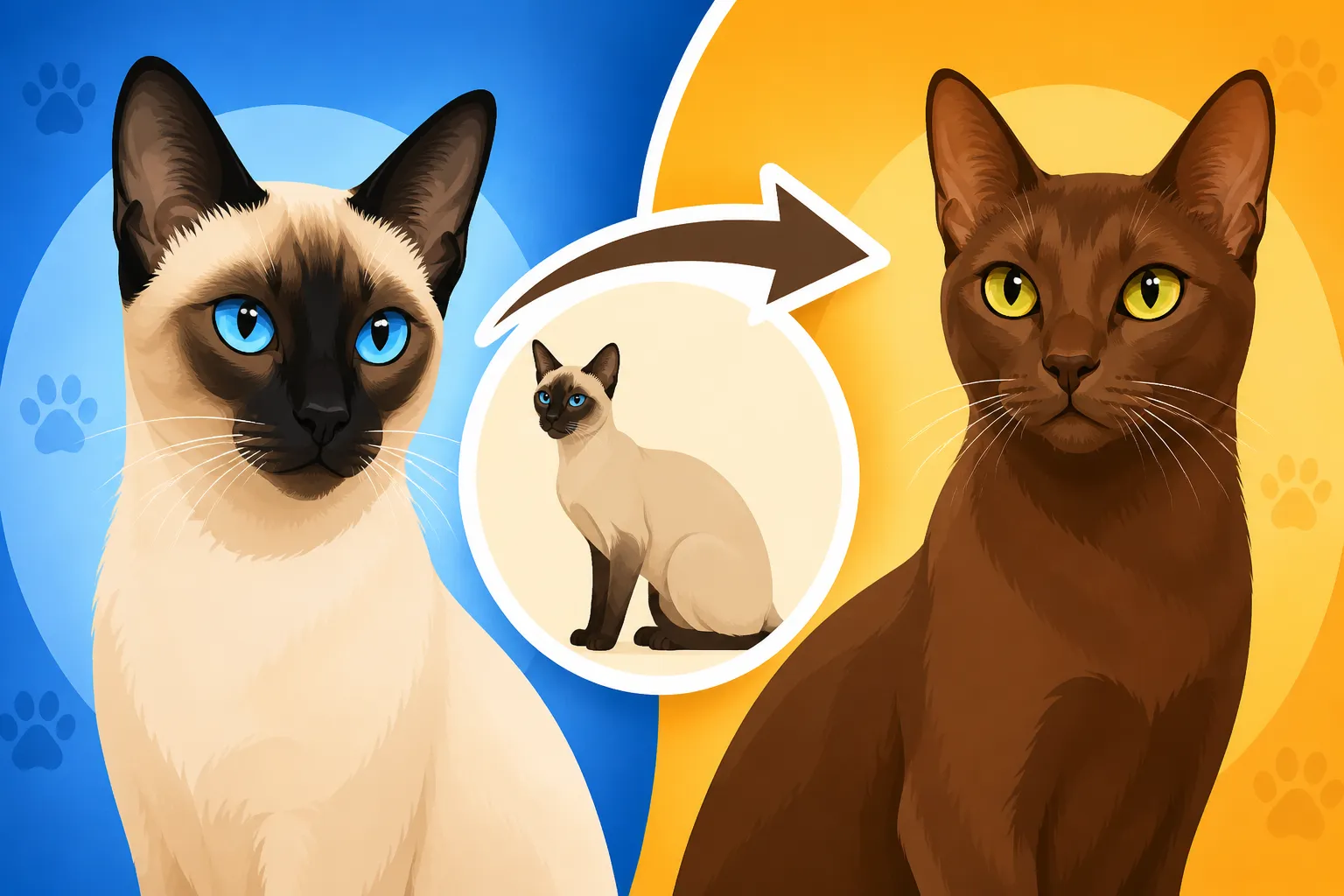
That distinction matters: the Havana Brown did not arise simply because someone found a brown-looking Siamese. Siamese cats are known for their pointed pattern, in which the face, ears, legs, and tail are darker than the body. The breeders’ aim was different: a cat with a uniform brown coat rather than Siamese points.
The Siamese contributed important ancestry and helped establish some of the traits breeders wanted. Black domestic shorthairs broadened the mix and contributed to the development of a solid-coated cat. It was selective breeding over generations—not a single cross—that helped create a recognizable breed.
From breeding project to established breed
In Britain, early breeders worked to make the brown cats more consistent in appearance and type. The cats were initially associated with names such as Chestnut Brown Foreign, reflecting both their coat color and their relationship to the “foreign” type of cat popular in British breed circles. The name Havana Brown became the familiar one in the United States.
The history is not a simple, uninterrupted family tree. Breeders in different places worked with related ideas and cats, and the American Havana Brown developed from cats brought over from British lines as well as continued breeding work. That means a short description such as “a Siamese crossed with a black cat” captures the broad starting point, but not the full process.
The broader story fits into the Siamese breed’s influence on other cats. Siamese ancestry contributed to several later breeds, though each was developed for different traits and eventually became distinct. For more context, see The Breeds a Siamese Cat Founded and How the Siamese Cat's Head Changed Shape in Fifty Years.
What the Siamese contributed and what changed
The role of Siamese ancestry
The Siamese connection is especially meaningful in the Havana Brown’s early breeding history and in the genetics of coat color. Some Siamese cats carry genes associated with chocolate coloration, which breeders could use when trying to develop brown-coated offspring. But a Siamese’s familiar pointed coat and a Havana Brown’s solid brown coat are different expressions of inherited traits.
A pointed Siamese has a temperature-sensitive color pattern: pigment is darker in cooler parts of the body, such as the ears and paws. A Havana Brown’s coat is intended to appear brown across the body rather than as contrasting points. The two cats can share ancestry and color-related genes without looking alike or being the same breed.
This is why coat color alone can be misleading. A brown cat is not automatically a Havana Brown, just as a pointed cat is not automatically a Siamese. A cat’s pedigree and the standards used by a registry matter when identifying a pedigreed breed. For an overview of Siamese color categories, see Which Siamese Cat Colors the Registries Accept.
The traits breeders selected for
As the Havana Brown became more established, breeders selected for a consistent combination of features: a solid brown coat, a distinctive head shape, expressive eyes, and a body that was neither as fine as some modern Siamese lines nor as heavy as some other brown-coated breeds. The desired result was a recognizable breed, not just a particular coat color.
The coat is often described as warm brown or mahogany. A Havana Brown’s whiskers and nose leather are also expected to harmonize with the coat, rather than creating the strong contrast seen in many pointed cats. Its eyes are typically green, another feature that helps distinguish the breed’s overall look from that of a blue-eyed Siamese.
Breed standards can differ among registries, and breed names are not always used identically in different countries. A cat that resembles a Havana Brown may be a brown domestic shorthair or another breed or mix. Appearance can suggest a possibility, but it does not establish ancestry.
| Feature | Siamese | Havana Brown |
|---|---|---|
| Coat pattern | Colorpoint, with darker extremities | Solid brown coat |
| Typical eye color | Blue | Green |
| Historical connection | One of the breeds used in early Havana Brown development | Developed through selective breeding that included Siamese ancestry |
| Breed identity | A distinct breed with its own standards | A distinct breed with its own standards |
| What appearance alone can prove | It may suggest a type, but not pedigree | It may suggest a type, but not pedigree |
How the Havana Brown differs from other Siamese-related cats
Similar ancestry does not mean the same breed
It is easy to group Havana Browns with other cats that have some Siamese ancestry, especially because Siamese cats played a role in developing multiple breeds. But ancestry is only one part of breed identity. Breeders shape a breed over time by choosing which cats produce the next generation, and registries define the traits they recognize.
The Oriental Shorthair, for example, is closely associated with Siamese-type ancestry and has a broad range of coat colors and patterns. The Havana Brown, by contrast, is known for its specific solid brown appearance and its own breed identity. These distinctions are easier to understand in How a Siamese Cat Differs From an Oriental Shorthair.
The Tonkinese is another useful comparison. It developed through Siamese and Burmese ancestry and is associated with its own coat patterns and breed history. A Havana Brown’s relationship to the Siamese is not the same as the Tonkinese’s, even though Siamese ancestry appears in both stories. See How a Siamese Cat Differs From a Tonkinese for a closer comparison.
Why a brown coat does not identify a Havana Brown
Several cats can have brown coats without belonging to the Havana Brown breed. A domestic shorthair may inherit a brown coat, and other breeds have their own brown or chocolate varieties. Even a cat with the right shade and general build may not have documented Havana Brown ancestry.
The reverse can be confusing, too: a Havana Brown kitten may not display its mature appearance immediately, and coat shade can look different under indoor lighting, in photographs, or at different ages. A single picture is not a dependable way to confirm breed. If the question matters—for example, when reviewing a breeder’s claim—ask about pedigree documentation and the relevant registry rather than relying only on color.
The same caution applies to labels such as “Siamese mix.” They can be useful informal descriptions, but a cat’s looks alone cannot confirm Siamese ancestry. Breed history is more complicated than matching a face, eye color, or coat pattern to a familiar image. What a Colorpoint Shorthair Is Next to a Siamese Cat offers another example of how similar-looking cats can have separate breed classifications.
What this history means for someone meeting a Havana Brown
Questions to ask about ancestry
If you are considering a cat described as a Havana Brown, ask what supports that identification. A breeder should be able to explain the cat’s lineage and provide appropriate pedigree information. If you are adopting from a shelter or rescue, the cat’s background may be unknown, and it is perfectly reasonable to describe the animal as a brown cat unless reliable records say more.
A breeder’s explanation should make sense beyond the phrase “it has Siamese in it.” Ask how the breeding lines are documented, what registry the cats are associated with, and what traits the breeder is working to preserve. These questions help separate a genuine breed history from a casual comparison based on appearance.
If a pet retailer such as Chewy comes up while you are preparing for a cat, remember that food, litter, and toys are separate from pedigree evidence. A product listing or a breed description on a shopping page cannot verify a cat’s ancestry. That is not a criticism of retailers; it is simply a different kind of information.
Understanding the breed without overreading the label
The Havana Brown’s history is a good reminder that breeds are made through generations of choices. Siamese cats helped provide part of the foundation, but breeders selected for a different coat pattern and a specific set of traits. Over time, that work established the Havana Brown as its own breed rather than a color variant of the Siamese.
For an owner, the shared history does not mean that every Havana Brown will behave like a Siamese or have identical care needs. Individual temperament depends on the cat, its experiences, and its health, not just a breed label. Basic care—such as suitable food, a clean litter setup, play, and regular veterinary attention—matters regardless of whether a cat has a documented pedigree.
When shopping for routine supplies, Chewy is one of many places people may encounter food and household essentials. Choosing supplies should be based on the cat’s needs and professional guidance where appropriate, not on an assumption that Siamese ancestry automatically calls for a special product. The historical link is fascinating, but it is not a substitute for getting to know the individual cat.
The Havana Brown did come from breeding work that included Siamese cats, but it became a distinct breed through careful selection and a different appearance goal. The clearest answer is therefore both yes and no: Siamese cats helped shape the breed’s origins, while the Havana Brown is not simply a brown Siamese.
Disclaimer
This article is for general informational purposes only and does not constitute professional advice. Laws, prices and regulations vary by location and change over time. Consult a qualified professional for guidance on your specific situation.