What a Wedge Headed Siamese Cat Is
A wedge-headed Siamese is the modern, elongated-looking type of Siamese cat, named for the long triangular shape of its head. The profile can look strikingly different from the rounder, sturdier cats many people picture as “traditional” Siamese. This guide explains the wedge’s defining features, how it differs from other types, and why a cat’s appearance alone cannot confirm its breed.
What a wedge-headed Siamese looks like
The defining head shape
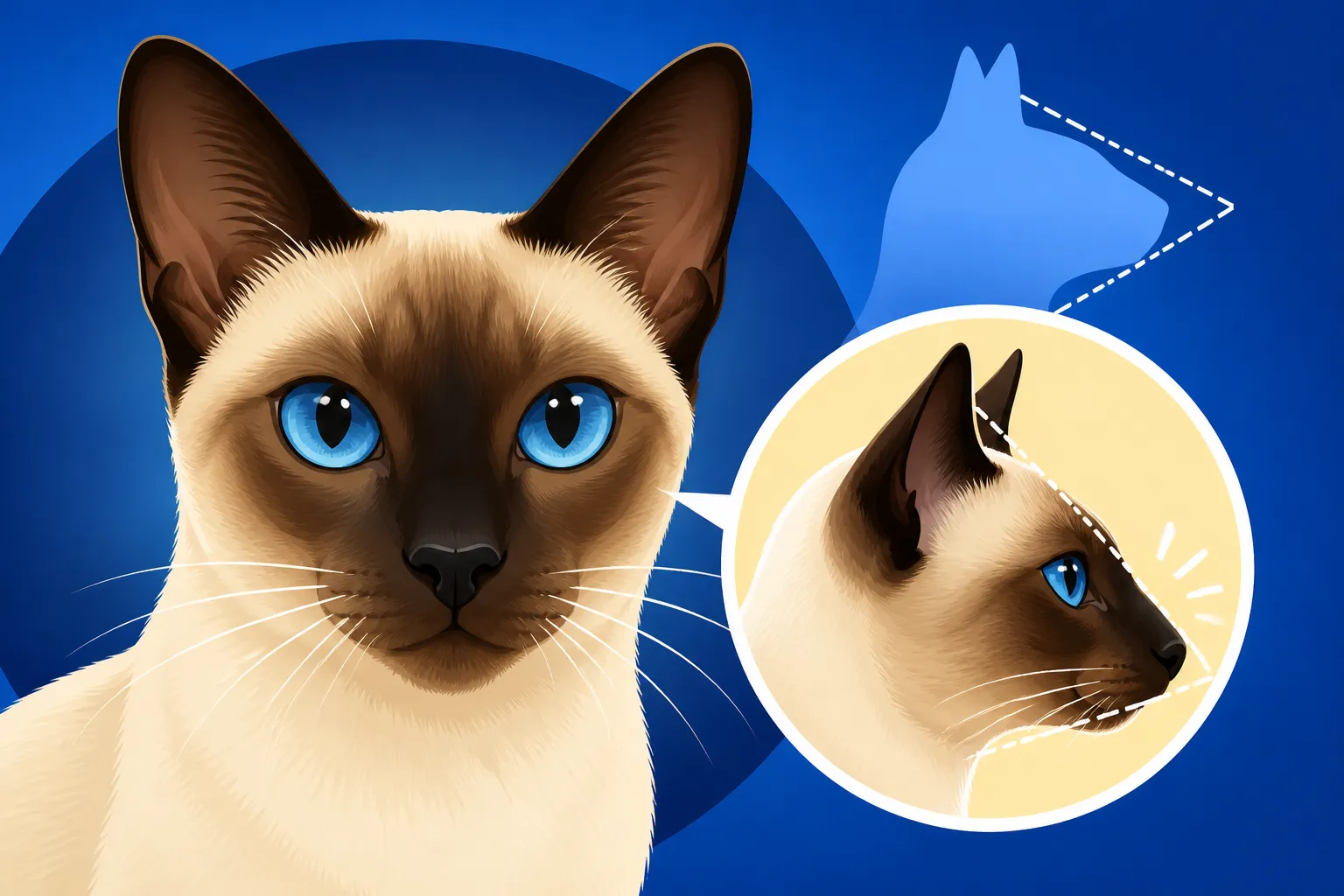
The wedge is the most noticeable feature: viewed from above or from the front, the head forms a long, tapering triangle. The muzzle continues the line of the wedge rather than looking short or rounded, and the cheeks are generally not full and round. Viewed from the side, the nose and forehead tend to make a relatively straight profile rather than a pronounced dip or break.
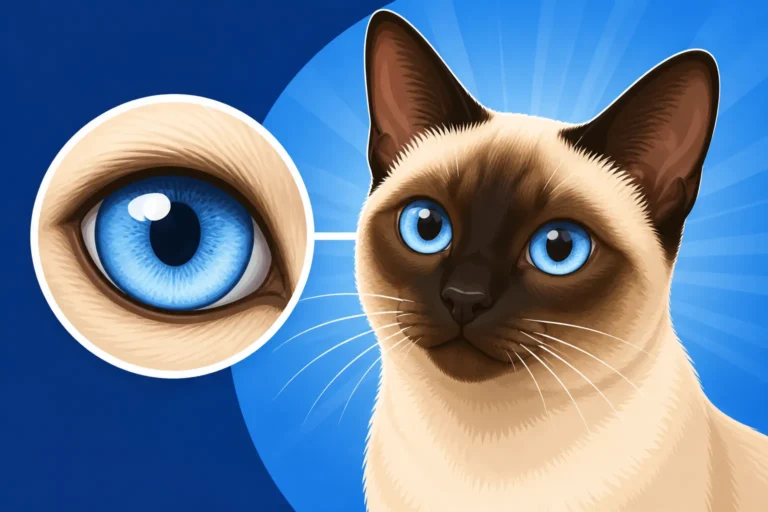
Large, pointed ears set wide at the base help complete the triangular outline. The eyes are blue and almond-shaped, set at a slight angle toward the nose. The effect can be quite dramatic, especially in show-line cats: a long face, prominent ears, and a fine, elegant frame.
The wedge is not simply a narrow face. Breed standards describe the whole head and its proportions, and a show cat is evaluated as a complete animal. For a broader picture of the expected features, see What a Siamese Cat Looks Like by the Standard and What the Siamese Cat Standard Asks For.
The body and coat that go with it
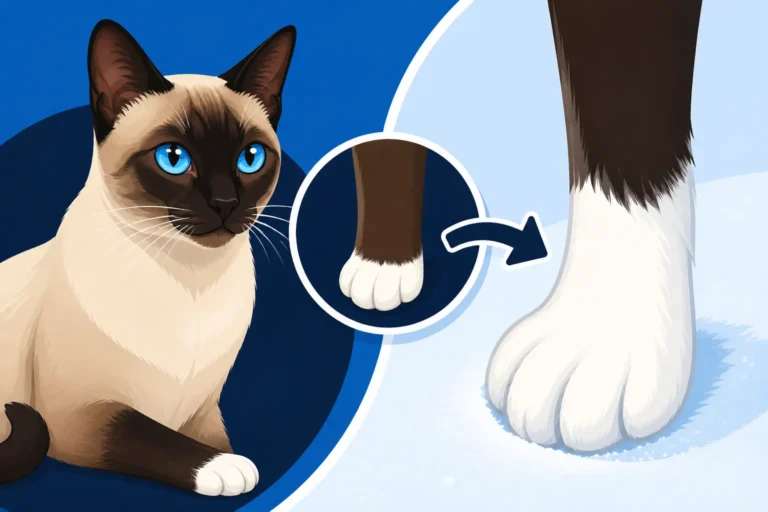
A wedge-headed Siamese is typically long and slim, with a fine-boned, muscular body, long legs, and a long, tapering tail. Its short coat lies close to the body. The familiar color pattern has a paler body and darker points on the face, ears, feet, and tail. Common traditional point colors include seal, blue, chocolate, and lilac, though which colors count as Siamese can depend on the registry.
That slim outline is part of the breed’s look, but it should not be confused with being underweight. You should be able to feel a cat’s ribs under a light layer of tissue, but prominent bones, unexplained weight loss, or a sudden change in body shape deserve a conversation with a veterinarian. Appearance standards are not a substitute for assessing an individual cat’s health.
The breed’s color pattern is temperature-sensitive, which helps explain why the body and extremities can look different in tone. For more on those variations, explore Which Colors a Siamese Cat Comes In and Why the Siamese Cat's Head Changed Shape in Fifty Years.
How the wedge differs from an applehead or traditional type
A useful comparison, not always a simple label
“Wedge head,” “applehead,” and “traditional Siamese” are common descriptions used to talk about differences in appearance. They are helpful shorthand, but they do not always mean the same thing to every breeder, registry, or cat owner. In everyday conversation, wedge-headed cats are usually associated with the modern Siamese show type, while applehead cats are described as having a rounder head, fuller cheeks, and a more substantial build.
| Feature | Wedge-headed type | Applehead or traditional-looking type |
|---|---|---|
| Head outline | Long and tapered, with a triangular appearance | Rounder or broader, with fuller cheeks |
| Muzzle and profile | Longer muzzle and relatively straight profile | Shorter-looking face and less angular outline |
| Ears | Large and wide-set, emphasizing the wedge | Often appear smaller in proportion to the head |
| Overall build | Long, slim, and fine-boned | Often appears sturdier or more compact |
| What the label tells you | A description of appearance and, often, show-line type | A description of appearance; not always a formal breed designation |
These are general impressions, not a checklist that identifies every cat. Cats vary, and a single feature—such as large ears or a slim body—does not determine which type a cat is. A mixed-breed cat can also have a wedge-shaped face, while a pedigreed Siamese may not look as extreme as the most angular show examples.
The shift toward the wedge-shaped show type happened over time through selective breeding. The history is more nuanced than a sudden switch from one kind of Siamese to another; How the Applehead Siamese Cat Became the Wedge and Why Show Breeders Changed the Siamese Cat's Head explore that change in more detail.
Is an applehead a separate Siamese breed?
Not necessarily. “Applehead Siamese” is widely used as a descriptive or marketing term, but it is not automatically the name of a separate, universally recognized breed. A breeder may use it to describe a rounder, older-style appearance, while a registry may apply its own breed definitions and show standards.
The Thai cat is a related but distinct point of comparison. Some registries recognize the Thai separately from the modern Siamese, with a standard intended to preserve a more moderate, traditional appearance. That does not mean every round-faced Siamese is a Thai cat, or that the terms “Thai” and “applehead Siamese” can always be swapped. See What the Thai Cat Is Next to a Siamese Cat and Whether the Traditional Siamese Cat Still Exists for the distinctions.
If you are choosing a cat, ask the breeder or rescue what they mean by “wedge,” “traditional,” or “applehead,” and whether the cat has pedigree paperwork. The words can describe appearance, but they do not prove a cat’s ancestry on their own.
How the wedge type developed and what the label means
Selective breeding shaped the modern look
The modern wedge-headed Siamese is associated with breeding toward a particular show standard. Over generations, breeders selected cats whose features matched the preferred outline: a longer head, larger ears, a lean body, and a fine, elongated silhouette. The breed’s appearance therefore reflects both inherited traits and human preferences about what a Siamese should look like.
That history can make discussions of “real” or “less real” Siamese cats feel surprisingly heated. It is more useful to separate three questions: What does the cat look like? What breed does its pedigree or registry identify? And what qualities matter to you as a companion? Those questions may have different answers. A cat can look wedge-headed without having documented Siamese ancestry, and a pedigreed Siamese can have a less exaggerated wedge.
For background on the breed’s changing appearance, How the Siamese Cat's Head Changed Shape in Fifty Years is a helpful companion read. To compare the Siamese with a related breed that can share some visual traits, see How a Siamese Cat Differs From an Oriental Shorthair.
Head shape does not tell you personality or health
A wedge-shaped head does not guarantee a particular temperament. Siamese cats are often described as social, active, and vocal, but an individual cat’s personality is shaped by many factors, including early experiences, health, age, and environment. A quiet Siamese is still a Siamese, and a talkative cat with a triangular face is not automatically one.
Likewise, head shape alone cannot establish that a cat is healthier or less healthy. A responsible assessment looks at the individual animal, its veterinary history, and relevant family information—not just the outline of its face. If you are considering a kitten from a breeder, ask about health records and what screening is appropriate for the family line. If you are adopting, request any available medical history and arrange a veterinary checkup.
When a cat’s head, weight, breathing, eating habits, or energy changes suddenly, focus on the change rather than trying to explain it through breed type. A veterinarian can assess what is happening in the individual cat.
Choosing and caring for a wedge-headed Siamese
Questions to ask before adopting or buying
If you are looking for a wedge-headed Siamese, start by asking what the seller means by the term. Ask whether “wedge-headed” describes the cat’s appearance or whether the cat comes with pedigree documentation. If a breeder claims registry status, ask which registry and request the relevant paperwork rather than relying on a verbal description or a photo.
It also helps to meet the cat, if possible, and ask about its parents, early socialization, veterinary care, and routine. Look for clear answers and a setting where the cats’ welfare is taken seriously. A very angular face in an online listing can be appealing, but it tells you little about the cat’s temperament, medical history, or how it will fit your household.
For a practical checklist on identity, see How to Tell a Siamese Cat From a Mixed Breed. If you are choosing between different head types, remember that the most important match is the individual cat’s needs and personality—not whether its profile is especially sharp.
Everyday care matters more than the silhouette
The wedge-headed type does not need a special care routine just because of its head shape. Provide a balanced diet suited to the cat’s age and health, fresh water, regular veterinary care, play, and safe places to climb or rest. The short coat usually needs modest grooming, though individual cats may enjoy more frequent brushing.
A curious, active cat may benefit from food puzzles, sturdy scratching posts, and interactive play. If you are putting together basic supplies, retailers such as Chewy may be one place to look for items like a carrier, brush, or puzzle feeder; choose products based on the cat’s size, habits, and safety rather than its head type. A well-fitted carrier, for example, should let the cat stand and turn around comfortably.
It is also worth choosing equipment for the actual cat in front of you. A slim Siamese may need a different harness fit from a broad-bodied cat, and a fast eater may benefit from a slow feeder if a veterinarian agrees it is appropriate. Chewy carries a range of everyday pet supplies, but check product dimensions and materials carefully; no retailer can replace a vet’s advice about food or medical needs.
In short, “wedge-headed” describes a recognizable modern Siamese look: a long triangular head, prominent ears, and an elegant, slender outline. It can help you talk about appearance and breeding history, but it does not by itself confirm pedigree, predict personality, or assess health. Chewy and other pet retailers can help with routine supplies, while a breeder’s records, a rescue’s history, and veterinary guidance are what help you understand the individual cat.
Disclaimer
This article is for general informational purposes only and does not constitute professional advice. Laws, prices and regulations vary by location and change over time. Consult a qualified professional for guidance on your specific situation.