Whether a Solid White Siamese Cat Exists
A cat that looks white from nose to tail may be advertised as a “white Siamese,” leaving you to wonder whether that’s a real Siamese color or just a label. The short answer: solid white is not the traditional pointed Siamese pattern. But a white cat can have Siamese ancestry, and a young Siamese kitten may look almost entirely white before its points develop.
Does a solid white Siamese cat exist
Why solid white is not the usual Siamese pattern
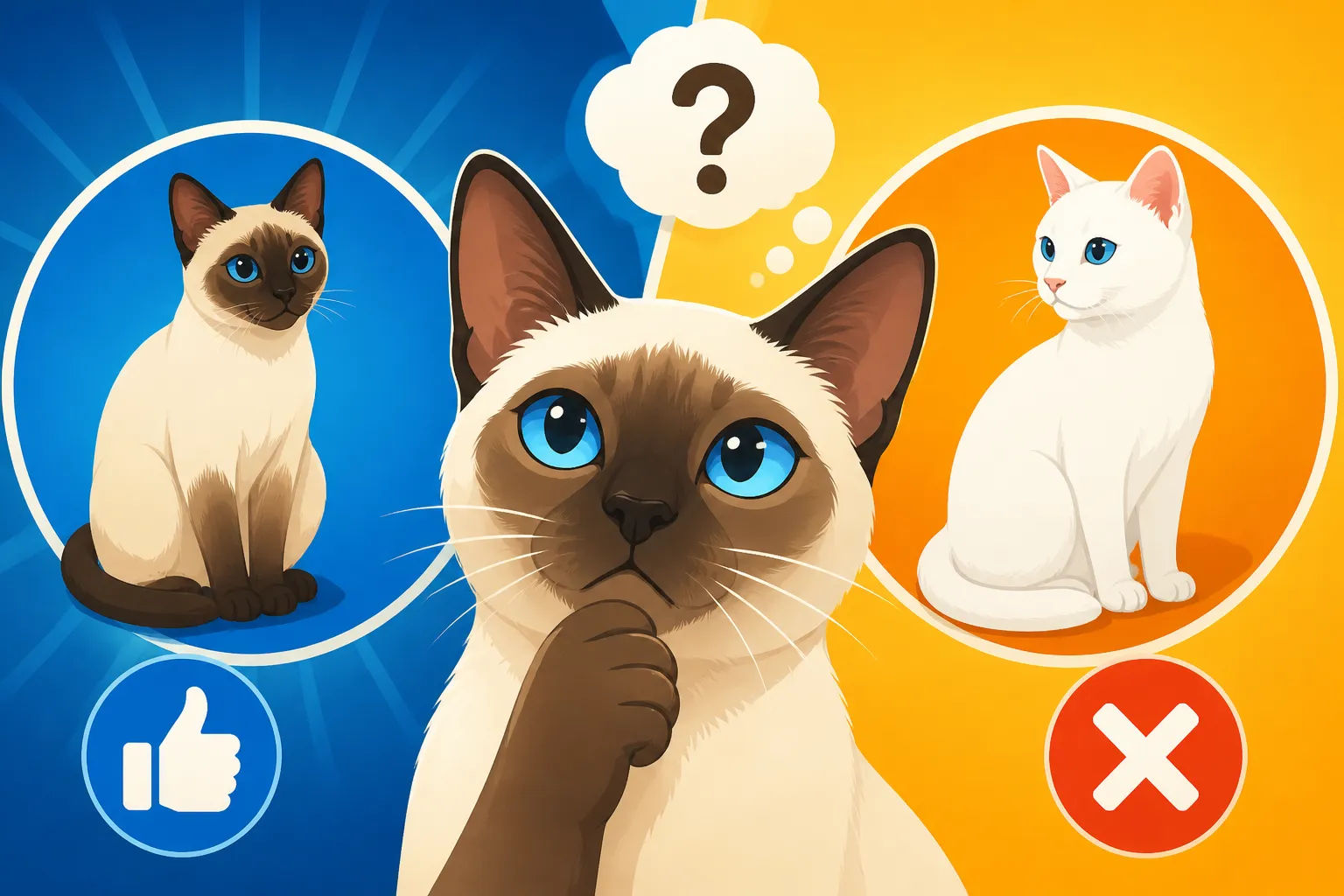
A Siamese is known for its colorpoint pattern: a lighter-colored body with darker fur on the face, ears, legs, and tail. Those darker areas are called points. A cat with uniformly white fur and no visible points does not show the typical Siamese appearance, so “solid white Siamese” is not a standard description of the breed’s familiar coat pattern.
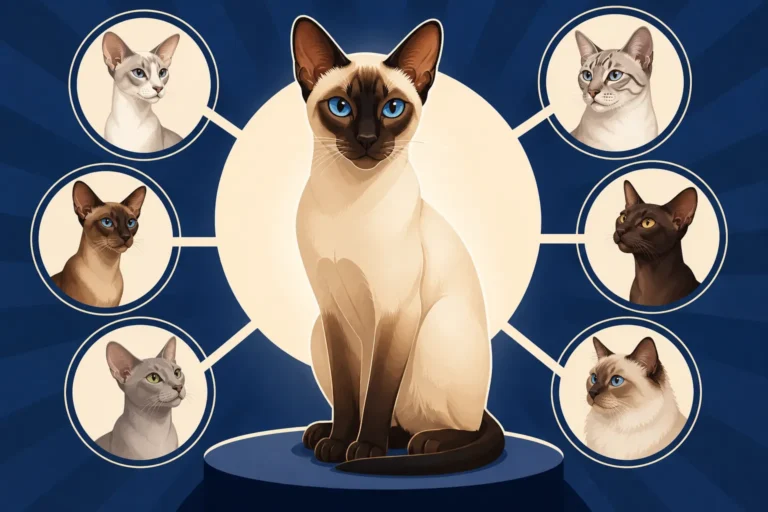
Breed standards focus on more than a cat’s general look. They specify features such as coat pattern, eye color, and body type. The details can differ among cat registries, particularly around which point colors they accept, but the defining Siamese coat remains colorpoint. For an overview of how the breed is described, see What the Siamese Cat Standard Asks For and Which Colors a Siamese Cat Comes In.
That distinction can feel frustrating if you’re looking at a beautiful white cat advertised as a Siamese. The seller may be using “Siamese” loosely to describe blue eyes, a slender build, or a family resemblance. Those features can be clues, but none of them by itself proves that the cat is a purebred Siamese.
A white cat can still have Siamese ancestry
A cat’s visible coat is not a complete record of its ancestry. A white coat can conceal other color patterns, and a cat with Siamese ancestry may not display the classic points people expect. In some cases, the cat may be a mixed-breed cat that inherited a Siamese-like trait; in others, a gene affecting coat color may make the underlying pattern difficult to see.
This is why it helps to separate two questions: “Does this cat have Siamese ancestry?” and “Does this cat look like a standard Siamese?” The answers can differ. A cat might have Siamese relatives without fitting the breed’s usual appearance, while a non-Siamese cat might share familiar traits such as blue eyes or a sleek shape.
If you are considering a cat described as Siamese, ask what the description is based on. A documented pedigree is different from a guess based on appearance. For a closer look at the limits of visual identification, read How to Tell a Siamese Cat From a Mixed Breed and Whether a DNA Test Confirms a Siamese Cat.
What people may mean by “white Siamese”
The phrase can refer to several different things. A person might mean a white cat with blue eyes, a colorpoint kitten whose points have not darkened yet, or a cat with some Siamese ancestry. These are not interchangeable descriptions, even though they can get blurred in casual conversation or online listings.
It may also be used for a cat whose coat is very pale, with subtle points that are hard to notice in certain lighting. A cream body and faintly shaded ears can look nearly white in a bright photograph. Looking at the cat in natural light, checking the color of the ears and tail, and asking about its age can help clarify what you’re seeing.
Why Siamese kittens can look white at first
The colorpoint pattern develops with temperature
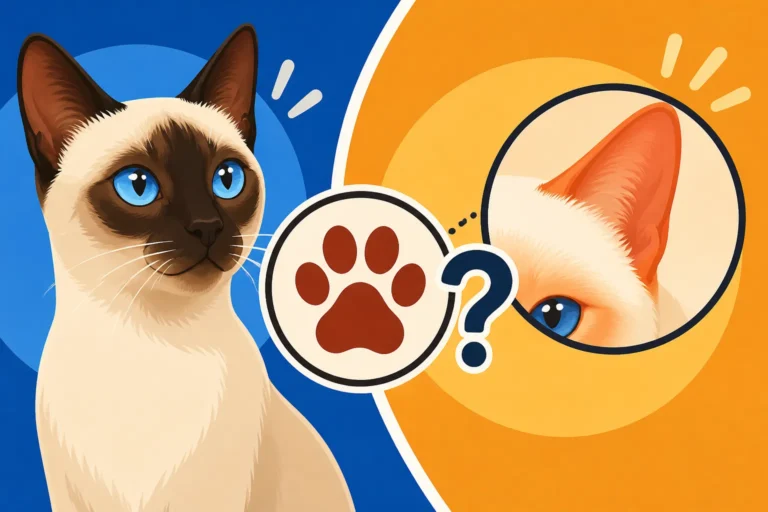
Siamese coloring is linked to a temperature-sensitive form of pigment production. The pigment-producing process works more in cooler parts of the body than in warmer areas. A kitten develops in the warmth of the womb, so it is born with little or no visible dark coloring. After birth, cooler areas such as the ears, face, paws, and tail gradually develop pigment.
That process does not happen all at once. A very young kitten may appear nearly white or ivory, then show increasingly noticeable points as it grows. The timing and depth of the color can vary, so two kittens from the same litter may not look identical at the same age. Their eventual shade also depends on their inherited color pattern.
This gradual change is one reason a photo of a newborn kitten is not enough to determine its adult appearance. If you’re curious about how the process works, Why a Siamese Cat Kitten Comes Out White and Why a Siamese Cat Has Dark Points explain the pattern in more detail.
How to tell a young pointed kitten from a solid-white cat
Start with the areas where points usually become visible: the ears, face, feet, and tail. In a young kitten, the change may begin subtly. The ear edges or tail tip might look slightly darker than the body, even when the difference is difficult to capture in a photo. As the kitten matures, the contrast may become clearer.
Age matters, but it is not the only factor. Lighting, camera exposure, and a pale point color can all make a kitten look whiter in pictures than it does in person. When possible, ask for recent photos taken in natural light and ask the breeder or rescue for the kitten’s age and information about its parents. A littermate’s coloring may offer context, though it cannot guarantee exactly how an individual kitten will develop.
A truly solid-white appearance in an older cat is a different situation from a young kitten whose points are still developing. If the cat remains uniformly white, it may simply not have the visible colorpoint pattern associated with a typical Siamese. The label used in an advertisement is not a substitute for an accurate description of the cat’s coat and background.
White cats with blue eyes and Siamese traits
Blue eyes do not confirm a Siamese breed
Blue eyes are strongly associated with Siamese cats, but eye color alone cannot establish breed. Many cats outside the Siamese breed can have blue eyes, including some white cats and cats with other coat patterns. A white, blue-eyed cat may look strikingly Siamese to someone who recognizes the breed mainly by its eyes, but its appearance does not confirm its ancestry.
It is also worth separating eye color from coat color. A cat can have blue eyes and a solid-white coat without having the Siamese colorpoint pattern. Conversely, a Siamese’s blue eyes are part of the breed’s familiar appearance, but the cat should be considered as a whole rather than identified by one feature. Learn more in Why a Siamese Cat Has Blue Eyes.
If you are choosing a cat, it is completely reasonable to ask about eye health and hearing as well as coat and breed. White coat color and blue eyes can be associated with a higher chance of congenital deafness, particularly when a cat has blue eyes on both sides, but not every white, blue-eyed cat is deaf. A veterinarian can help assess an individual cat; appearance alone cannot tell you whether it hears normally.
White masking and hidden color patterns
Some cats inherit coat-color genes that can make white fur cover or obscure other colors. This is sometimes described as white masking: the cat appears white, while other color information may be hidden beneath that appearance. That does not automatically make the cat a Siamese. It means visible coat color may not tell the whole story about the cat’s genetic background.
The practical point is simple: a white cat can carry genes for other colors or patterns without visibly showing them. But hidden ancestry is not the same as a visible Siamese pattern, and it does not make “solid white Siamese” a standard coat description. A pedigree, reliable family history, and careful identification are more useful than guessing from a white coat.
When a breeder or seller cannot explain what they mean by “Siamese,” ask for specifics. Is the cat registered as a Siamese? Are its parents documented? Is “Siamese” being used to describe appearance rather than pedigree? Those questions are more revealing than asking whether the cat has blue eyes.
How to assess a cat advertised as a white Siamese
Questions to ask a breeder, rescue, or seller
If the cat is being sold as a purebred Siamese, ask for pedigree documentation and the names or records of its parents. A responsible breeder should be able to explain the kitten’s expected coat pattern and why it is being described as Siamese. If the cat is a rescue or an unregistered pet, the most accurate description may be “white cat with possible Siamese ancestry” rather than a definite breed claim.
You can also ask whether the cat’s coat is expected to change. For a young kitten, ask what its points look like now and whether the parents show a colorpoint pattern. For an adult cat that is completely white, ask what evidence supports the Siamese label. Clear, direct answers are more helpful than a confident-sounding label without supporting details.
If you are trying to understand the breed’s family resemblance, What a Colorpoint Shorthair Is Next to a Siamese Cat explains why some cats can look similar while belonging to different breed categories. And if the main question is ancestry, Whether a DNA Test Confirms a Siamese Cat can help set realistic expectations about what a test can and cannot tell you.
A simple comparison of the possibilities
| What you see | What it may mean | What to check |
|---|---|---|
| Nearly white newborn kitten | A young colorpoint kitten before its points become obvious | Age, developing color on ears and tail, and parent information |
| White adult cat with blue eyes | A white cat; eye color alone does not establish Siamese ancestry | Pedigree or family history, plus a veterinary check if hearing is a concern |
| Pale body with darker ears, face, paws, or tail | A colorpoint pattern, possibly with subtle or light points | Coat in natural light and the cat’s age |
| White cat described as “Siamese mix” | Possible Siamese ancestry, but not confirmed by appearance alone | Rescue or family history, with the label treated as an estimate |
| White cat with a documented Siamese pedigree | A cat with recorded Siamese ancestry, though its visible coat may not match the typical pattern | Registration and pedigree details, and clarification of how its coat is classified |
What to do if you are adopting or buying
First, decide whether you are looking for a particular appearance or for a cat with documented breed ancestry. If you mainly love the look of a white, blue-eyed cat, you do not need to treat “Siamese” as a requirement. Focus on the individual cat’s temperament, health, and needs. If purebred status matters to you, ask for records rather than relying on a listing title or photograph.
Next, look at the cat in person if possible, or request several clear images from different angles. A single bright, edited photo can wash out faint points and make a pale colorpoint cat appear solid white. Ask about age, parentage, registration, and any known hearing concerns. For a rescue cat with little history, accept that its ancestry may remain uncertain; that uncertainty does not make it any less of a good companion.
Once you bring a cat home, make decisions based on its individual care needs, not just the breed label. Retailers such as Chewy may be one option for routine food, litter, or grooming supplies, but a store listing cannot confirm a cat’s breed. If you are choosing products for a particular health concern, ask your veterinarian what is suitable rather than relying on a label or online description. Chewy can be part of a household’s supply routine, while breed identification is a separate question that depends on reliable records.
A solid-white cat can be wonderful, and a Siamese can be wonderful; the important thing is not to confuse coat color with proof of breed. “White Siamese” is often a casual or imprecise label, while a young pointed kitten may simply need time for its characteristic coloring to emerge. When the distinction matters, look for documentation and ask clear questions. For everyday care items, Chewy may be a convenient place to compare routine supplies, but it cannot resolve uncertainty about ancestry.
Disclaimer
This article is for general informational purposes only and does not constitute professional advice. Laws, prices and regulations vary by location and change over time. Consult a qualified professional for guidance on your specific situation.