How Much Food a Siamese Cat Gets Per Meal
It’s a common worry among Siamese cat owners: you’ve got this incredibly active, vocal, and often seemingly insatiable feline companion, and you constantly wonder if you’re feeding them enough. Their lean, svelte physique often makes us second-guess if they’re getting the right amount of fuel. This guide will walk you through understanding your Siamese cat's unique dietary needs and how to accurately determine how much food they truly need per meal to keep them healthy, happy, and well-nourished, without overfeeding or leaving them hungry.
Understanding Your Siamese Cat's Metabolism and Body Type
One of the first things you notice about a Siamese cat is their distinctive build: long, lithe, and often quite muscular, but rarely chunky. They're often described as "bony" or "slender," which can lead to owners feeling like they need to feed them more. However, this is largely just their natural body type, driven by a high metabolism that’s as famous as their chattiness.
The Siamese "Go-Go-Go" Energy Level
Siamese cats are renowned for their incredible energy. They aren't content to lounge all day; they want to play, explore, and talk about everything they're doing. This isn't just a quirky personality trait; it's a reflection of a fast metabolism that burns through calories at a quicker rate than many other breeds. Think of them as tiny, furry athletes. A Siamese might spend an hour chasing toys, scaling cat trees, and darting around the house, burning a significant amount of energy in the process. This sustained activity means their caloric needs can be higher on a per-pound basis compared to a more sedentary breed. If you've ever tried to feed a lean Siamese cat that burns everything, you know exactly what I mean.
Why They Often Appear Thin
It's easy to look at a Siamese and think they're underweight because you can feel their ribs or hip bones. But for a healthy Siamese, this can be perfectly normal. Their breed standard calls for a sleek, tubular body with fine bones and firm muscles, not a robust, heavily muscled frame. A healthy Siamese should have a noticeable waist when viewed from above, and their abdomen should tuck up slightly when viewed from the side. You should be able to feel their ribs easily under a thin layer of flesh, but they shouldn't protrude sharply or be visible from a distance. Worrying about their thinness is valid, but it's important to differentiate between naturally lean and genuinely underweight. Knowing what a healthy Siamese cat weighs is crucial, and it's often less than you might expect for their length.
The Impact of Age and Activity on Metabolism
Just like people, a Siamese cat's metabolism isn't static. A rambunctious kitten or a young adult Siamese zooming through its prime will have a significantly higher caloric requirement than a senior Siamese cat who spends more time napping in sunbeams. An intact (unspayed or unneutered) cat often has a higher metabolic rate due to hormonal activity compared to a spayed or neutered counterpart. Similarly, a Siamese living in a multi-cat household where they are constantly playing and interacting will burn more calories than a solo cat whose main form of exercise is stretching. These factors all feed into the overall daily calorie count your cat needs, which then gets divided into meals.
Calculating Your Siamese Cat's Daily Caloric Needs
Before you can determine how much food to put in the bowl for each meal, you need to understand your Siamese cat's total daily caloric requirements. This isn't a one-size-fits-all number; it depends on several key factors.
Step 1: Determine Your Cat's Ideal Weight
This is the foundation. If your Siamese is currently overweight or underweight, the calculation should be based on their ideal weight, not their current weight. Your veterinarian is the best resource for determining your cat's ideal weight and body condition score (BCS). They can help you assess if your cat is truly too thin or just naturally slender. For general guidance, most adult male Siamese cats weigh between 9-14 pounds, and females between 6-10 pounds, but again, this varies greatly by individual build and genetics. It’s not just about the number on the scale, but how they feel and look. If you're wondering how to tell if a Siamese cat is too thin, feeling their ribs and checking their waistline are key indicators.
Step 2: Calculate Resting Energy Requirement (RER)
The Resting Energy Requirement (RER) is the energy needed for basic bodily functions like breathing, circulation, and digestion when your cat is at rest. It's a baseline. A common formula for RER is:
RER (kcal/day) = 70 x (body weight in kg)^0.75
- Convert pounds to kilograms: Divide your cat's ideal weight in pounds by 2.2.
- Calculate: For example, if your Siamese cat's ideal weight is 8 lbs:
- 8 lbs / 2.2 = 3.63 kg
- (3.63)^0.75 ≈ 2.76
- RER = 70 * 2.76 = 193.2 kcal/day
This calculation gives you a starting point, but it's not the whole picture.
Step 3: Apply the Maintenance Energy Requirement (MER) Factor
The Maintenance Energy Requirement (MER) takes RER and multiplies it by a factor that accounts for your cat's activity level, age, and reproductive status. This is where individual differences truly shine.
Here's a general guide for MER factors:
| Cat Status | MER Factor | Example Calculation (for 193.2 kcal RER) |
|---|---|---|
| Neutered/Spayed Adult | 1.2 | 193.2 * 1.2 = 231.8 kcal/day |
| Intact Adult | 1.4 | 193.2 * 1.4 = 270.5 kcal/day |
| Senior (less active) | 1.0 | 193.2 * 1.0 = 193.2 kcal/day |
| Kitten (0-4 months) | 2.5-3.0 | 193.2 * 2.5 = 483 kcal/day (min) |
| Kitten (4 months-adult) | 2.0 | 193.2 * 2.0 = 386.4 kcal/day |
| Weight Loss | 0.8 | 193.2 * 0.8 = 154.5 kcal/day |
| Weight Gain | 1.6 | 193.2 * 1.6 = 309.1 kcal/day |
- Example: For our 8-pound neutered adult Siamese, the estimated daily caloric need (MER) would be roughly 232 kcal/day. This number represents the total calories they need to maintain their ideal weight. Keep in mind these are general guidelines, and your vet might recommend a slightly different factor based on a thorough examination. This is precisely why it's so important to regularly check in with your vet about how many calories a Siamese cat needs a day.
Practical Feeding Strategies: How Much Per Meal?
Once you have your cat's total daily caloric requirement, the next step is to divide that into appropriate meal portions. This is where the "per meal" question truly comes into play.
Reading Food Labels Accurately
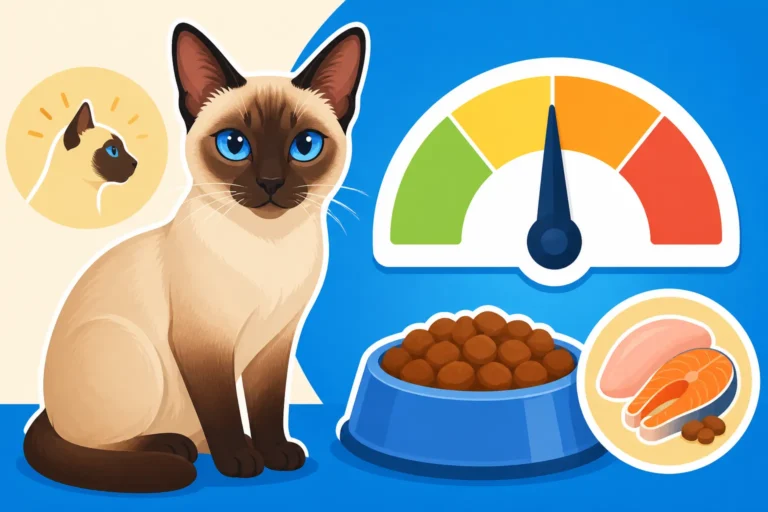
The biggest mistake owners make is just scooping without checking the bag. Cat food labels provide calorie content, usually listed as "kcal/cup" for dry food or "kcal/can" or "kcal/pouch" for wet food. This number is critical. A cup of one brand's dry food might have 350 calories, while another has 500. A 3oz can of wet food might have 70 calories, while another has 100. Always check the specific food you're using.
Let's continue with our example Siamese who needs 232 kcal/day.
- Dry Food Scenario: If your dry food contains 400 kcal per cup, then your cat needs 232 kcal / 400 kcal/cup = 0.58 cups per day.
- Wet Food Scenario: If your wet food is 85 kcal per 3oz can, your cat needs 232 kcal / 85 kcal/can = 2.73 cans per day.
- Mixed Diet Scenario: Say you give two 3oz cans of wet food (170 kcal total) and supplement with dry. You have 232 – 170 = 62 kcal left for dry food. If dry food is 400 kcal/cup, then 62 kcal / 400 kcal/cup = 0.155 cups of dry food.
This shows how varied the actual volume of food can be based on caloric density. You can find a vast selection of cat food, with detailed nutritional information, on sites like Chewy, making it easier to compare options.
How Many Meals Per Day?
Most adult cats do well with two meals a day, roughly 12 hours apart. This helps regulate hunger, prevents overeating (which can be a concern even for lean Siamese if given too much, leading to issues like diabetes in a Siamese cat), and provides consistent energy.
- For our example Siamese needing 0.58 cups of dry food per day:
- Morning Meal: 0.29 cups
- Evening Meal: 0.29 cups
- For our example Siamese needing 2.73 cans of wet food per day:
- Morning Meal: 1 can
- Midday (optional snack if home): 0.73 can (approx. 2/3 of a can)
- Evening Meal: 1 can
Kittens, however, need more frequent meals – typically 3-4 smaller meals a day – to support their rapid growth and high energy. As they mature, you can gradually transition them to two meals a day.
The Role of Wet Food vs. Dry Food
Many Siamese cat owners find that a mixed diet or primarily wet food diet works well. Wet food has a higher moisture content, which is excellent for hydration and urinary tract health, and can help a cat feel fuller on fewer calories if they tend to scarf down dry food. Whether a Siamese cat needs wet food is a common question, and while not strictly necessary for every cat, it offers significant benefits. Fresh food options can also be tailored to specific caloric needs and often come with clear portioning guides, which simplifies mealtime planning.
Treats and Toppers: Don't Forget the Calories!
It's easy to forget that treats, dental chews, and food toppers all contribute to your cat's daily caloric intake. As a rule of thumb, treats should make up no more than 10% of their daily calories. If your Siamese needs 232 kcal/day, that means only about 23 kcal from treats. This isn't much! If you give too many treats, you need to reduce their regular meal portions accordingly. This is where a small kitchen scale (easily found on Amazon) can be incredibly helpful for measuring both food and treats.
Monitoring and Adjusting Portions
Feeding isn't a static process. Your cat's needs will change throughout their life.
- Regular Weight Checks: Weigh your Siamese every month or two. A digital pet scale can be a worthwhile investment.
- Body Condition Scoring (BCS): Regularly assess your cat's BCS. This involves feeling their ribs, spine, and waist. There are many charts online that show you how to do this. Your vet can show you how to properly assess your cat's body condition during wellness exams.
- Activity Level: Is your cat more active or less active than usual? Did you introduce a new toy that's gotten them playing more? Did you move house, and they're now more sedate? Adjust accordingly.
- Health Changes: Illnesses, medications, or changes in dental health can all impact appetite and caloric needs. What changes in a Siamese cat after twelve, for example, often includes a slower metabolism and potential changes in dental health that affect eating. Always consult your vet if you notice significant changes in appetite or weight.
It's an ongoing conversation between you, your cat, and your veterinarian.
Common Feeding Mistakes and Troubleshooting for Siamese Owners
Even with the best intentions, feeding a Siamese cat can present unique challenges. Their strong personalities and high intelligence mean they can be very persuasive, and their lean build can make you second-guess yourself.
The "Always Hungry" Siamese Syndrome
Many Siamese owners will tell you their cat acts like they're starving, even right after a meal. This isn't always a sign that they're truly hungry; it's often part of their highly communicative nature and food-motivated personality. They learn quickly that meowing or rubbing against your legs gets results.
- Stick to the Schedule: Establish a consistent feeding schedule and stick to it. Don't give in to demands between meals. Your cat will learn that food appears at specific times, not just when they yowl.
- Puzzle Feeders: These are a game-changer for many Siamese. They slow down eating, provide mental enrichment, and make your cat "work" for their food, mimicking hunting behavior. This can extend mealtime and reduce begging. You can find many options on Chewy or Amazon.
- High-Quality Food: Ensure the food you're providing is nutritionally dense and appropriate for their life stage. Sometimes, lower-quality foods don't provide adequate satiety, even with enough calories.
Dealing with Picky Eaters
Despite their "always hungry" reputation, some Siamese can be surprisingly particular about their food. They might turn up their nose at a new flavor or even a different batch of their usual food.
- Gradual Transitions: When introducing new food, do it slowly over 7-10 days, mixing increasing amounts of the new food with decreasing amounts of the old.
- Variety (Within Reason): Some cats enjoy a bit of flavor rotation, while others prefer consistency. Find what works for your cat. Offering different textures (pate, shreds, gravy) can also help if they're finicky.
- Warm it Up: Slightly warming wet food (to body temperature) can enhance its aroma and palatability, making it more appealing.
Over-grooming and Pica Related to Food
Some Siamese cats develop behaviors like psychogenic alopecia in a Siamese cat or why a Siamese cat chews wool and swallows it when stressed or bored. While often behavioral, sometimes diet or feeding routine can play a role. If a cat is consistently underfed or bored by their eating routine, they might seek other oral fixations.
- Enrichment at Mealtime: As mentioned, puzzle feeders are great. Hiding small portions of dry food around the house (if safe from other pets) can turn mealtime into a hunt.
- Consistent Routine: A predictable daily routine, including meal times, can reduce anxiety.
- Veterinary Consultation: If pica or over-grooming is persistent, a vet visit is essential to rule out underlying medical conditions and to discuss behavioral modification strategies or even medication.
Ultimately, the exact amount of food a Siamese cat gets per meal is not a fixed, universal number. It’s a carefully calculated portion derived from their individual daily caloric needs, taking into account their unique metabolism, activity level, age, and the specific nutritional content of the food you're offering. Regular monitoring and veterinary guidance will help you fine-tune this for a lifetime of happy, healthy eating.
Disclaimer
This article is for general informational purposes only and does not constitute professional advice. Laws, prices and regulations vary by location and change over time. Consult a qualified professional for guidance on your specific situation.