How Fast the Siamese Cat Spread in America
A Siamese cat’s arrival in the United States did not make the breed an overnight sensation. The story began with a celebrated cat at the White House, then moved through importers, breeders, cat shows, and changing ideas about what a fashionable pet looked like. This guide traces how Siamese cats spread across America and why their distinctive appearance and personality helped them catch on.
Siamese Cats Arrived in America as a Curiosity
The White House cat Siam helped introduce the breed
The best-known early chapter in the American story centers on Siam, a Siamese cat associated with the White House during the Hayes administration. The cat was sent from Bangkok by David B. Sickels, a U.S. diplomat, as a gift for First Lady Lucy Hayes. Accounts commonly place Siam’s arrival in the late 1870s, though details of the journey and timing are not always consistent.
Siam was not just another pet in the eyes of the American public. A cat from Siam, with a pale body, darker face and paws, and striking blue eyes, felt unfamiliar compared with the cats most people knew. The White House connection gave the animal extra attention: newspapers and curious readers could follow the story of an unusual pet living in a prominent household.
That attention mattered, but it should not be mistaken for widespread ownership. One well-publicized cat could make people curious about Siamese cats without making them easy to find. Imports were uncommon, transportation was difficult, and a small number of cats could not immediately establish a large breeding population. Siam helped put the breed on the map; it did not, by itself, spread the breed across the country.
The story also illustrates how much early breed history depended on individual animals and personal connections. A diplomatic gift, a prominent household, and newspaper coverage could give a breed a public introduction long before most Americans had a chance to see one in person.
Rare imports kept Siamese cats scarce
In the decades after Siam’s arrival, Siamese cats remained unusual in the United States. Bringing cats from overseas required money, planning, and access to the right networks. The cats also needed suitable care during a long journey, and importing a small number of animals offered no guarantee that they would establish a healthy, lasting breeding line.
The breed’s rarity made it seem even more intriguing. People who had never encountered a Siamese might have heard descriptions of the cats’ coloring or seen a photograph, but firsthand sightings were limited. Early interest therefore grew unevenly: a few people encountered the breed through travel, social connections, or cat shows, while many others knew it only as an exotic name.
It helps to separate the breed’s early visibility from its later availability. Siam’s White House story made headlines, but a cat breed spreads in a practical sense when people can find cats, breed them responsibly, and encounter them in everyday homes. That process took much longer than the initial burst of publicity.
For readers curious about the breed’s wider history, Which Siamese Cat Reached America First looks at the early American arrival, while Where the Siamese Cat Comes From explores the breed’s origins before it crossed the Pacific.
Cat Shows and Breeders Helped Build a Breed in America
Shows gave the public a place to see Siamese cats
Cat shows helped turn a rare import into a recognizable breed. At a show, visitors could compare cats side by side, hear their breed names, and see that certain features—such as blue eyes and darker points—were not isolated quirks in one individual animal. Shows also gave breeders and enthusiasts a place to meet, exchange information, and develop shared expectations for what a Siamese should look like.
For a person in the early twentieth century, a cat show could be the first chance to see a Siamese in the flesh. A description in a newspaper might sound fanciful; seeing the coat pattern and build in person made the cat more concrete. Shows helped shift the breed from a story about an unusual foreign pet to a type of cat that could be recognized, discussed, and deliberately bred.
Cat registries and breed clubs contributed to that shift by recording pedigrees and formalizing standards. The Cat Fanciers’ Association, founded in the United States in the early twentieth century, became part of the organized show world in which Siamese cats could gain recognition. Such institutions did not make the breed instantly common, but they helped create a framework for consistent breeding and public identification.
The show ring also brought a trade-off. Formal standards gave breeders a way to describe and preserve breed traits, but standards could influence which features became most desirable. Over time, the Siamese’s appearance changed as breeders selected for particular head shapes and body types. How the Siamese Cat's Head Changed Shape in Fifty Years explains how those preferences affected the breed’s look.
Breeders made the breed more available
The number of Siamese cats in America grew as breeders developed lines and made kittens available to more households. This was a gradual process. A breeder needed healthy cats, interested buyers, and enough knowledge to care for a breed that was still unfamiliar to many people. Early breeding programs were necessarily smaller than the broad network of breeders and pet owners that developed later.
Pedigree records helped buyers distinguish cats bred as Siamese from cats that merely shared some of the same coloring. That distinction mattered as the breed became more visible. A pointed coat and blue eyes could catch someone’s attention, but registration and pedigree gave breeders a way to document ancestry and maintain a recognizable breed identity.
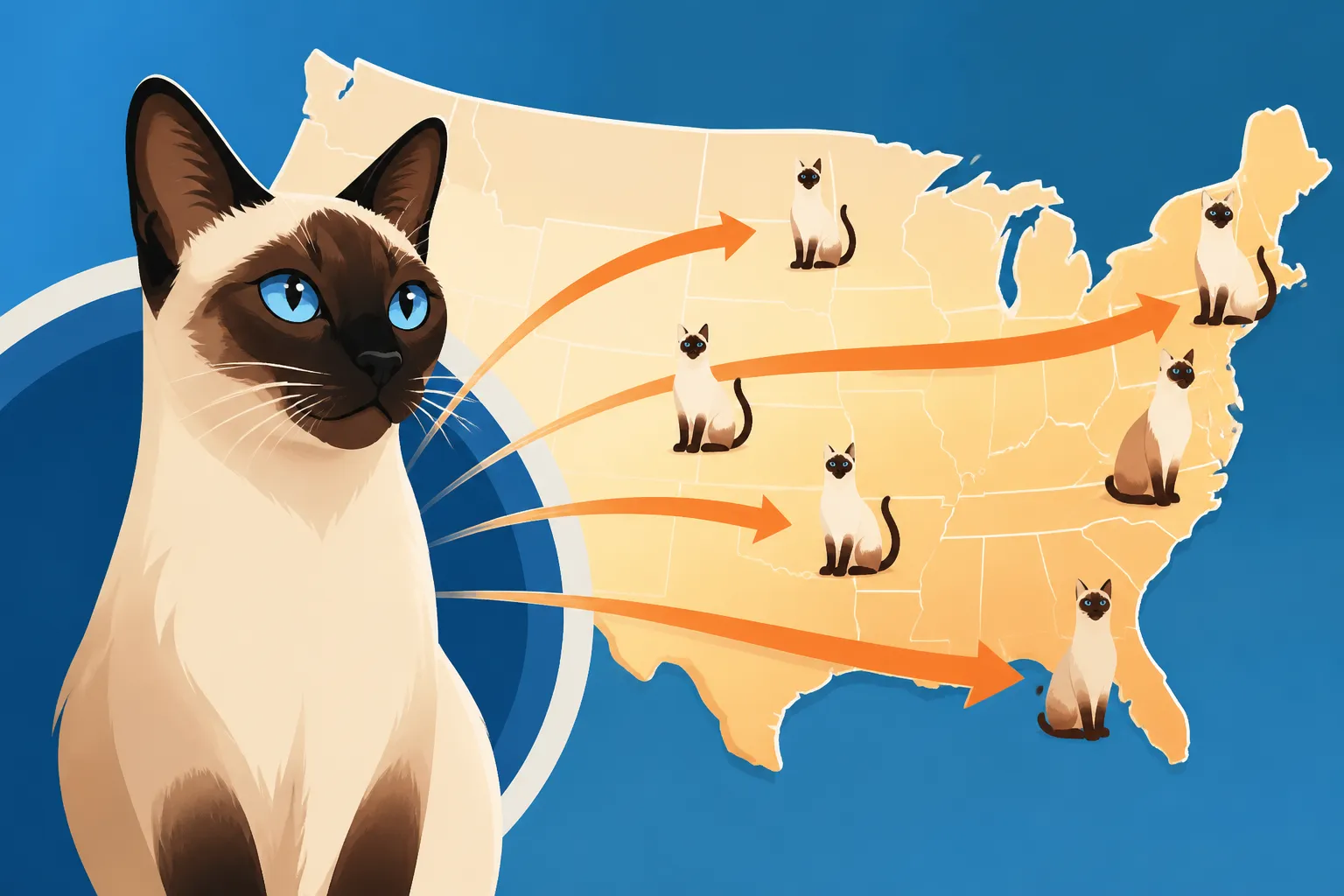
Availability also depended on where a person lived. Someone near a major city or an active cat-show community might have had an easier time finding a Siamese than someone in a rural area. This kind of uneven access is common when a breed is growing: popularity can rise nationally while the actual chance of meeting or adopting one still depends on local breeders and networks.
For prospective owners interested in how breeders approach health and documentation, What a Siamese Cat Standard Asks For explains the role of breed standards, and Which Health Results a Siamese Cat Breeder Can Show covers the records buyers may want to discuss.
Why Siamese Cats Caught American Attention
Their appearance was instantly recognizable
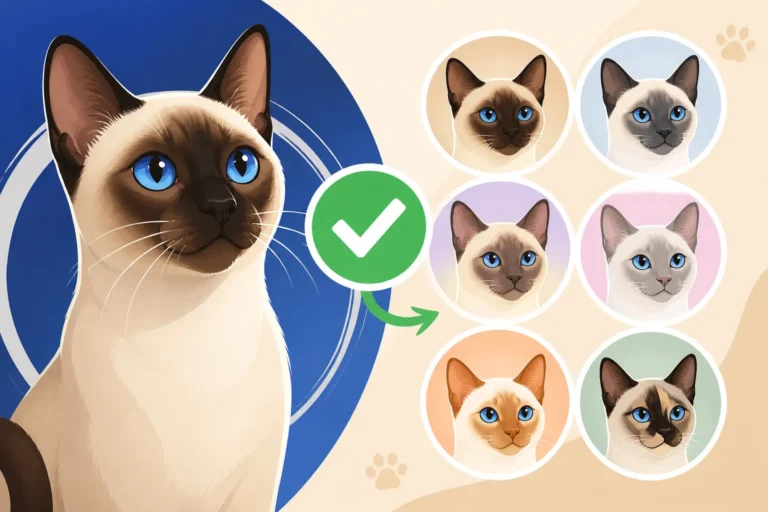
Siamese cats were visually distinctive in a way that helped them stand out in photographs, show halls, and public descriptions. Their color pattern—lighter fur on the body with darker coloration on the face, ears, legs, and tail—was unlike the appearance of many familiar domestic cats. Blue eyes added another memorable feature.
That look was not simply decorative. The Siamese color pattern is linked to temperature-sensitive pigmentation, which is why the points are darker than much of the body. A cat’s appearance could also shift with age and environment, making the coat an ongoing point of fascination for owners. Why a Siamese Cat Has Blue Eyes and How Temperature Controls a Siamese Cat's Color explain two features that helped make the breed so recognizable.
Distinctiveness helped the Siamese travel by word of mouth. A person who had seen one could describe it clearly to someone else: the dark mask, the blue eyes, the elegant build. This made the cat easier to remember than a breed whose distinguishing traits were subtle.
Appearance alone, however, does not explain lasting popularity. A striking cat may attract attention once, but people keep talking about a breed when its everyday behavior also leaves an impression. Siamese cats became known not only for how they looked, but also for how actively they engaged with people.
Their social personalities became part of the reputation
Siamese cats are often described as social, alert, and vocal. Individual cats vary, but the breed’s reputation for communicating with people helped give it a personality beyond its coat pattern. Owners might describe a cat that follows them between rooms, calls for attention, or becomes involved in household routines.
That sociability could make the breed appealing to people who wanted an interactive companion. It could also surprise owners expecting a quiet, independent pet. A Siamese that meows insistently at dinner time or objects when a door closes can be charming in one household and exhausting in another. The breed’s public image grew around both sides of that experience.
Stories about personality travel especially well. A person may forget the exact shape of a cat’s ears, but remember the Siamese that greeted guests, vocalized through the evening, or seemed to follow a conversation. Those stories helped make the breed familiar even to people who had not yet owned one.
A new owner considering the breed today may find it useful to read What a Siamese Cat's Temperament Is Really Like and Why a Siamese Cat Meows So Much. These topics help explain why the Siamese reputation includes so much more than appearance.
From Scarce Import to Familiar American Breed
Popularity expanded with pet culture
As cat keeping became more established and organized, Siamese cats moved beyond the circle of importers and show enthusiasts. Breeders, registries, pet publications, and growing interest in pedigreed animals all helped make the breed easier for the public to recognize. The pace was gradual rather than a single dramatic boom.
Siamese cats also benefited from being easy to identify. Their distinctive points and blue eyes made them visually memorable in printed material and in person. As more people encountered them through shows, friends, and breeders, the breed became less of a distant curiosity and more of a possible companion for ordinary households.
The breed’s wider popularity developed alongside the broader growth of pet ownership. People increasingly treated cats as household companions, and breed identity became a way for some buyers to look for a particular appearance or temperament. Siamese cats fit neatly into that interest because they were both visually striking and widely associated with an engaging, people-oriented nature.
The breed’s spread was not uniform. Some households preferred the sleek, angular cats favored in modern show circles; others were drawn to cats with a more traditional appearance. Whether the Traditional Siamese Cat Still Exists and What the Thai Cat Is Next to a Siamese Cat discuss how different ideas about Siamese type developed.
Modern familiarity does not erase the breed’s early challenges
Today, the name “Siamese” is familiar to many people, but familiarity can make the breed’s early scarcity easy to overlook. The journey from one celebrated cat to a recognized American breed involved more than public fascination. It required importation, breeding, record keeping, shows, and generations of owners willing to make room for a cat that could be demanding as well as beautiful.
For a modern household, the practical question is no longer usually whether a Siamese exists nearby; it is whether the breed’s needs match the home. A vocal, social cat may thrive with regular interaction and enrichment but struggle if left alone for long periods without stimulation. Pet retailers such as Chewy can be one place owners look for everyday supplies, but choosing equipment or food is only one small part of deciding whether the breed fits a household.
Chewy may also come up when new owners are comparing food, litter, or enrichment options for an active cat. The useful starting point is still the cat itself: its age, health, preferences, and advice from a veterinary professional matter more than a breed label or shopping list. For readers thinking about day-to-day care, Enrichment for a Siamese Cat That Gets Bored in an Hour offers ideas for keeping an engaged cat occupied.
The story of the Siamese in America is ultimately a story of gradual recognition. A diplomatic gift sparked curiosity; shows and breeders gave the breed structure and visibility; and distinctive looks and sociable behavior helped it become familiar. Chewy and other modern pet-supply outlets belong to the much later landscape of cat ownership, not the early history, but they illustrate how far the experience of keeping a cat has changed since Siam first drew attention.
Disclaimer
This article is for general informational purposes only and does not constitute professional advice. Laws, prices and regulations vary by location and change over time. Consult a qualified professional for guidance on your specific situation.