How the Himalayan Used the Siamese Cat
The Himalayan’s familiar Persian coat and Siamese-style points can make its family tree seem simple, but creating the breed took generations of planned crosses and careful selection. This guide explains which traits came from Siamese cats, how breeders developed the Himalayan, and why registries do not all classify it the same way.
How Siamese Cats Contributed to the Himalayan
The Himalayan combines Persian type with Siamese color
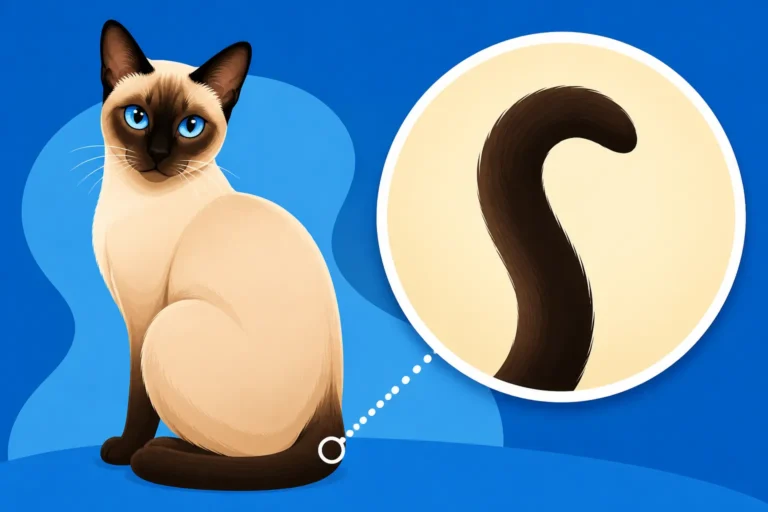
The Himalayan was developed by combining two distinct sets of traits. Persian cats contributed the long, dense coat and much of the breed’s compact, rounded appearance. Siamese cats contributed the colorpoint pattern: a lighter body with darker coloring on the face, ears, legs, and tail.
That contrast is not simply a matter of coat colors being mixed together. It comes from a temperature-sensitive form of pigment production associated with the colorpoint gene. Pigment develops more strongly in the cooler areas of the body, which is why a Himalayan’s extremities are generally darker than its warmer torso. This same basic pattern is central to the familiar Siamese look described in What Point Coloration in a Siamese Cat Is.
The Himalayan’s points can appear in several colors, including seal, blue, chocolate, and lilac, depending on inherited coat-color genes. Its coat is long rather than the short, close-lying coat associated with the traditional Siamese standard. So while the Himalayan visibly carries a Siamese-derived feature, it does not look like a long-haired Siamese in every respect: its Persian ancestry shaped its overall appearance and coat.
The colorpoint gene is inherited, not applied by breeding preference alone
The point pattern is associated with a recessive form of a gene affecting tyrosinase, an enzyme involved in pigment production. A kitten generally needs to inherit the relevant colorpoint variant from both parents to show the classic pointed pattern. That is why breeders working toward a Himalayan could not rely only on choosing a cat that looked a certain way; they also had to consider what it could pass on.
This inheritance helps explain why a cross between a Persian and a Siamese does not automatically produce a litter of Himalayan-looking kittens. The outcome depends on the genes each parent carries. A kitten may inherit a long coat, a colorpoint pattern, both, or neither, depending on the parents’ genetic makeup. Appearance alone cannot reveal every inherited trait.
The temperature-sensitive pattern also means a Himalayan’s coat can change in appearance over time. Cooler conditions may be associated with darker points, and many pointed cats darken as they age. Those changes are part of how the colorpoint pattern works, not evidence that the cat has suddenly become a different breed. How Temperature Controls a Siamese Cat's Color explains the related pattern in Siamese cats.
How Breeders Developed the Himalayan
Early experiments brought Persian and Siamese cats together
Breeders began experimenting with Persian and Siamese ancestry in the early twentieth century. These efforts aimed to produce a longhaired cat with the Siamese colorpoint pattern, rather than simply a one-generation cross. Among the best-known early work was conducted in the United States by Virginia Cobb and geneticist Clyde Keeler, who studied the inheritance of coat traits and bred cats with Persian and Siamese ancestry.
A key challenge was combining the desired features reliably. A first-generation cross might show some of the sought-after traits, but it would not necessarily have the Persian coat, body type, or face that later Himalayan breeders wanted. Breeders therefore continued selective mating over generations, choosing cats that showed the right combination and, where needed, breeding them back toward Persian type.
Similar efforts took place in Britain. Breeders there developed longhaired colorpoint cats, sometimes under names that reflected their coat pattern rather than the Himalayan label. The history was not a single, perfectly coordinated project with one universally accepted starting point. It involved different breeders and breeding programs working toward related goals.
Establishing a breed meant breeding for consistency
A successful breed program needs more than one striking kitten. Breeders have to produce cats with traits that are consistent enough to be recognized and described by a standard. For the Himalayan, that meant selecting not only for colorpoints, but also for long hair and a broadly Persian appearance.
Repeated selection also changed the proportions of ancestry across generations. A breeder might use a Siamese cat to introduce or strengthen the colorpoint pattern, then mate offspring back to Persians to move the appearance closer to the desired Persian type. The precise breeding choices varied, but the broad aim was to retain the point pattern while establishing a stable longhaired type.
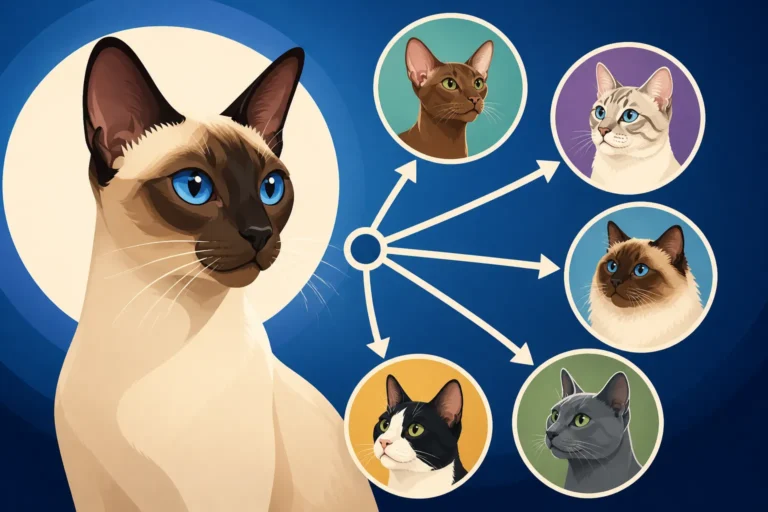
This is why the Himalayan is better understood as a developed breed or breed variety than as a simple Persian-Siamese mix. The founding crosses mattered, but so did the generations of selection that followed. The modern cat reflects a deliberate breeding history, much as other breeds developed from Siamese ancestry are discussed in The Breeds a Siamese Cat Founded.
| Feature | Siamese contribution | Persian contribution |
|---|---|---|
| Coat pattern | Colorpoint pattern | Not the source of the Himalayan’s points |
| Coat length | Short coat in the Siamese breed | Long, dense coat |
| Body and head type | Siamese traits are not the main basis of Himalayan type | Persian influence shaped the overall type |
| Eye color | Blue eyes are characteristic of the colorpoint look | Persian ancestry contributed other physical features |
| Breeding role | Introduced or reinforced colorpoint traits | Helped establish the longhaired Persian-like appearance |
Why the Himalayan Looks Different From a Siamese Cat
The colorpoint pattern is only one part of breed identity
It is easy to focus on the face, ears, legs, and tail and assume that a Himalayan is simply a Siamese with longer fur. But breed identity is based on a wider collection of characteristics, including coat length, body shape, head type, and the standard used by a registry.
The Siamese is typically described as a shorthaired, fine-boned cat with a long, slender body and a distinctive wedge-shaped head in modern show standards. The Himalayan, by contrast, is associated with a Persian-like build and a long coat. Individual cats can vary, and different breeding lines may emphasize different features, but the contrast in overall type remains important.
The breeds also differ in the grooming they require. A short-coated Siamese generally needs less coat maintenance than a longhaired Himalayan, whose fur can mat if it is not combed regularly. That practical difference follows from the Persian coat contribution, not from the colorpoint gene. For a deeper look at how the Siamese silhouette developed, see How the Siamese Cat's Head Changed Shape in Fifty Years.
A shared feature does not make two breeds the same
Many cat breeds can share a visible trait without being classified as the same breed. Blue eyes and colorpoint markings are familiar in Siamese cats, but those features alone do not settle whether a cat is a Siamese, Himalayan, or another colorpoint breed. The cat’s documented pedigree and the relevant registry’s rules matter.
The history is also more nuanced than a simple label such as “half Siamese.” A Himalayan’s ancestry includes Siamese cats in the development of the colorpoint pattern, but established breeding programs selected for a particular combination over multiple generations. A contemporary Himalayan is not necessarily the direct offspring of a Siamese and a Persian.
That distinction is useful when reading breed descriptions or comparing cats from different registries. The Siamese appearance and the Himalayan’s colorpoint coat are related through ancestry, but the breeds are not interchangeable. The broader range of accepted point patterns is covered in Which Colors a Siamese Cat Comes In.
How Registries Classify the Himalayan
Some organizations treat the Himalayan as a separate breed
Breed organizations have not always grouped the Himalayan in the same way. Some have recognized it as a distinct breed, with its own name and standard. Others have treated it as a Persian variety distinguished by colorpoint markings. The classification can depend on the organization’s history, show rules, and approach to breed categories.
This difference can create confusion for people comparing pedigrees, show listings, or breed descriptions. A cat may be called a Himalayan in one context and described as a colorpoint Persian in another. That does not necessarily mean the cat’s background is disputed; it may reflect the terminology used by a particular registry.
The name “Himalayan” refers to the pointed color pattern, often compared with the appearance of Himalayan rabbits. It does not mean the breed originated in the Himalayan mountain region. The development of the cat took place through breeding programs, particularly in the United States and Britain.
Pedigree records matter more than a cat’s appearance
A pointed, longhaired cat may resemble a Himalayan, but appearance alone cannot confirm its registration or ancestry. A formal pedigree traces generations of recorded parentage. If someone needs to know how a specific cat is classified, the most useful details are the breeder’s records and the registry under which the cat is registered.
This is especially relevant when comparing a Himalayan with other longhaired or colorpoint cats. Similar coat patterns can occur in cats with different pedigrees, and mixed-breed cats can also have striking points and blue eyes. A visual resemblance may suggest shared traits, but it does not prove a particular breed history. The limits of identifying breed from looks are explored in How to Tell a Siamese Cat From a Mixed Breed.
The Himalayan’s story is a good example of how selective breeding can preserve one feature from a founding breed while changing much of the animal’s overall appearance. Siamese ancestry supplied the colorpoint pattern, while generations of breeding toward Persian type established the longhaired cat now recognized as the Himalayan or colorpoint Persian, depending on the registry.
Disclaimer
This article is for general informational purposes only and does not constitute professional advice. Laws, prices and regulations vary by location and change over time. Consult a qualified professional for guidance on your specific situation.