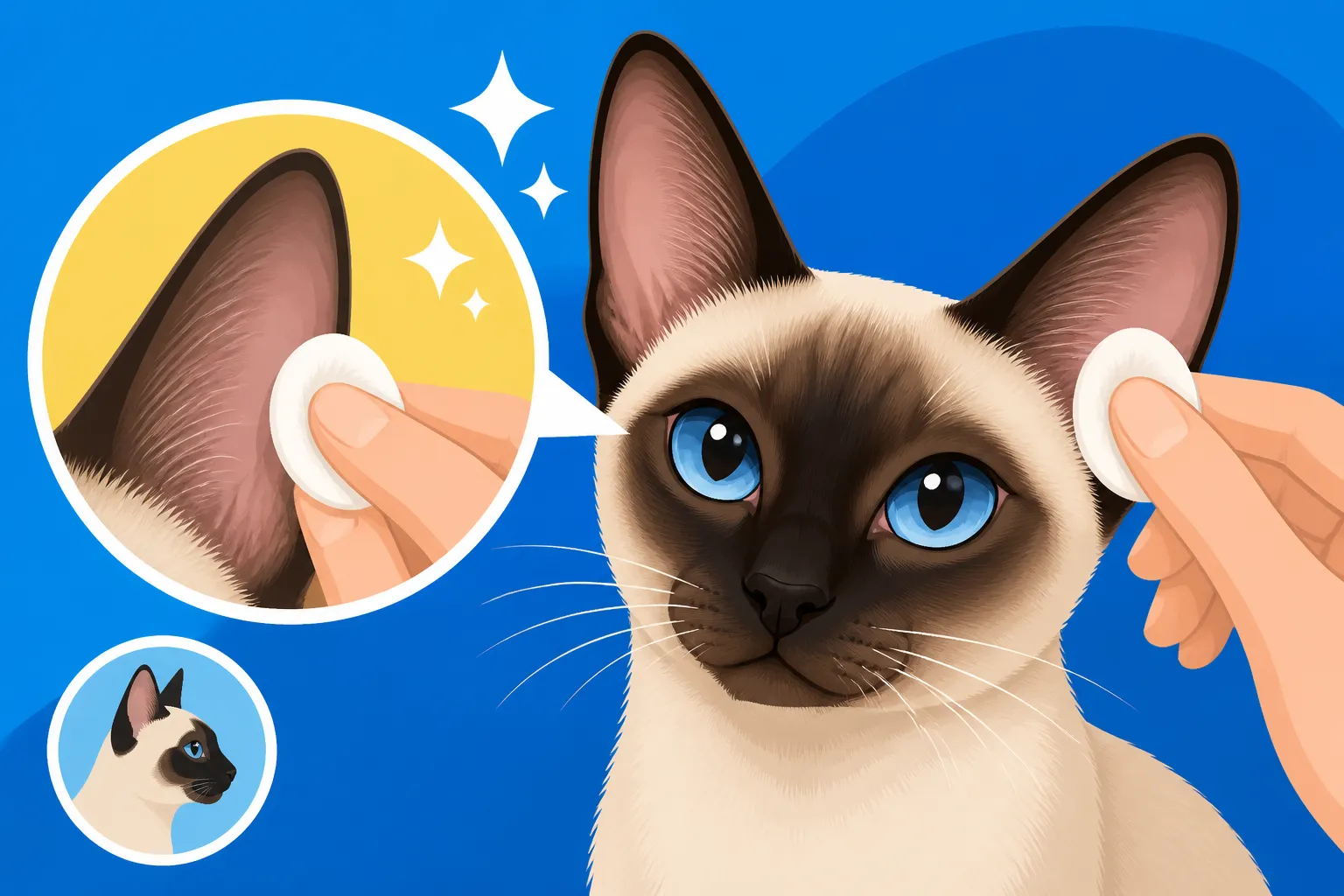
How to Clean a Siamese Cat’s Big Ears
Your Siamese cat has ears like satellite dishes, and lately you have noticed a dark smudge inside one of them, a little head shaking after naps, or a faint smell when you lean in for a cuddle. Those enormous ears catch more dust, wax and debris than most cats ever deal with. This guide walks you through checking, cleaning and protecting them safely, and tells you when home care stops being enough.
Why a Siamese Cat’s Ears Need Their Own Routine
Most cat owners never think about ears at all. Cats are fastidious groomers, and for many breeds the ears quietly look after themselves for years. The Siamese is a little different, and not because the breed is fragile. It is simply built in a way that puts the ears front and center, literally, on a long wedge or rounded head where they act like open funnels.
If you are coming to the breed from a domestic shorthair or a fluffy Persian, the first thing you notice is how much of the inner ear you can actually see. That visibility is a blessing, because problems show early, and a small burden, because you will see every speck of wax and wonder whether it matters. Most of the time it does not. Some of the time it absolutely does, and learning to tell those apart is the real skill here.
The Shape and Size of the Siamese Ear
The breed standard for the modern Siamese calls for strikingly large ears, wide at the base and continuing the lines of the wedge-shaped head. Even traditional or applehead Siamese cats, with their rounder faces, usually have generous, upright ears compared with the average moggy. That open bell shape funnels air, sound and anything floating in the air straight toward the ear canal.
The inner surface, called the pinna, has very little fur on a Siamese. Longhaired breeds carry tufts of ear furnishing that trap dust before it reaches the canal. Your Siamese has almost none, so the skin of the inner ear is exposed. That makes it easy to inspect, but it also means household dust, litter particles and pollen land directly on the skin and mix with the natural wax.
The ear canal itself, like every cat’s, runs down vertically and then turns horizontally toward the eardrum. That L shape matters enormously when you clean. Whatever you push into the vertical part tends to get packed down into the bend, where you cannot see it and the cat cannot shake it out.
Why the Ears Look Darker Than the Rest of the Coat
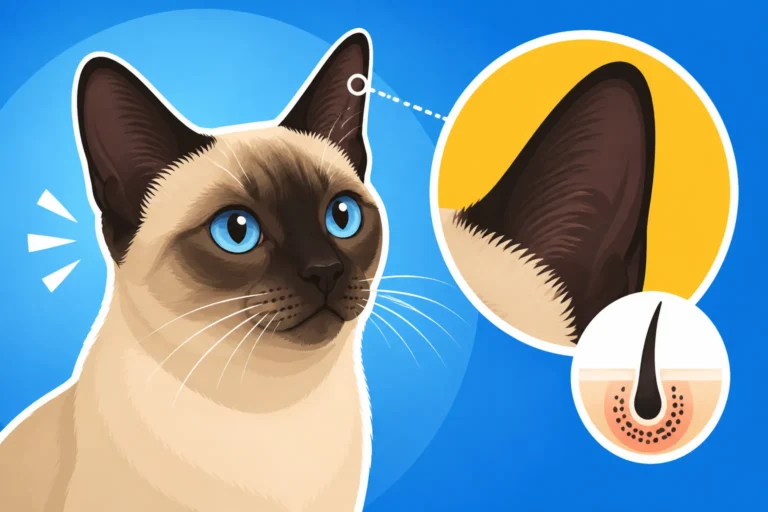
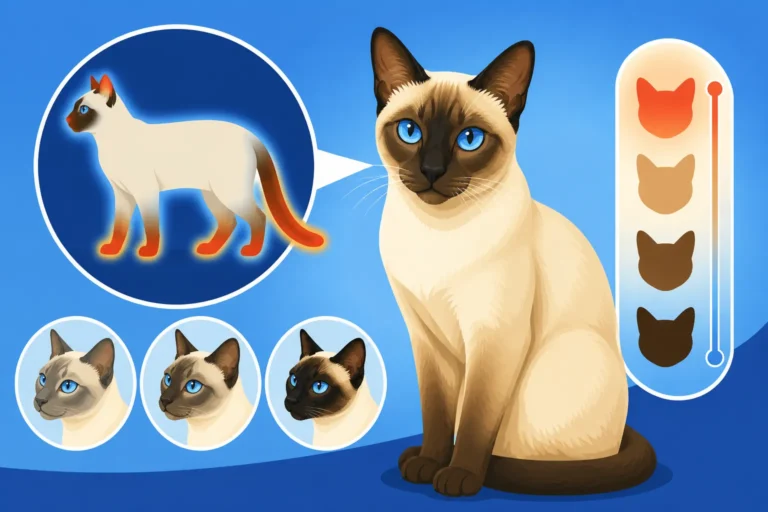
New owners sometimes panic because the ear leather looks almost black on a seal point. That is normal pigment, not dirt. The Siamese coloring comes from a temperature-sensitive enzyme, so the cooler extremities of the body, including the ears, develop the darkest color. If you want the full science, Why a Siamese Cat’s Ears Are Darker Than Its Back explains exactly how the coolest parts of the body end up with the deepest pigment.
The practical point is this: when you inspect a seal or chocolate point, the outer ear will be dark, and the inner skin may show some grayish or brownish tone near the edges. Clean, healthy inner ear skin should still look smooth and fairly pale pink toward the canal opening. What you are looking for is debris sitting on top of the skin, not the color of the skin itself. A cotton pad wiped gently along the inner flap tells you quickly. Pigment stays put, dirt comes off.
On lilac and blue points the contrast is softer, which can make dark wax easier to spot. On seal points you sometimes need better lighting. A small flashlight or your phone’s torch held at an angle helps a lot.
Wax, Oil and the Self-Cleaning Ear
Healthy ears are mostly self-cleaning. The skin lining the canal migrates slowly outward, carrying wax and debris with it like a conveyor belt. A small amount of light tan or pale brown wax at the opening is completely normal, and your cat’s own head shakes finish the job.
Some Siamese do produce a little more visible wax than other cats. If you have seen this and wondered whether it is a problem, Why a Siamese Cat’s Ears Get Waxy covers the common reasons, from simple anatomy to seasonal allergies. The key takeaway for cleaning is that wax is protective. It traps particles, keeps the canal skin supple and discourages some microbes. You are not trying to remove all of it. You are trying to remove the excess that builds up on the visible surfaces.
Over-cleaning is one of the most common mistakes owners make. Scrubbing the ears every few days strips that protective layer, irritates the skin and can actually trigger more wax production. The goal is maintenance, not sterility.
How Often a Siamese Cat’s Ears Need Attention
Frequency is where most people feel unsure, and the honest answer is that it depends on your individual cat. Some Siamese go months with nothing more than a glance. Others need a gentle wipe every couple of weeks. The trick is to separate inspection, which should be frequent, from cleaning, which should be occasional.
A Weekly Look Is Enough for Most Cats
A quick look inside both ears once a week is the single most useful habit you can build. It takes about thirty seconds, and it fits naturally into the wider routine described in Grooming a Siamese Cat Takes Five Minutes a Week. While you are running a grooming glove over the coat and checking the teeth, fold each ear back gently and look.
You are checking for four things: color, smell, debris and comfort. Healthy ears are pale pink inside with only a light film of wax. They smell of nothing much, or of faintly warm skin. There is no crumbly or tarry material. And your cat does not flinch, pull away sharply or tilt its head when you touch the base of the ear.
If everything looks fine, you are done. No cleaner, no cotton, no fuss. Many owners find that their cat simply needs nothing more than this weekly look for long stretches. For a fuller discussion of intervals across different life stages, see How Often a Siamese Cat’s Ears Need Cleaning.
Signs It Is Time for a Gentle Clean
Cleaning becomes appropriate when you can see a visible buildup on the inner flap or around the canal opening that your cat is not clearing on its own. Typical examples include a light brown film that comes off on a cotton pad, a little dust or litter grit caught in the folds near the canal, or a thin line of wax collecting along the ridges of the inner ear.
These are cosmetic and comfort issues, not medical ones. A gentle wipe of the outer structures solves them. For many indoor Siamese this happens every two to four weeks, sometimes less. Cats that spend time in a catio, on window perches with open windows, or in dusty homes during renovation may need it a little more often.
What should not trigger home cleaning is anything that looks or smells abnormal. That brings us to the line every owner needs to know.
When Cleaning at Home Is the Wrong Move
There are situations where reaching for the ear cleaner can make things worse. If the ear looks red and inflamed, smells yeasty or sour, has dark coffee-ground debris, has any discharge that looks like pus, or if your cat is in obvious discomfort, cleaning at home is not the answer. Some medicated cleaners and even plain solutions can sting inflamed skin, and if the eardrum is damaged, certain products can cause real harm to the middle and inner ear.
In those cases the right order is examination first, cleaning second. A vet will look down the canal with an otoscope, check that the eardrum is intact and usually take a swab to look at under the microscope. That swab tells them whether they are dealing with mites, yeast, bacteria or a mix, which completely changes the treatment.
The table below summarizes the difference between a routine clean and a vet visit.
| What You See | What It Usually Means | What To Do |
|---|---|---|
| Pale pink skin, faint light wax | Healthy ear | Nothing, keep checking weekly |
| Light brown film on the inner flap | Normal wax buildup | Gentle wipe of the visible ear |
| Dust or litter grit in the folds | Environmental debris | Gentle wipe, check litter dust |
| Dark, crumbly coffee-ground debris | Possible ear mites | Vet visit before cleaning |
| Brown greasy wax with a sweet or musty smell | Possible yeast overgrowth | Vet visit, swab test |
| Yellow or green discharge, strong smell | Possible bacterial infection | Vet visit promptly |
| Red, hot, swollen skin or a puffy flap | Inflammation or hematoma | Vet visit, do not clean |
| Head tilt, poor balance, circling | Possible middle or inner ear issue | Vet visit urgently |
What You Need Before You Start
One of the nicest things about ear care for a Siamese is that you need very little equipment. Most of it is already in your cupboard or can be ordered alongside your regular cat supplies. Owners who buy food and litter through Chewy or Amazon often add a bottle of vet-recommended ear cleaner and a pack of cotton pads to the same order so they are never caught short.
Choosing an Ear Cleaner
Not every bottle labelled for pets is suitable for a cat. Cats are more sensitive than dogs to certain ingredients, and some products designed for floppy-eared dogs are far too harsh for a small feline canal. Look for a cleaner specifically labelled as safe for cats, ideally one your vet has suggested.
A good routine cleaner is usually a gentle solution designed to soften wax so it can be wiped away. Avoid anything containing alcohol for routine use, because it stings and dries the skin. Avoid hydrogen peroxide entirely, as it irritates the delicate canal lining and leaves moisture behind. Avoid essential oils, especially tea tree oil, which can be toxic to cats even in small amounts. Never use household oils, vinegar mixes or homemade remedies passed around online forums.
If your cat has had ear problems before, your vet may prescribe a specific cleaner with drying or antimicrobial properties. Use exactly what they recommend and do not switch to a different product without checking. When ordering online, read the product label for the species and ingredient list rather than relying on the listing photo. Check the retailer’s or manufacturer’s own page for current details, since formulations do change.
Cotton, Gauze and What to Leave in the Drawer
For wiping, you want soft, lint-free material. Cotton pads, cotton balls or squares of plain gauze all work. Gauze wrapped around a fingertip is many owners’ favorite because it lets you feel what you are doing and follow the natural folds of the ear.
What you should leave in the drawer is the cotton bud, the slim swab on a stick. Cotton swabs are the classic cause of ear trouble in cats. They push wax down into the horizontal canal, compact it against the eardrum and can scratch or even rupture the drum if your cat jerks its head at the wrong moment. Siamese cats are quick, curious and not shy about objecting, so that sudden movement is a real risk.
If there is debris deep in a fold that your finger cannot reach, leave it. Either it will work its way out or it needs a vet’s attention. There is no situation in routine home ear care where you need to put anything into the canal itself.
Treats, Towels and a Helper
The other half of your kit is about making the experience tolerable. Have a handful of high-value treats ready, the kind your cat would perform a small circus act for. A thin towel or small blanket is useful for a gentle wrap if your cat wriggles. A second person to hold and distract is a luxury, but a welcome one.
Choose a calm, warm spot. Siamese cats feel the cold and are more relaxed somewhere cozy, so a sunny window seat or a lap with a fleece blanket beats a cold bathroom counter. If you can, schedule ear care after a play session or meal when your cat is naturally sleepy.
The table below lists the basic kit and what each item does.
| Item | Purpose | Notes |
|---|---|---|
| Cat-safe ear cleaner | Softens wax for easy removal | Use only products labelled for cats |
| Cotton pads or gauze squares | Wipes the visible ear surfaces | Lint-free, soft, disposable |
| Small flashlight | Lets you see into the folds | Phone torch works fine |
| High-value treats | Builds a positive association | Use small pieces, give often |
| Thin towel | Gentle wrap for wriggly cats | Leave the head and ears free |
| Paper towel or old cloth | Catches cleaner and shaken-out wax | Cats shake hard afterwards |
Step by Step: Cleaning a Siamese Cat’s Ears at Home
Once you have decided a clean is appropriate and you have your kit ready, the process itself takes only a few minutes. The most important thing is patience. A Siamese who has a calm, rewarding first experience will tolerate ear care for life. One who is wrestled and scared will remember it for a very long time, and probably tell you about it loudly.
Getting Your Siamese Comfortable
Before you open the cleaner, spend a minute simply handling the ears. Stroke the head, rub gently at the base of each ear and give a treat. Many Siamese love having the base of the ears rubbed, so this part often feels like a reward in itself. If your cat is relaxed, fold one ear back gently to expose the inner surface and give another treat.
If your cat is tense, stop there for today. Repeat the handling and treat routine daily for a week or two before you introduce any cleaner. This kind of gradual training works remarkably well with the breed. Siamese cats learn routines quickly, and clicker methods translate very well to handling for grooming.
If you need to wrap your cat, drape the towel around the body like a loose cape, leaving the head free. The aim is to stop paws batting at your hand, not to restrain the cat tightly. A cat that feels trapped will fight harder.
The Cleaning Process
Follow these steps for a routine clean of healthy ears.
- Check both ears first with your flashlight, so you know what you are dealing with and can confirm there is no redness, strong smell or dark crumbly debris.
- Warm the bottle of cleaner by holding it in your hand for a few minutes. Cold liquid in the ear is unpleasant and makes cats shake their heads violently.
- Moisten a cotton pad or piece of gauze with cleaner until it is damp but not dripping.
- Hold the ear flap gently folded back with one hand, supporting the head with your palm.
- With the damp pad, wipe the inner surface of the flap from the base outward toward the tip, following the natural folds and ridges.
- Work gently around the visible opening of the canal and the folds just above it, wiping outward, never pushing inward.
- Switch to a fresh pad whenever the current one looks dirty, so you are not wiping debris back into the ear.
- Finish with a dry pad to remove any excess moisture from the visible surfaces.
- Let go and allow your cat to shake its head. Step back, because whatever is loose will fly.
- Give a treat and plenty of praise, then repeat on the other ear with fresh materials.
Some vets prefer a slightly different method for cats with heavier wax, where a few drops of cleaner are placed into the canal opening and the base of the ear is massaged gently so the liquid loosens wax before the cat shakes it out. Only do this if your vet has examined the ears, confirmed the eardrums are intact and shown you how. For a healthy Siamese with ordinary wax, wiping the visible ear is usually enough.
What a Good Result Looks Like
After a gentle clean, the inner ear should look pale pink and smooth, with the visible film of wax gone. A little wax may remain deeper in the canal, and that is fine. Your cat might scratch at its ear once or twice afterward as the sensation settles, then forget about it entirely.
What you should not see is redness that was not there before, ongoing scratching, or your cat holding its head to one side. If any of that happens, the ear may have been more irritated than it looked, or the product may not suit your cat. Stop cleaning and let your vet take a look.
Keep a simple note of the date and what you saw. Over a few months you will build a picture of your own cat’s normal, which is far more useful than any general rule. Some owners keep this in the same place as grooming and dental notes, so a vet visit can draw on real history rather than vague memory.
Common Ear Problems in Siamese Cats
Cleaning and inspection matter because they help you catch problems early. While the Siamese is not known for an especially high rate of ear disease, its open ears make problems visible, and some conditions are common enough in cats generally that every owner should recognize them.
Ear Mites
Ear mites are tiny parasites that live in the ear canal and feed on skin debris. They cause intense itching and produce the classic dark, dry, crumbly debris that looks like coffee grounds. They are extremely contagious between cats and can spread to dogs and ferrets in the same household.
Mites are most common in kittens, rescue cats and cats that go outdoors or mix with other animals. A Siamese bought from a careful breeder and kept indoors is less likely to have them, but a newly adopted rescue or a household that brings in a new pet should keep an eye out. All pets in the home usually need treating at the same time, or the mites simply bounce back and forth.
Do not try to clean mites out yourself. Vets have effective prescription treatments, often applied to the skin, and they need to confirm the diagnosis under the microscope first, because yeast infections can look surprisingly similar to the untrained eye. If you are bringing an older rescue home, ask the shelter whether the ears were examined and whether any mite treatment was given.
Yeast and Bacterial Infections
Yeast infections, usually caused by an overgrowth of Malassezia, produce greasy brown wax and a distinctive musty or sweet smell. Bacterial infections tend to cause more inflammation, a yellow or greenish discharge and a sharper, unpleasant odor. Both are usually secondary problems, meaning something else has disturbed the ear’s normal balance first.
Common underlying triggers in cats include allergies, both environmental and food-related, along with foreign bodies and growths in the canal. A Siamese who keeps getting ear infections should be investigated for those causes rather than simply treated over and over. Diet trials are sometimes part of this process, and they require strict consistency. In multi-pet homes this can be tricky: if a dog in the house eats its own food, the cat needs to be kept away from the dog's bowl during any feline elimination diet, or the trial is wasted.
Treatment usually involves a thorough clean by the vet, followed by medicated drops at home for a set period. Finish the full course even if the ear looks better after a few days, because stopping early is a common reason infections return.
Polyps, Hematomas and Other Lumps
Inflammatory polyps are benign growths that can develop in the middle ear or the back of the throat, and they are seen most often in young cats. They can cause chronic discharge from one ear, head shaking, noisy breathing and sometimes a head tilt. A one-sided ear problem in a young Siamese that does not resolve with standard treatment is worth discussing with your vet in these terms.
An aural hematoma is a blood-filled swelling of the ear flap, usually caused by vigorous head shaking or scratching that breaks small blood vessels. On a big Siamese ear it looks dramatic, like a soft pillow under the skin. It needs veterinary treatment, and the underlying cause of the shaking must be found too.
Any lump, scab or sore that does not heal on the ear flap should be checked. Although the pigmented points of a Siamese offer more sun protection than a white-eared cat would have, paler points and older cats with thinning ear fur can still develop skin changes worth examining.
Ear Problems Versus Balance Problems
A head tilt, wobbly walking, circling or rapid flicking eye movements can come from the ear, because the balance organs sit in the inner ear. They can also come from conditions elsewhere. In young kittens, a congenital form of vestibular trouble is described in the breed, and Vestibular Disease Signs in a Siamese Cat Kitten explains how that looks and why it often improves.
Siamese cats can also show nystagmus, a fast, rhythmic flicking of the eyes, as part of the breed’s visual wiring, which is entirely different from a sudden new balance problem. If your cat has always had flickering eyes and is otherwise fine, that is a long-standing trait. If balance problems appear suddenly, treat it as urgent.
| Condition | Typical Signs | Who Gets It Most |
|---|---|---|
| Ear mites | Dark crumbly debris, intense itching | Kittens, rescues, multi-pet homes |
| Yeast overgrowth | Greasy brown wax, musty smell | Cats with allergies |
| Bacterial infection | Discharge, inflammation, strong odor | Cats with an underlying trigger |
| Inflammatory polyp | One-sided discharge, head shaking, noisy breathing | Young cats |
| Aural hematoma | Soft, fluid-filled swelling of the flap | Cats shaking or scratching hard |
| Inner ear involvement | Head tilt, circling, poor balance | Any age, needs prompt care |
Building Ear Care Into Your Cat’s Whole Life
Ears are not a standalone task. They fit into the wider rhythm of caring for a Siamese, which changes as your cat moves from playful kitten to confident adult to gentle senior. Thinking about ear care in that context helps it become a habit instead of a chore you remember only when something smells odd.
Starting With a Kitten
The best time to introduce ear handling is in the first weeks after your kitten comes home. Kittens are naturally accepting of touch if it is paired with good things. Short sessions of ear rubs, a gentle fold of the flap and a treat build the foundation for a lifetime of easy checks.
Combine ear handling with the other small jobs every kitten needs to learn. Paw handling makes nail trims painless, and the timing advice in How Often a Siamese Cat’s Nails Need Trimming slots neatly into the same session. Gentle lip lifts prepare your kitten for tooth brushing, which is far more important for this breed than many owners realize. The routines in How to Brush a Siamese Cat’s Teeth start the same way as ear handling, with patience and treats.
Kittens rarely need their ears cleaned at all unless they arrived with mites. Use this period to teach tolerance, not to scrub.
Adult Maintenance Without Drama
For most adult Siamese, ear care settles into a predictable pattern: a weekly look and an occasional wipe. The more consistent you are, the less likely you are to face a battle. Siamese cats are intelligent and notice routines, so doing ear checks at the same time and place each week, with the same treats, turns it into something your cat expects and often enjoys.
Adults are also the age when allergies tend to appear. If you notice that ear wax increases in certain seasons, or that ear trouble arrives together with itchy skin, overgrooming or a scabby chin, mention the pattern to your vet. Allergic skin disease often shows itself in the ears first. Bathing is rarely needed for this breed, but if your vet does recommend a medicated bath, protect the ears from water by placing a cotton ball loosely at the opening and removing it afterward.
Professional grooming is rarely necessary for a Siamese, but if your cat simply will not tolerate ear handling, a vet nurse or experienced groomer can help.
Senior Siamese Cats and Their Ears
As Siamese cats age, they groom less thoroughly. Stiff joints make it harder to reach the head with a back paw, and older cats may simply spend more time sleeping. This means wax and debris can build up more than it used to. The changes are covered in Why an Aging Siamese Cat Stops Grooming, and ears are one of the places where you will notice it first.
Hearing also changes with age. Some older cats lose hearing gradually, and owners often notice that a cat sleeps more deeply, startles when touched or becomes louder. Since Siamese are already vocal, an increase in volume can be a clue rather than just personality. Deafness in an Aging Siamese Cat covers the signs and how to adapt. Approach a senior cat from the front, so it sees you before you touch its ears.
Senior cats can also have more fragile skin and may be more sensitive to handling. Use extra gentle pressure, keep sessions short and watch for any sign of pain. Older cats are good at hiding discomfort, so subtle changes in tolerance matter. If an older cat suddenly resists ear handling it used to accept, that change in itself is worth reporting at the next checkup.
Working With Your Vet
Your vet will look in your cat’s ears at every wellness exam. That is the perfect time to ask whether the amount of wax you are seeing is normal for your cat, whether your chosen cleaner is suitable and how often you should be cleaning. Bring your notes. A simple record of when you cleaned and what you saw makes that conversation far more productive.
Some Siamese are famously dramatic at the clinic, with loud yowling and creative escape attempts. If your cat struggles during ear examinations, ask whether the vet team can use gentle handling techniques, a towel wrap or a quieter room. How a Siamese Cat Behaves at the Vet has practical tips to make visits less stressful, and a calmer cat makes for a better ear exam.
If your cat shows any of the warning signs listed earlier, do not wait for the next routine visit. Ear problems are uncomfortable and can become chronic if left untreated, and the open canal of a Siamese does nothing to stop that discomfort. For a broader list of red flags that tell you something is off, Signs a Siamese Cat Is Unwell is worth bookmarking.
Mistakes to Avoid and Habits Worth Keeping
Every experienced Siamese owner has a story about an ear-cleaning session that went sideways. The good news is that almost every one of those stories comes from a handful of predictable mistakes. Avoid these, and you avoid most of the drama.
The Most Common Mistakes
The first and biggest mistake is using cotton swabs inside the canal. It is worth repeating because the temptation is strong. The swab feels precise and thorough, but it pushes debris down toward the eardrum and risks injury. Stick to wiping what you can see with a pad or gauze over your fingertip.
The second mistake is cleaning too often. If you clean healthy ears every few days, you strip their natural protection and invite irritation. Inspect weekly, clean only when there is visible buildup.
The third mistake is using the wrong products. Hydrogen peroxide, alcohol, vinegar, essential oils and dog-only formulas have no place in a Siamese cat’s ear. Use a cat-safe cleaner recommended by your vet.
The fourth mistake is cleaning an ear that is already sore or infected without a diagnosis. You can mask the signs a vet needs to see, irritate inflamed tissue and, if the eardrum is damaged, cause much bigger problems. When in doubt, have it checked first.
The fifth mistake is forcing the issue. A frightened cat that is pinned down will associate ear care with fear. Short, positive sessions that end on a good note always work better in the long run.
Habits That Make a Difference
The habits that make a difference are simple. Look in both ears once a week. Keep notes. Use treats generously. Keep the litter low-dust if your cat seems to collect grit in its ears. Wash bedding regularly, as dust and dander build up quickly on blankets that a Siamese loves to burrow into.
Keep the home comfortably warm and well ventilated, and vacuum around favorite sleeping spots. A Siamese that spends hours tucked under a duvet or curled on a radiator shelf is in close contact with whatever dust collects there. Small changes to the environment can reduce how often the ears need wiping.
Finally, treat ear care as part of a bigger picture. Teeth, nails, coat, weight and ears all work together, and a quick weekly once-over catches far more than any single check. The overview in What Care a Siamese Cat Needs Its Whole Life ties all of these routines together, so ear checks become one easy part of looking after a cat that may share your home for fifteen to twenty years.
| Do | Do Not |
|---|---|
| Inspect both ears weekly | Clean healthy ears every few days |
| Use a cat-safe cleaner your vet recommends | Use peroxide, alcohol, vinegar or essential oils |
| Wipe visible surfaces with pad or gauze | Push cotton swabs into the canal |
| Warm the cleaner in your hand first | Pour cold liquid into the ear |
| Reward with treats every time | Pin down a frightened cat |
| See a vet for smell, redness or dark debris | Treat a suspected infection at home |
| Keep simple notes of what you see | Rely on memory alone |
Disclaimer
This article is for general informational purposes only and does not constitute professional advice. Laws, prices and regulations vary by location and change over time. Consult a qualified professional for guidance on your specific situation.