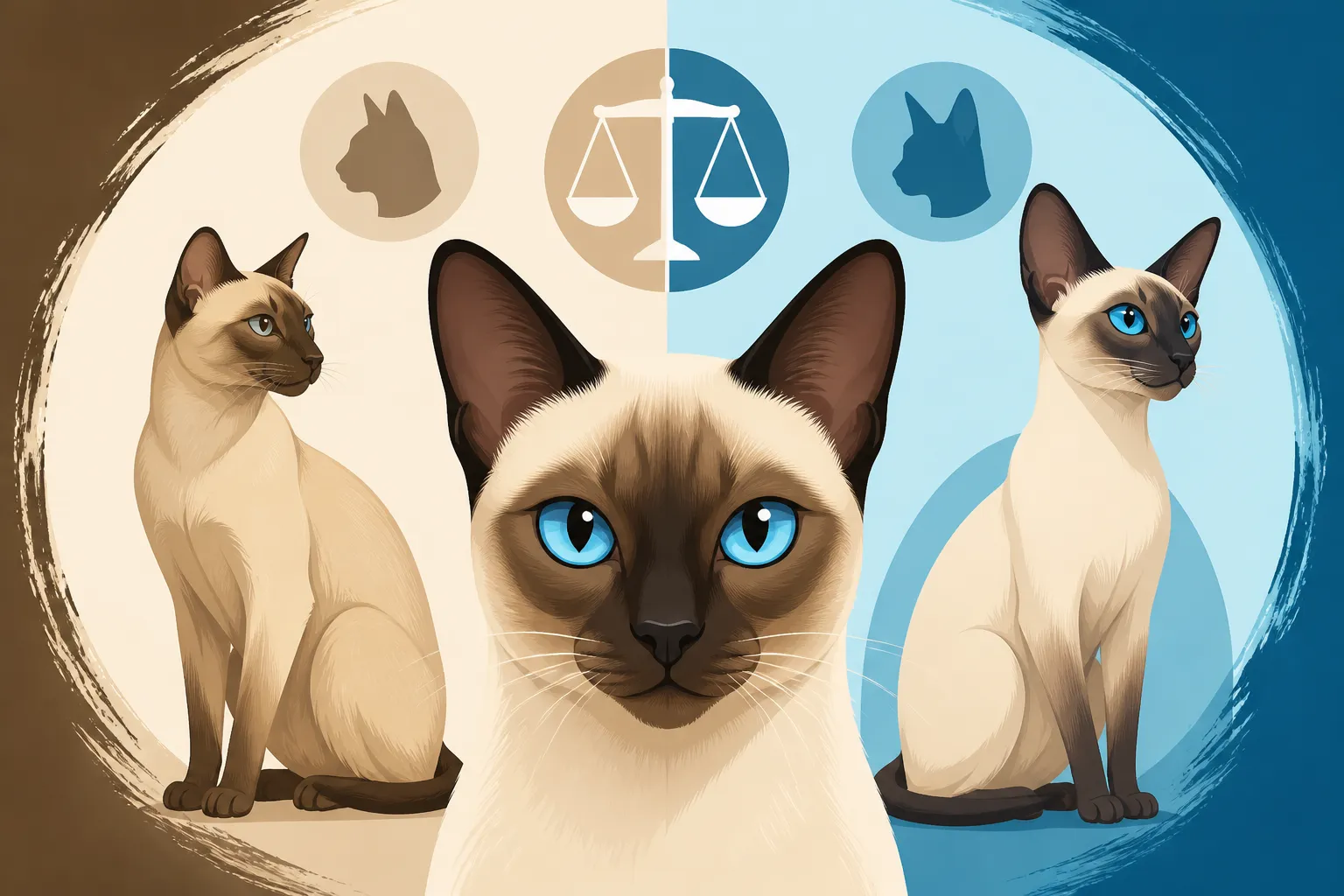
Whether the Siamese Cat Standard Has Changed Since 1900
A Siamese cat seen in an old show photograph may look surprisingly different from one bred for the show ring today. That doesn’t mean one is fake: breed standards have shifted, and different registries describe the ideal Siamese in different ways. This guide explains what changed since 1900, what stayed consistent, and why the standard still depends on which registry you consult.
There Has Never Been Just One Siamese Cat Standard
Standards belong to registries, not to the breed as a whole
A breed standard is a written description of the ideal cat for a particular registry or cat fancy organization. It guides judges at shows and gives breeders a target for selection. It is not a universal rulebook, and it does not mean every cat of that breed must look exactly alike.
That distinction matters when you compare a Siamese photographed a century ago with a modern show cat. The old cat may have been judged under an earlier standard, by a different organization, or in a period when the breed’s look was less uniform. Today, standards can still differ on details such as accepted point colors, head shape, and how particular features are described.
A standard also describes an ideal, not a checklist that every pet must satisfy. A Siamese with a broader head or less extreme profile may still be a Siamese, even if it would not match a particular show standard closely. For background on the breed’s arrival and early history, see The Siamese Cat Came From Siam, Not Thailand and Pho and Mia Brought the Siamese Cat to Britain in 1884.
Early descriptions were not identical to modern show rules
The Siamese became known in Western cat shows in the late nineteenth century. As organized showing developed, breeders and clubs began writing standards that put the breed’s traits into words. Those descriptions helped establish a recognizable type, but they did not instantly create one fixed appearance across every country or organization.
Early Siamese cats were generally described by their short coat, blue eyes, pointed coloring, and distinctive build. But the wording and emphasis around body proportions, head shape, and other details developed over time. Photos and illustrations from the period can be helpful, but they are not always enough to identify a cat’s pedigree, registry, or exact standard.
The standard is therefore best understood as a history of changing preferences and formal descriptions. It is not evidence that older cats were “incorrect” or that every modern Siamese must look alike. To understand how the breed’s historical roots relate to its modern forms, it helps to read What the Tamra Maew Says About the Siamese Cat and What the Wichianmat Behind the Siamese Cat Is.
How the Siamese Standard Changed Since 1900
The breed’s outline became more refined
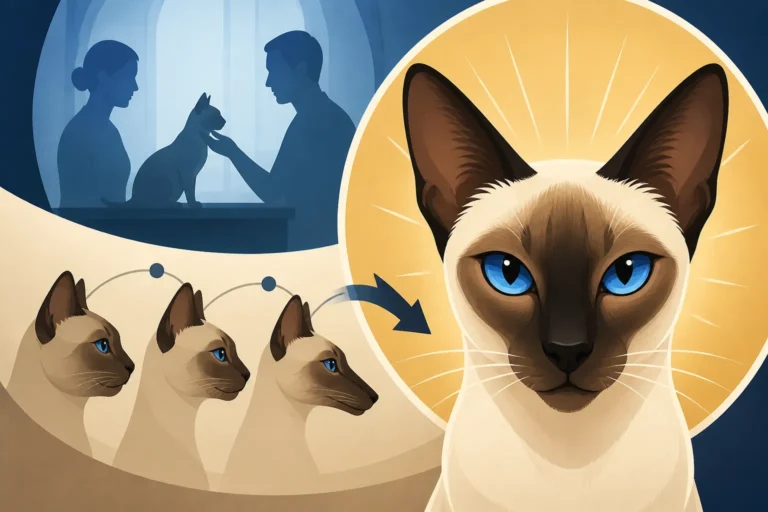
Across the twentieth century, show preferences increasingly emphasized an elegant, long-lined cat. The Siamese ideal came to be described with a slender body, long legs, a tapering tail, and a more elongated overall outline. Breeders selecting toward that ideal helped make the modern show type look more consistent than the broader range of Siamese cats seen in early photographs.
This was not a sudden switch in one year. Standards are revised through organizations, and breeding changes take place over generations. A written standard may be updated, while the cats competing in shows gradually reflect what breeders have been selecting for. So a photo from one decade can look noticeably different from a photo taken several decades later, even when both cats are described as Siamese.
The shift also helps explain why people sometimes use labels such as “traditional,” “old-style,” or “applehead” when comparing cats with a more modern wedge-shaped look. Those terms are used in everyday conversation and by some breeders, but they do not always correspond to a separate registry-recognized breed. For more on the difference between types, see How the Siamese Cat's Head Changed Shape in Fifty Years and What a Siamese Cat Looks Like by the Standard.
The head became one of the most visible points of difference
The modern show Siamese is often associated with a long, narrow wedge-shaped head, large ears, and a profile that flows in a straight line from the forehead toward the nose. In older photographs, the head can appear rounder or shorter, with less pronounced angles. This is one of the most obvious reasons people ask whether the standard has changed since 1900.
The answer is yes, but it is more accurate to say that selection and written standards evolved together. Standards describe what a registry rewards; breeders then choose cats that they believe best represent that ideal. Over time, that can shift the overall look of cats bred for the show ring.
It’s also worth keeping perspective. A show-standard description is not a health guarantee or a measure of personality. Nor does a cat’s head shape alone prove its ancestry. If you are comparing cats, focus on reliable pedigree information and the registry’s own standard, rather than relying only on a photo or an informal label. The history of the head-type shift is explored further in How the Applehead Siamese Cat Became the Wedge and Why Show Breeders Changed the Siamese Cat's Head.
Color descriptions and accepted varieties depend on the registry
The classic Siamese image is a pale body, darker points on the face, ears, legs, and tail, and blue eyes. That core pattern remains central to how the breed is recognized. But registries have not always drawn the same boundaries around which point colors count as Siamese.
Some organizations maintain a narrower list of accepted colors for the Siamese, while others recognize a broader range or classify similar cats under a separate breed name. This is why one cat may be called a Siamese in one context and a Colorpoint Shorthair in another. The difference is not necessarily about whether the cat has the color-point pattern; it may reflect the registry’s classification system.
When reviewing an individual cat, check the registry named on its pedigree or registration paperwork. Do not assume that a color label used by a breeder, rescue, or online listing automatically matches every registry’s rules. For a closer look, read Which Colors a Siamese Cat Comes In and How a Siamese Cat Differs From an Oriental Shorthair.
| Feature | Common emphasis in early descriptions and images | Emphasis in many modern show standards |
|---|---|---|
| Overall outline | Elegant, but with more visible variation among cats | Long, slender, and carefully defined |
| Head shape | Often appears rounder or less elongated in old photographs | More elongated wedge shape is commonly emphasized |
| Ears | Described as part of the head and expression | Often expected to be large and set to complement the wedge |
| Coat pattern | Pale body, darker points, and blue eyes are defining traits | The pointed pattern remains central, with accepted colors depending on registry |
| Breed classification | Standards and club practices were still developing | Registry-specific rules more clearly define type and eligibility |
What Changed and What Stayed Consistent
The pointed pattern and blue eyes remain defining features
Even as the preferred outline changed, the Siamese remained closely identified with its color-point pattern and blue eyes. The points are usually darker than the body, and the contrast can become more noticeable as a cat matures or experiences cooler conditions. The coat pattern is part of the breed’s recognizable appearance, although the precise accepted colors depend on the organization.
It is easy to focus so much on body shape that the enduring traits get overlooked. The Siamese has long been recognized for its distinctive points, short coat, and striking blue eyes. These features connect many historical depictions with modern cats, even when their head and body proportions look different.
A breed standard is also more detailed than a list of visual highlights. It may describe balance, structure, coat texture, eye shape, and the relationship between features. If a cat does not match every ideal detail, that does not erase its history or its suitability as a companion. Breed-standard points are primarily useful for understanding show judging and breeding goals.
The words in a standard can change even when the trait remains
A standard may be revised to clarify wording, align descriptions, or reflect a registry’s current priorities. A change in phrasing does not always mean that breeders suddenly began producing a completely different cat. Sometimes the adjustment is a more precise description of a feature that was already being selected for.
The reverse can also happen: a feature may remain familiar to owners but become more strongly emphasized in a later standard. For example, a characteristic that was once described broadly might later be tied to specific proportions or placement. That added precision can make show judging more consistent, while also making the modern show ideal appear more distinct from cats bred outside the show ring.
This is why a simple before-and-after claim can be misleading. The Siamese did not have one single appearance in 1900, and there is no single standard that represents every registry today. A careful comparison asks which standard, which organization, and which period are being discussed.
How to Compare a Siamese Cat’s Type Without Getting Misled
Start with the registry and the date
If you are reading an old standard or looking at a historical show record, first identify the organization that issued it and when. A standard from one country may use different wording from one issued elsewhere. A modern standard may also have been revised since the version a breeder or website is quoting.
For a cat you are considering buying or adopting, ask which registry the breeder uses and whether the cat is registered or eligible for registration under that organization’s rules. Ask to see the paperwork rather than relying on phrases such as “pure Siamese,” “traditional Siamese,” or “show type” without explanation. Those terms can be used in different ways.
If you are simply trying to identify a cat in an old family photograph, treat appearance as a clue rather than proof. A pointed coat and blue eyes may suggest Siamese ancestry, but they cannot establish a pedigree by themselves. Details about the cat’s origin, registration, and relatives are more informative than head shape alone.
Separate breed identity from show suitability
A cat can belong to a breed without being a strong match for the show ideal. Show standards describe qualities that judges evaluate, while pet suitability involves other questions: health, temperament, social needs, and the fit between the cat and the household. Those are related to responsible ownership, but they are not the same thing.
For instance, a family may adore a Siamese with a rounder face and compact build, even if a show judge would favor a longer outline. Another cat may closely resemble a modern show type but still need an owner prepared for its individual energy level, vocal habits, and need for interaction. Appearance cannot tell you how a cat will behave at home.
When you are comparing breeders, look for clear records and honest discussion of the cats’ health and family history. Breed standards alone cannot answer every health question; see What a Siamese Cat Breeder Should Have Screened for more on what to ask. If you are getting ready for a new cat, a retailer such as Chewy may be convenient for everyday supplies, but it cannot verify pedigree claims or replace registration documents.
Treat informal type labels as descriptions, not guarantees
“Applehead,” “old-style,” and “traditional” can help people describe a rounder or less elongated appearance. However, the meaning of these labels can vary between breeders and communities. They do not automatically establish that a cat is registered as a Siamese, comes from a particular historical line, or will be healthier than a cat with a different head shape.
Ask what a seller means by a label and what documentation supports the claim. A breeder should be able to explain the registry, provide relevant paperwork, and describe the parents without making sweeping promises based on appearance. For adoption, a rescue may have limited background information; that does not make the cat less deserving of a home, but it does mean you should be cautious about assuming a precise breed history.
For practical preparation, Chewy can be one place to look for basics such as a carrier, litter supplies, or grooming tools. Those purchases do not determine whether a cat meets a standard, of course. Whether you choose a show-bred cat or a rescued companion, the most useful next step is to understand the individual animal in front of you, not to judge its worth by how closely it matches an idealized profile.
Disclaimer
This article is for general informational purposes only and does not constitute professional advice. Laws, prices and regulations vary by location and change over time. Consult a qualified professional for guidance on your specific situation.